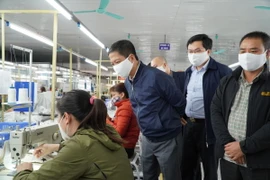
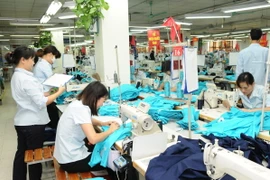
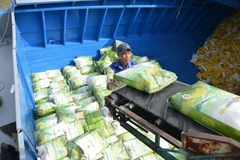
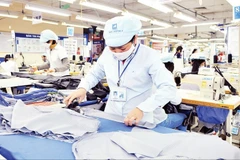
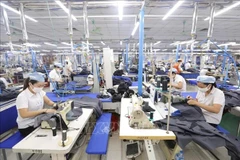
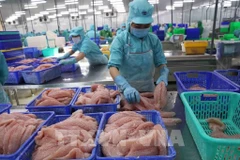
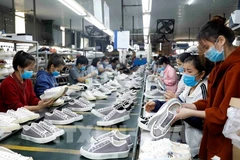
The textile and apparel industry is directly affected by the COVID-19 pandemic. (Photo: VietnamPlus)
Hanoi (VNA) - The COVID-19 pandemic had a direct impact on Vietnam's textile and garment industry in the first quarter of this year. Decreased orders forced businesses to cut production, resulting in falling business efficiency.
Big brands see great personnel cuts
A representative of the Vietnam National Textile and Garment Group (Vinatex) said that Vietnam's textile and garment exports in the first quarter of 2020 reached 8.4 billion USD, down 2.02 percent over the same period in 2019. In March, the export turnover experienced a decline of 7.42 percent.
More worrying, if the epidemic prolongs, it will lead to difficulties for the industry in the coming months, Vinatex forecasts that the second quarter will be the period most severely affected by the COVID-19. Its impact will gradually ease in the third quarter and at the latest, everything can return to normal in the fourth quarter.
According to Cao Huu Hieu, Vinatex Deputy General Director, although Europe and the US have overcome the peak time of the COVID-19 pandemic, they still apply travel restrictions, social distancing and closure of retail stores until early May, leading to delayed orders while new orders plummet.
“Most of the delayed orders were for spring-summer, when the epidemic began to break out. When the disease is controlled, the weather will turn to autumn, so there is a high possibility that the postponement will become cancellation,” said he.
According to the latest survey by the International Textile Manufacturers Federation, world textile orders in 2020 could drop 29 percent from the previous year's average.
Notably, the disruption of global production and supply chains caused businesses not to optimize production efficiency, thus increasing costs.
Vu Duc Giang, Chairman of the Board of Directors of Viet Tien Garment Joint Stock Company, said that due to the unpredictable developments of the pandemic, importers from China, the US, the EU and Japan have reduced a large number in orders.
Especially, due to COVID-19, businesses have faced many difficulties in the three largest markets of the US, the EU, and Japan, which account for about 65 percent of the industry’s export turnover.
Therefore, many financial indicators are forecast to be unsatisfactory. For example, the total revenue set for this year is only 6.3 trillion VND or 70 percent of the 2019 figure, and the pre-tax profit is set at 150 billion VND, equal to 39 percent of last year’s figure.
According to Vinatex, almost all subsidiaries of the group have failed to create enough jobs for workers in April and May, with 30-70 percent of capacity. In particular, the bigger the brands are, the larger their personnel cuts are.
“With this situation, the export turnover for the whole 2020 is expected to be about 20 percent lower than that of 2019. Businesses will only operate at only 70-75 percent of capacity, assuming normal production from in June,” added Vinatex's representative.
Changing production plans to compensate for losses
In the context of the pandemic’s complex developments, in order to reduce bad impacts from big markets, the deployment of flexible production and business plans is the most effective solution.
Many businesses have found some opportunities from products such as masks and protective clothing, not only for the domestic market but also for export to international markets.
Than Duc Viet, General Director of Garment 10 Corporation, said that due to the COVID-19, in April, the company lacked nearly 30 percent of orders. However, face mask production is hoped to make up for it somewhat.
According to Tran Viet, General Director of Dong Xuan Knitting Company, as the firm owns a closed production chain and self-produces antibacterial fabric, it took the opportunity to increase revenue from making masks and increasing fabric supply to businesses in the industry.
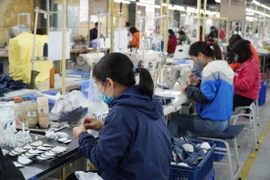
 Textile-garment production for export orders (Photo: VietnamPlus)
As of mid-April, Vietnam exported nearly 416 million masks worth more than 63 million USD. Particularly, the Vietnam National Textile and Garment Group has supplied the domestic market with about 80 million masks, meeting the domestic demand for disease prevention. The current mask production is helping the group create jobs for 20 percent of workers who became unemployed due to the pandemic.
In 2019, Vietnam's textile and garment exports reached 39 billion USD, up 7.22 percent against the previous year. The US remained the largest market with an export turnover of 15.2 billion USD, up 8,9 percent annually and accounting for 38.97 percent of Vietnam’s total export turnover. It was followed by the EU with 4.4 billion USD, or 11.28 percent./.