Work starts on Hanoi Opera House near West Lake

The opera house will include two main auditoriums: a 1,797-seat opera hall and a versatile multi-purpose hall with 1,430 standing places and 216 balcony seats, suitable for concerts, live shows, and large-scale events. Other spaces include rehearsal rooms, a museum, viewing terraces, and an expansive main foyer.

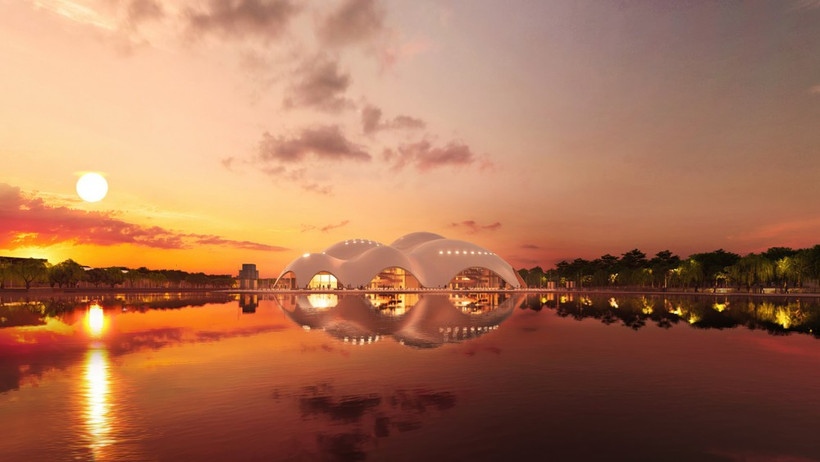
The Hanoi Opera House, also known as the Pearl Opera House, is designed by renowned Italian architect Renzo Piano, one of the most influential architects of the 20th century (Photo: VNA)

Hanoi (VNA) – A groundbreaking ceremony for the Hanoi Opera House and Thematic Cultural and Artistic Park project was held in Tay Ho ward on October 5 by the Hanoi People’s Committee, marking the beginning of one of the capital’s most ambitious cultural developments in decades.

The project, covering an area of 40 hectares with total investment capital of more than 12.756 trillion VND (over 480 million USD), will be built on the Quang An Peninsula by developer Sun Group, one of Vietnam's biggest real estate players.

Once completed in 2027, it will comprise a modern, multifunctional opera house with nearly 2,000 seats and a cultural park designed to serve major political and cultural events of the capital, as well as everyday recreational and creative needs of residents and visitors.

The Hanoi Opera House, also known as the Pearl Opera House, is designed by renowned Italian architect Renzo Piano, one of the most influential architects of the 20th century. The building’s distinctive feature is its dome structure, inspired by the gentle ripples of West Lake. The ultra-thin, high-strength roof will be coated with a mother-of-pearl-like material, reflecting the changing hues of the lake’s surface throughout the day.

The opera house will include two main auditoriums: a 1,797-seat opera hall and a versatile multi-purpose hall with 1,430 standing places and 216 balcony seats, suitable for concerts, live shows, and large-scale events. Other spaces include rehearsal rooms, a museum, viewing terraces, and an expansive main foyer.

With a total floor area almost six times the size of a standard football pitch, the complex will also feature surrounding green spaces, lakes, and lotus ponds, all revitalised as part of an integrated cultural landscape.

Speaking at the groundbreaking ceremony, Vice Chairman of the municipal People’s Committee Duong Duc Tuan said the project reflects the city’s vision to build a capital that is “civilised, modern, and rich in cultural identity.”

He noted that the Hanoi Opera House and the cultural park are key components of the 2021–2030 Hanoi Capital Planning and the 2045–2065 General Adjustment Plan, in which culture and heritage are identified as one of five central pillars of development.

“In the context of deep international integration, investing in iconic cultural works of this scale carries profound meaning,” he. “It reaffirms Hanoi’s thousand-year heritage and promotes the image of a creative, humane, and sustainably developing Vietnam.”

He added that the project is entirely funded through social resources, not public investment, which is a rare model for a cultural complex of this magnitude. “The city is committed to creating the most favourable conditions to ensure the project is completed on schedule, with the highest standards of quality and safety,” he said.

Also addressing the ceremony, Nguyen Xuan Thang, Director of the Ho Chi Minh National Academy of Politics, said the project represents “a milestone of strategic vision” by the Party and State in developing culture and people as the driving forces of national progress.

“When completed, the Hanoi Opera House and Cultural Park will stand as a cultural landmark of international stature, a meaningful gift for the 71st anniversary of Hanoi’s Liberation Day (October 10),” he said.

Thang also called for the synchronised completion of surrounding transport infrastructure so that “residents can fully enjoy the values that this work will bring.”

As part of the project, nearby ponds and lakes such as Pho Linh Pagoda’s lotus pond and Thuy Su Lake will be cleaned, restored, and planted with Tay Ho lotus. Plans also call for the creation of eight boat docks around West Lake, including one near the opera house, to facilitate access for visitors and tourists via a scenic waterway route./.
VNA

See more

National Assembly Vice Chairman Tran Quang Phuong presents a gift to the bishop’s office of the Can Tho Diocese during his pre-Christmas visit on December 17 (Photo: VNA)

NA Vice Chairman pays Christmas visit to Can Tho Diocese

A National Assembly delegation led by Vice Chairman Tran Quang Phuong on December 17 paid a visit and extended Christmas greetings at the bishop’s office of the Can Tho Diocese, which currently covers the Mekong Delta’s Can Tho city and Ca Mau province, with a total of 142 parishes of various sizes.

Students of Nguyen Hue High School in Yen Bai ward, Lao Cai province are at the new STEM education practice classroom. (Photo: VNA)

Deputy PM: STEM classrooms help students explore science, technology

The STEM classrooms should serve as meaningful and practical spaces where students can explore, experience and access knowledge, strengthen creative capacity and critical thinking, and achieve breakthrough learning outcomes that contribute to national development, said Deputy PM Pham Thi Thanh Tra.

Delegates attend the seminar. (Photo: The Courtesy of the Vietnamese Embassy in Greece)

Vietnam, Greece seek to unlock cooperation potential in labour field

According to statistics from the Department of Overseas Labour under the Ministry of Home Affairs, Vietnam has sent nearly 160,000 workers abroad annually in recent years. Currently, around 800,000 Vietnamese workers are employed in 40 countries and territories across more than 30 occupational groups.

At the app launch event (Photo: VNA)

Vietnam Women’s Union launches digital app to empower members

The “Vietnamese Women” app focuses on practical features tailored to the daily needs of VWU members and women nationwide, including real-time information feeds from the union, thematic sections providing essential life skills and knowledge, and online surveys to ensure women’s voices are heard more quickly and fully.

Defendants at the court (Photo: VNA)

Lighter sentences suggested in appeal of Phuc Son corruption case

Prosecutors recommended cutting the sentences of Hoang Thi Thuy Lan, former Secretary of the Party Committee of Vinh Phuc province (before its administrative merger with Phu Tho and Hoa Binh), by 24-30 months; Le Duy Thanh, former Chairman of the provincial People’s Committee, by 30-36 months; and Pham Hoang Anh, former Vice Secretary of the provincial Party Committee, by 18-24 months.

Nguyen Thanh Ha, Consul General of Vietnam in Western Australia and the Northern Territory presents Certificates of Commendation from the Consul General to students and volunteers in recognition of their outstanding contributions to the organisation of Xuan Que Huong (Homeland Spring) 2025. (Photo: VNA)

Vietnamese community in Australia united through youth engagement

Speaking at the ceremony, Nguyen Thanh Ha, Consul General of Vietnam in Western Australia and the Northern Territory, praised the dedication of young Vietnamese living in the region. She emphasised that the success of Xuan Que Huong was built not only on its colourful performances, but also on the strong sense of responsibility and tireless behind-the-scenes efforts of students and volunteers.

A full suite of automated technologies has been deployed across the Terminal T2 at Noi Bai International Airport, giving travellers greater control over their procedures from check-in to boarding. (Photo: VNA)

Noi Bai Airport to operate expanded int’l terminal with comprehensive automation

The upgrade follows directives from the Prime Minister and the Ministry of Construction and is designed to ease pressure on existing infrastructure by lifting the terminal’s annual capacity from 10 million to 15 million passengers. For the first time, a full suite of automated technologies has been deployed across the terminal, giving travellers greater control over their procedures from check-in to boarding.