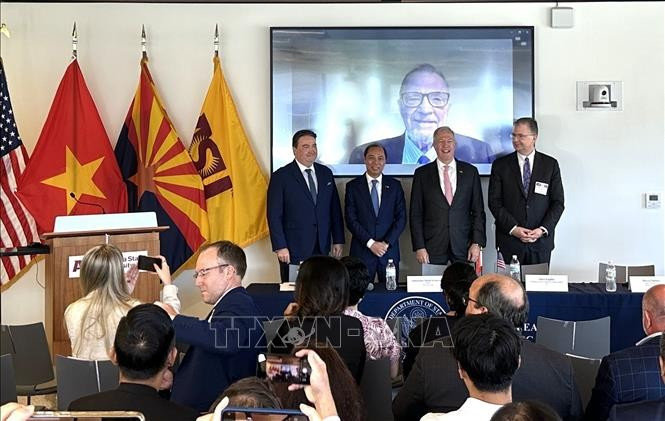
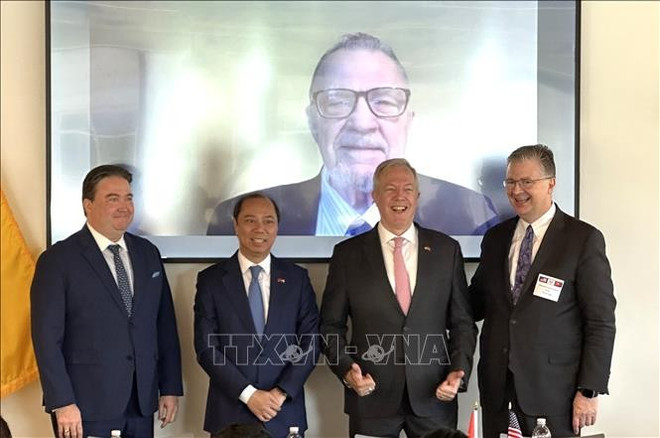
Hanoi (VNA) – Three former US ambassadors to Vietnam – Michael Michalak (2007–2011), Ted Osius (2014–2017), and Daniel Kritenbrink (2017–2021) – have gathered at a seminar in Washington D.C. to share their insightful perspectives on past achievements and future prospects of the two countries' relations, and the importance of jointly addressing common challenges for the benefit of both peoples.
Humanitarian legacy – Foundation of bilateral relations
Speaking at the seminar, which marked the 30th anniversary of the normalisation of diplomatic relations between Vietnam and the US (1995–2025), former Ambassador Kritenbrink highlighted that humanitarian efforts were crucial in bridging Vietnam and the US towards normalisation, laying the groundwork for dialogue. It was those humanitarian issues that started to build goodwill between the two nations, he stated.
The US has invested tremendous amounts of funds to address the aftermath of Agent Orange/dioxin. With the advocacy of Senator Patrick Leahy and other lawmakers, it has supported unexploded ordnance clearance and treatment for disabled individuals in the provinces most affected by the chemical.
“I think that work has built tremendous goodwill, and I felt during my time as ambassador and since I've run into so many Vietnamese friends and officials who have noted that fact, that's what started to change attitudes, I think, towards the United States. That's what got us talking together, and I think that work remains vitally important today,” he said.
Regarding USAID, he expressed concern earlier this year when funding cuts were announced for humanitarian programmes. However, he noted that all funding has since been reinstated and disbursed, underscoring international and US governmental recognition of these programmes’ ongoing importance.
Reflecting on the dramatic transformation from a brutal war 50 years ago to diplomatic normalisation and now a comprehensive strategic partnership, Kritenbrink remarked: “I once told the first American Ambassador to Vietnam Pete Peterson, that what we'd achieved together was a miracle. And he corrected me, no, it's extraordinary, but it's not a miracle. It wasn't an accident. It wasn't an act of God. What we built was built together through goodwill and courage and hard work by people on both sides. And that continues to inspire and motivate me today, and we have to keep doing that work going forward.”
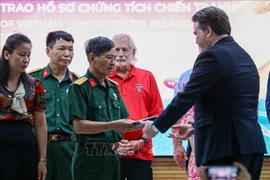
Kritenbrink underscored reconciliation as vital. “I remember when Senator John McCain passed away, in Vietnam, we opened a condolence book to the Vietnamese public, and thousands of people lined up to sign that book. And the first gentleman in line was a veteran, Vietnamese veteran, and he asked me to come meet him because he wanted to shake my hand and wanted to tell me personally that he came to sign the book to recognise that John McCain was a warrior who fought against Vietnam, but then helped lead reconciliations.”
He pointed to the respect shown by Vietnamese citizens at the memorial of McCain’s downed aircraft at Truc Bach Lake as testament to the importance of ongoing reconciliation.
The former ambassador held that a particularly meaningful reconciliation effort is the expanded bilateral cooperation in searching for missing servicemen. Initially focused on US personnel, both nations now collaborate more broadly, including verifying Vietnamese missing persons from the war.
Education – A bright spot in bilateral relations
For former Ambassador Michalak, education was central to his mission in Vietnam. Prior to his posting, he set a goal to double the number of Vietnamese students in the US. By the end of his tenure, that number had tripled, and the trend continues. Vietnam is currently the largest source of ASEAN students in the US and the fifth largest globally.
He noted that most recently, 40 professors from 21 different universities visited Vietnam as part of an international academic partnership programme to cooperate on ways to send even more students from Vietnam to the US. “Every university president that has come to Vietnam has said to me, and I'm sure he sent it to all the other ambassadors as well, send us more of these students, they raise the curve, and they provide excellent incentives for everybody else to work even harder,” he stated.
He said he believes that bilateral cooperation, especially in science, technology, and innovation, is being propelled forward under the comprehensive strategic partnership, which includes key elements of scientific and technological collaboration. At the first anniversary celebration of the upgraded partnership, initiatives such as English language training for STEM students and the establishment of the International Technology, Security and Innovation Fund (ITSE) were announced. These lay the groundwork for expanded cooperation in semiconductors, rare minerals, policy coordination, and open radio access networks, he asserted.
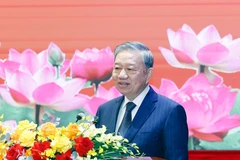
Michalak cited Vietnamese Party General Secretary To Lam’s affirmation of the immense potential for US – Vietnam cooperation in high-tech sectors like semiconductors and artificial intelligence (AI) as particularly significant in this new era, especially following the upgrade to the comprehensive strategic partnership, with innovation and semiconductor industrie as pillars of breakthrough cooperation.
Journey to become leading trade partners
According to former Ambassador Osius, 40 years ago, the most important decision was made by the Communist Party of Vietnam to integrate Vietnam's economy with that of the world. That was a decision made in the mid-80s, and the country has stuck to it, no matter what all the ups and downs, he noted, underlining that the decision towards comprehensive integration into the world has been the foundation on which all of the progress we've seen subsequently has been built.
He held that the second really important decision was made in the mid-90s by the US to negotiate a bilateral trade agreement with Vietnam, knowing that would facilitate the entry of Vietnam into the WTO. He said he believes that the provisions that were put into that bilateral trade agreement were all designed to make it speedier, easier for Vietnam to then join the WTO.
Osius observed that a significant part of Vietnam’s economic growth over recent decades has been driven by foreign direct investment. When he first arrived in Vietnam in 1996, bilateral trade was only a few hundred million US dollars. Today, that figure stands at approximately 132 billion US dollars, reflecting the relationship’s remarkable growth. He credited the normalisation in 1995, the 2002 bilateral trade agreement, and subsequent WTO membership as foundational to Vietnam’s economic breakthrough. The year 2008 marked a turning point when global investors began viewing Vietnam as an attractive destination, reflecting confidence in its long-term growth potential. The Vietnamese Government also implemented decisive reforms to realise this investment influx.
Osius noted that Vietnam has transformed from a minor trading partner into the US’s eighth-largest trading partner in 2024. He cited Deputy Assistant Secretary of State Andrew Herrup’s remarks highlighting Vietnam’s innovation, value addition in production chains, adoption of new technologies like AI, and development of a skilled workforce as key to its continued rise. He characterised this development as the outcome of strategic decisions made over decades.
Recalling the September 2024 visit of General Secretary To Lam to New York for the 79th UN General Assembly session’s high-level week, he highlighted the Vietnamese leader’s emphasis on innovation and his call for US corporations and partners to assist Vietnamese enterprises in enhancing production capacity and integrating into global supply chains. The General Secretary also proposed establishing a research and development centre at the National Innovation Centre (NIC) and providing scholarships for Vietnamese students specialising in IT, programming, electronics, semiconductors, and AI, the former ambassador said./.