Hanoi (VNA) - Placing people at the centre of development and making human well-being the ultimate goal of progress have been a consistent policy of the Party and State. The tangible actions and clear results that people enjoy, as well as the recognition from international organisations, serve as strong evidence that refutes the distorted allegations of hostile elements attempting to undermine the country's achievements.
According to the Government's report on the implementation of the 2025 socio-economic development plan, the Gross Domestic Product (GDP) for this year is expected to grow by over 8%, with the total size of the economy reaching 510 billion USD. This places Vietnam in 32nd position globally, and the per capita GDP is estimated at approximately 5,000 USD.
The latest edition of the World Economic League Table (WELT) from the UK-based Centre for Economics and Business Research (CEBR) predicts that Vietnam's GDP per capita in purchasing power parity (PPP) terms will reach 17,688 USD, with the total GDP estimated at 524 billion USD.
Among the top 10 outstanding domestic events for 2025, as selected by the Vietnam News Agency, two are closely linked to the statement: "Economic growth must be associated with promoting social welfare." These are: “Vietnam’s economic growth ranks among Asia’s fastest,” and “nationwide elimination of makeshift housing completed ahead of schedule.”
Results from 34 provinces and cities show that by the end of August, with 334,234 houses newly built or repaired and upgraded, the national emulation movement on eliminating makeshift and dilapidated houses achieved its target five years and four months ahead of schedule set in the Party Central Committee's Resolution No. 42-NQ/TW, dated November 24, 2023, and four months ahead of the target set in the Prime Minister's Directive No. 42/CT-TTg, dated November 9, 2024. This is regarded as a “special national project” embodying the Party’s will and people’s hearts, as well as the spirit of solidarity and compassion among compatriots, and carrying profound humanitarian significance. The three groups that received support are families of people with contributions to the revolution and martyrs; poor and near-poor households; and families facing difficulties.
The state budget collection and spending for 2025 has also been restructured with a focus on prioritising social welfare and progress. By mid-December, state budget revenue was estimated to exceed 2.47 quadrillion VND, surpassing the National Assembly’s target by more than 25%. This has enabled timely and effective implementation of social welfare programmes.
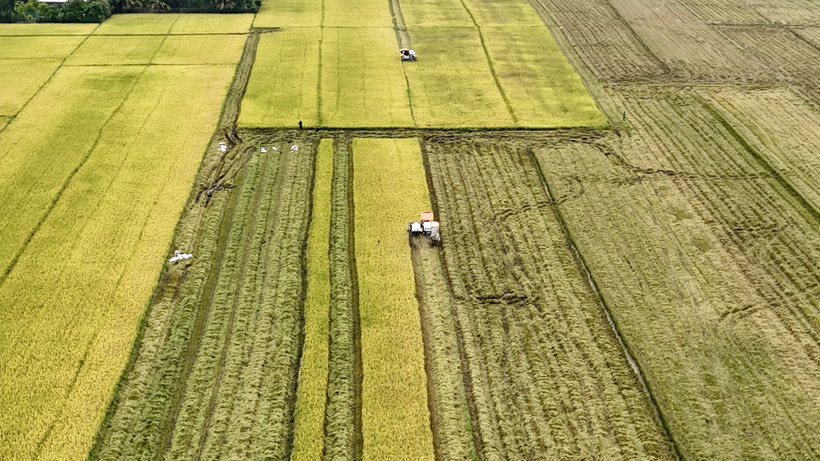
In the January-November period, the Government provided more than 38,200 tonnes of rice to assist citizens. This included 6,000 tonnes for Tet celebrations benefiting 402,600 people, 4,300 tonnes for the pre-harvest period in 2025 for 284,500 people, and more than 27,900 tonnes for disaster relief efforts after storms and floods, aiding over 1.86 million people.
By November 23, 6.794 trillion VND from the central budget was allocated to assist localities in recovering from natural disasters.
Economic growth in Vietnam always closely linked to poverty reduction
According to the National Office for Poverty Reduction, the multidimensional poverty rate has decreased from 4.4% in 2021 to 1.3% in 2025. By the end of 2025, the number of poor households across the country is expected to be around 1%, with poverty among ethnic minorities dropping by an average of 4.45% per year. This progress places Vietnam among the countries with the fastest poverty reduction rates globally. The country's poverty reduction efforts are being implemented comprehensively, reflecting the spirit of "leaving no one behind."
In 2025, the social assistance network has expanded, covering 4.5% of the population, equivalent to 4.5 million people receiving regular benefits and 1.5 million people benefiting from emergency assistance.
The rise in state revenue and GDP provides a solid foundation for social welfare policies in 2026.
From 2026 to 2030, Vietnam will shift its approach from “poverty reduction by criteria” to “poverty reduction with adaptation,” focusing on three main areas: developing socio-economic infrastructure in disadvantaged regions, improving basic social services, and enhancing the effectiveness of management, communication, and monitoring efforts.
The National Assembly’s Resolution No. 257/2025/QH15, dated December 11, 2025, approved the investment policy for the National Target Programme on building new-style rural areas, sustainable poverty reduction, and socio-economic development in ethnic minority and mountainous areas for the 2026-2035 period.
This decision reflects the strong determination of the legislature and the Government to achieve the Party and State's goal of ensuring that people enjoy a prosperous and happy life, especially those in ethnic minority and mountainous areas. Accordingly, the total state budget allocated to the programme for the 2026-2030 period is approximately 423 trillion VND, of which 100 trillion VND will come from the central budget, around 300 trillion VND from local budgets, and the remaining from policy credit capital (state-funded budget).
In addition, according to Resolution No. 261/2025/QH15 on certain mechanisms and policies to create breakthroughs in the protection, care, and enhancement of public health, from January 1, 2026, the rights to healthcare services and reduced medical costs for the public will be expanded.
Specifically, individuals participating in health insurance from near-poor households, elderly people aged 75 and above receiving social pension benefits, will be entitled to 100% coverage of medical examination and treatment costs within the scope of benefits for health insurance participants. The insurance benefit rate will be increased for vulnerable groups, social policy beneficiaries, low-income individuals, and other priority groups. Meanwhile, the health insurance fund will cover the costs of screening, diagnosing, and early treatment of certain diseases.
In a meeting with the sub-committee for socio-economic affairs of the 14th National Party Congress on November 13, Party General Secretary To Lam emphasised that development must be rapid but sustainable, high growth must be balanced with macroeconomic stability, economic development must be in harmony with culture, society, and environmental protection, with national defence and security ensured.
All policies and strategies must stem from real life, the aspirations, rights, and legitimate interests of the people; and their happiness and prosperity must be the ultimate goal of the nation’s collective efforts, he added./.