Vietnam to expand access to high-quality education for ethnic minority people

During 2026–2035, it targets annual enrolment of 2,000–2,500 new students at college and university levels, including 1,000–1,500 students with strong potential to be developed into a core workforce for ethnic minority and mountainous regions.

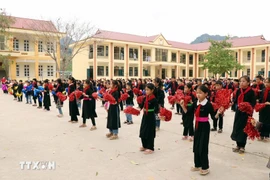
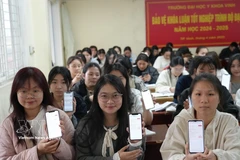
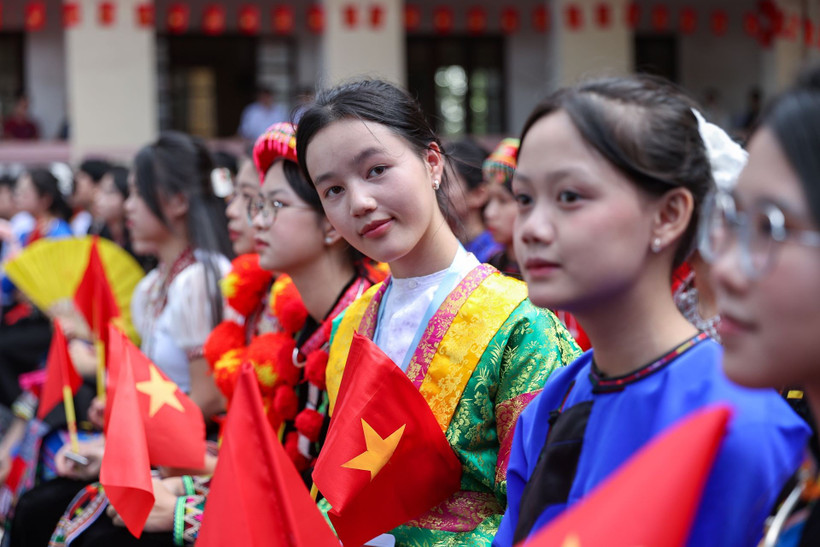
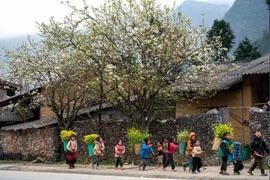
The project on training high-quality human resources from ethnic minority communities for the 2026–2035 period, with a vision to 2045, reflects the Government’s commitment to building a core ethnic minority workforce to serve socio-economic development and ensure national defence and security. (Photo: Vietnamnet.vn)

Hanoi (VNA) – Deputy Prime Minister Le Thanh Long has signed a decision approving a project aimed at expanding equitable access to high-quality education for ethnic minority people, enabling them to pursue studies in key sectors and fields with high demand for skilled labourers.

Under Decision No. 2776/QD-TTg, the project on training high-quality human resources from ethnic minority communities for the 2026–2035 period, with a vision to 2045, reflects the Government’s commitment to building a core ethnic minority workforce to serve socio-economic development and ensure national defence and security, particularly in ethnic minority, mountainous, border and island areas.

The project applies to ethnic minority pupils, students and trainees living in ethnic minority, mountainous, border and island areas, or belonging to poor households, who pursue studies in key sectors and fields. University preparatory schools, vocational education institutions, higher education institutions, academies, research institutes and relevant agencies and organisations are also involved in its implementation.

During 2026–2035, it targets annual enrolment of 2,000–2,500 new students at college and university levels, including 1,000–1,500 students with strong potential to be developed into a core workforce for ethnic minority and mountainous regions.

Learners in health-related fields are expected to account for 7–10% of the total enrolment, agriculture and forestry 5–10%, tourism 5–10%, with the remainder in other sectors.

The number of ethnic minority students trained at master’s and doctoral levels is projected to increase by at least 10% annually, while enrolment in university preparatory programmes is also expected to grow by no less than 10% each year.

In the 2026–2030 period, training will focus on health care, information technology, agriculture, finance and banking, teacher training, tourism and social work. Additional sectors will be introduced in the 2030–2035 phase in line with socio-economic development requirements in ethnic minority areas.

Priority will be given to improving the capacity and quality of the training system, particularly ethnic minority boarding and semi-boarding schools and university preparatory institutions. Targeted investment will also be made in a number of key higher education institutions to ensure adequate facilities, curricula and teaching staff.

The project will promote digital transformation in education through a unified digital training management platform, and the application of artificial intelligence and big data in enrolment, learner management and workforce demand forecasting. A multilingual digital learning resource system, including Vietnamese and several widely-spoken ethnic minority languages, will also be developed.

It further calls for mobilising diversified resources, with the state budget playing a leading role alongside public–private partnerships and the participation of enterprises, private training institutions and other lawful social resources.

Another focus is linking training with the labour market to ensure sustainable employment outcomes. Training institutions will strengthen cooperation with enterprises, employment service centres and local authorities to provide career counselling and job placement for learners.

The project also highlights the need to refine tailored policies for ethnic minority learners, including tuition fee exemptions and reductions, support for study and living expenses and accommodation, as well as foreign language and information technology training.

Career guidance, communications and international cooperation will be strengthened to inspire learning aspirations and create opportunities for outstanding ethnic minority students to study and participate in exchange programmes abroad, contributing to long-term human resource development./.
VNA

See more

Nguyen Duy Anh, Honorary Chairman of the Vietnamese Association in Fukuoka. (Photo: VNA)

OVs enjoy diverse channels to contribute expertise to national development

He said OVs are ready to share professional expertise in education, science and technology, and business governance, and facilitate investment connections and trade promotion. They also help preserve Vietnamese culture and language, promote the country’s image abroad, and support social welfare activities at home.

Delegates pose for a commemorative photo at the Bo Y International Border Gate. (Photo: doanthanhnien.vn)

Youths from Vietnam, Cambodia and Laos gather for 2025 festival

Sam expressed his hope that the experiences gained at the festival, together with positive impressions of the heroic and beautiful land of Quang Ngai, will become valuable assets, enabling young people to act as strong bridges for the great friendship among the three countries.

Prime Minister Pham Minh Chinh (central) and students who win prizes at international competitions in 2025. (Photo: VNA)

Prime Minister commends Vietnamese students winning international prizes

According to the Ministry of Education and Training (MoET), over the past decade, Vietnamese student teams competing in international academic contests have won a total of 434 prizes, including 132 gold, 169 silver and 133 bronze medals, along with certificates of merit. Many students achieved consecutive gold medals over two years, while some secured gold medals when they were 10th graders.

Nguyen Hong Son, President of the Union of Vietnamese Associations in Japan, grants an interview to the Vietnam News Agency's reporter. (Photo: VNA)

OV community a vital bridge in Vietnam’s international integration, development

The UVAJ President also praised the Party and State’s consistent and comprehensive policies towards overseas Vietnamese, ranging from citizen protection and integration support to encouraging their contributions to national development. In particular, creating conditions for overseas Vietnamese to engage in political, economic and cultural activities at home reflects the spirit of great national unity.

Illustrative image (Photo: VNA)

Breakthrough mechanisms, policies for education, training approved

Regarding recruitment, employment and management of human resources in the education sector, the Resolution stipulates that the directors of provincial Departments of Education and Training are authorised to recruit and receive teachers, school managers and staff for public kindergartens, general education institutions, continuing education centres, specialised schools and public vocational high schools in their provinces.

Delegates at the opening of the exhibition (Photo: VNA)

Exhibition highlights vitality of Vietnamese cultural heritage

The exhibition features nearly 200 images showcasing Vietnam’s cultural heritage and efforts to preserve and promote its values in recent years. It is structured around four themes: the legal and policy framework for heritage protection; Vietnamese heritage recognised by UNESCO; the diversity and uniqueness of Vietnamese cultural heritage; and cultural heritage for sustainable development.

During the 2026 New Year holiday, civil servants and public employees will enjoy a continuous four-day break from Thursday, January 1, to Sunday, January 4, 2026. (Photo: VNA)

Civil servants, public employees to have four-day New Year break

Under Official Dispatch No. 12729/VPCP-KGVX dated December 25, civil servants and public employees will have a four-day break from Thursday (January 1) to Sunday (January 4, 2026). To offset this, the working day on Friday (January 2, 2026) will be shifted to Saturday of the following week (January 10, 2026).

The campaign aims to mobilise social resources to support 1.5 million people in need during the upcoming Tet (Lunar New Year) holiday. (Photo courtesy of the VNRC)

Vietnam Red Cross Society launches Tet gift campaign

The campaign aims to mobilise social resources to support 1.5 million disadvantaged individuals, including people with disabilities, the elderly, orphaned children and those affected by natural disasters, for the upcoming Tet (Lunar New Year) holiday.

Illustrative image (Photo: VNA)

Incentives in Population Law expected to reverse birth rate decline

Vietnam’s population has already topped 100 million, but the 2025 population report reveals trends accelerating well beyond earlier forecasts. Fertility has nosedived to all-time lows: the total fertility rate slipped from 2.01 children per woman in 2022 to 1.96 in 2023, then plunged to a record 1.91 in 2024.

Hanoi plans fireworks displays at five locations to welcome New Year 2026. (Photo: qdnd.vn)

VGCL supports proposal for four-day New Year break

Under the plan, civil servants and public employees will take the statutory holiday on January 1, be off work on January 2, and make up the working day on the next Saturday, which falls on January 10, 2026. This would create an uninterrupted four-day break from Thursday (January 1) to Sunday, (January 4, 2026).

Streets flowing toward the heart of HCM City teemed with festive crowds (Photo: chinhphu.vn)

Christmas 2025 in HCM City brings faith and community together

Solidarity and kindness define Christmas in HCM City, where love transcends religion and ethnicity. A striking example is Most Venerable Thich Le Trang, Head of the Vietnam Buddhist Sangha (VBS) Executive Board of HCM City, extended Christmas greetings to Archbishop Nguyen Nang of the Archdiocese of Ho Chi Minh City, and they pledged to guide believers and followers to live virtuous lives in love, compassion, and charity, serving as a vivid testament to religious unity.