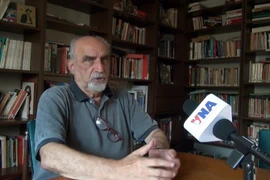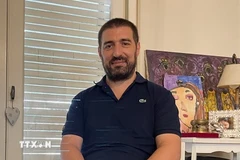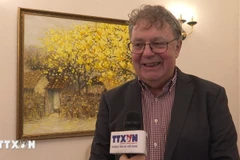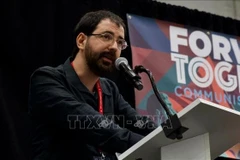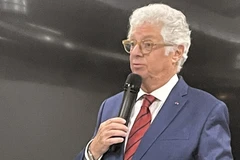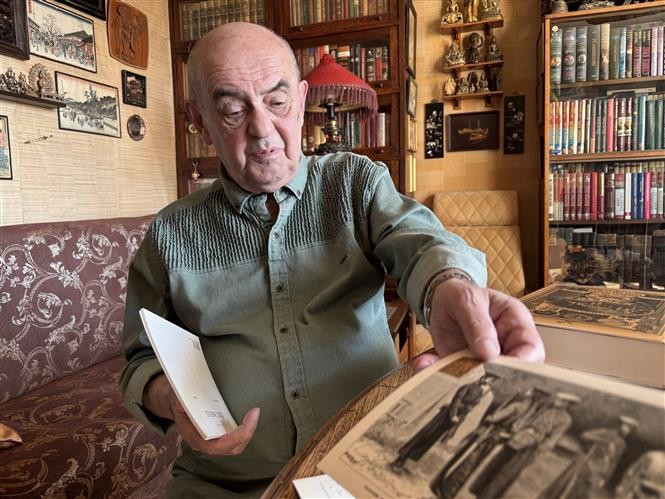
Hanoi (VNA) – Even after 50 years, Russian journalist Aleksey Sunnerberg, who has dedicated his career to the Vietnamese Section of Radio Moscow (later Voice of Russia, now Sputnik), still vividly remembers the day Radio Moscow broadcast the news of Vietnam’s April 30, 1975 victory, making it the first foreign media outlet to deliver this important information to the world.
Sunnerberg graduated with a degree in Vietnamese from the Faculty of Oriental Languages at Lomonosov Moscow State University (MGU), which is now the Institute of Asian and African Studies.
In the late 1960s, all Vietnamese language teachers in Moscow had to return home due to the war. Determined to continue his studies, Sunnerberg turned to Vietnamese students studying in Moscow. Through them, he learned about the Vietnam War, witnessed anti-war demonstrations, and became aware of the atrocities committed by the US in South and North Vietnam. The era saw massive public support movements for Vietnam across the Soviet Union, spearheaded by the Vietnam–Soviet Friendship Association, chaired by cosmonaut and Hero of the Soviet Union German Titov.
While still a fourth-year student, Sunnerberg began working as an interpreter for visiting Vietnamese delegations in Moscow. These encounters deepened his understanding of Vietnam's struggle for independence.
One of his Vietnamese friends, translator Tran Phu Thuyet, affectionately gave him the Vietnamese name Ho Van Dan, a name that evokes the ethnic Van Kieu people’s reverence for President Ho Chi Minh, which he always feels grateful for.
He kept a Vietnamese conical hat at home, gifted by Thuyet, which his late wife cleverly transformed into a lampshade.
After university, Sunnerberg stumbled upon a job writing in Vietnamese for media outlets. That serendipity led him to join the Vietnamese Section of Radio Moscow. The head of the department then was journalist Leonid Krichevsky, who resided in Vietnam for 20 years. Despite not speaking Vietnamese, he delivered reports in French by phone amid the wartime (1967–1968). Explosions and air raids often interrupted these transmissions, bringing the reality of war right into Sunnerberg’s newsroom.
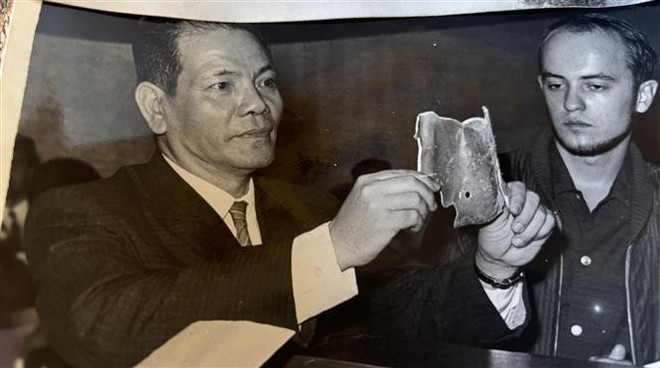
On April 30, 1975, Sunnerberg came to work as usual, unaware of the historic day ahead. Then came the moment - news broke that Liberation Army had entered Saigon and surrounded the presidential palace of the Republic of Vietnam. Could it be true? Could 30 years of war really be over?
Faced with an editorial dilemma - report the unconfirmed news or wait - Sunnerberg chose courage. He selected a brief update, passed it to a translator, and sent it to the broadcaster. That day, Radio Moscow became the first foreign outlet to broadcast Vietnam’s victory on April 30, 1975 - in Vietnamese.
The confirmation arrived the next morning, when the Soviet Union’s Ambassador Boris Chaplin was invited to meet Vietnamese Prime Minister Pham Van Dong. As Chaplin recalled in his memoirs, the Prime Minister greeted the ambassador with a warm embrace and said: “Congratulations, Ambassador. We have liberated Saigon!”
Now, 50 years later, Sunnerberg reflects with pride: “I was right to believe in heroism, in courage, in the will and patriotism of the Vietnamese people.”
The entire Soviet Union celebrated Vietnam’s triumph - an achievement they had long supported. Workers had donated portions of their wages, and many participated in “communist Saturdays” to raise funds for Vietnam. According to Russia’s Ministry of Defence, more than 6,000 high-ranking officers served as military advisers in Vietnam. Sunnerberg met many of them and was inspired by their stories of heroism and Vietnamese bravery.
This inspiration led him to create a special feature entitled "The Golden Pages of History" on Sputnik. Over the past three years, he has written 109 research-based articles chronicling key events in the relationship between Vietnam and the Soviet Union and now Russia.
His latest article focuses on Thang Long Bridge, the second bridge over the Red River in Hanoi, built with the Soviet Union’s assistance. Upcoming pieces include a April 30 feature on Soviet experts who supported Vietnam’s military efforts and a May 9 story on Soviet soldiers who fought both in World War II and Vietnam. He’s also preparing a tribute to President Ho Chi Minh, based on lesser-known personal recollections, not from state meetings but from more private moments.
Aleksey Sunnerberg’s connection with Vietnam seems destined. His son, Maxim Sunnerberg, is now an associate professor and Ph.D. in history, teaching Vietnamese at the Institute of Asian and African Studies. He was born on the day Sunnerberg interviewed Nguyen Van Linh, who later became General Secretary of the Communist Party of Vietnam. His granddaughter was born on May 19, President Ho Chi Minh’s birthday, and can now count to ten in Vietnamese.
These poetic coincidences continue to fuel Sunnerberg’s passion. His "Golden Pages" collection keeps growing, rich with historical insight, heartfelt reflection, and, above all, faith. It was this same faith that, on the unforgettable morning of April 30, 1975, led him to trust his instincts and share with the world the voice of Vietnamese victory./.