90 percent of Vietnamese millionaires invest in real estate

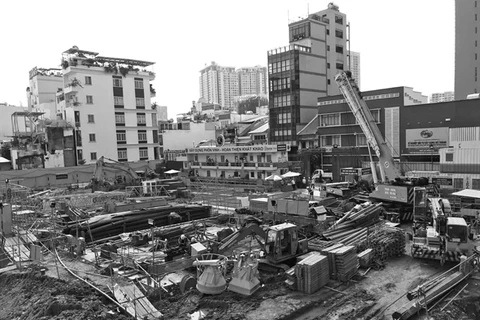
While COVID-19 continues to impact the whole economy, most millionaires in Vietnam have been investing in the real estate market.
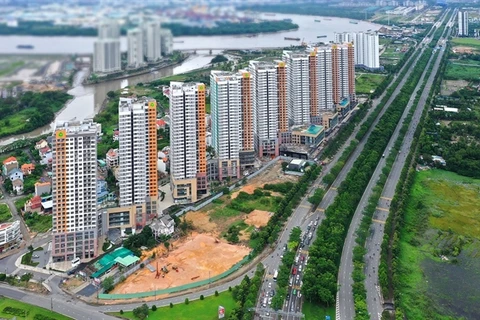
90 percent of Vietnamese millionaires invest in real estate ảnh 1A view of Da Nang. The real estate market has been least affected by the pandemic. (Photo: tapchitachinh.vn)

Hanoi (VNS/VNA)
- While COVID-19 continues to impact the wholeeconomy, most millionaires in Vietnam have been investing in the real estatemarket.

Experts who took part in a recent seminar themed "Vietnam Real Estate2020-2021: Ready for a new cycle" in Thanh Hoa city, said that among thecountry's more than 12,000 millionaires, 90 percent of them had invested inrealty. At the same time, among the 100 richest people in the country withfortunes of more than 30 million USD each, investment in the real estate sectordirectly and indirectly had reached 99.1 percent.

Dang Van Quang, director of Jones Lang Lasalle Vietnam Co, Ltd (JLL), told theseminar: “Even though there is a trend of factories relocating around the worldwhich is helping Vietnam benefit from foreign businesses that want to enter thecountry, the pandemic is making it harder for investors to visit and survey thelocal market.”

Quang added that even if they were able to, the process for investment couldtake some years, saying: “Vietnam does not have to wait for the leadingenterprises in the world to come. Instead, it can welcome the right businesses, maybe smaller but morecompatible among domestic investors.”

Sharing the same idea, Nguyen Van Dinh, vice chairman of the VietnamAssociation of Realtors (VARS), said: “There is always an effort to attractforeign investment to boost businesses in Vietnam, but over the past 20 yearslocal real estate development has mainly been contributed by domesticinvestors.”

Dinh said: “Most of the development of new areas in Vietnam such as the currentcity of Ha Long in the coastal province of Quang Ninh has been done by localinvestors, not foreign investors."

“It clearly shows that domestic investors are investing in real estate withvery strong growth,” he said, while recommending that in the current context,the Government should adopt appropriate investment policies to attract domesticresources to develop real estate projects.

Finance and banking expert Can Van Luc said that at the present time while Vietnamis dealing with the second wave of COVID-19 and local GDP growth was likely tofall to 1.5-2 percent this year, the realty market was one of the leastaffected sectors.

Luc said normally when the economy was in trouble, securities and real estatewere among the worst affected. However, in Vietnam he said: “Our assessment ofthe 15 main sectors, contributing 80 percent to GDP, shows that real estate wasone of the eight least impacted areas by COVID-19.“

Luc also proposed strong support for the real estate market.

He considered three bright spots of the sector: industrial real estate, realestate and logistics.

“The Government is promoting public investment, and real estate will be one ofthe industries that will benefit the most. During the COVID-19 pandemic, thebehaviour of investors has also changed dramatically. Therefore, real estatestructure will also change a lot to adapt,” added the expert.

Dinh from VARS said: “Despite being affected by the COVID-19 pandemic, realestate is the fastest recovering market in Vietnam.”

Sharing that after the first wave of the pandemic, the market quicklyrecovered, Đính said: “Real estate will be one of the first areas to berestored when the second wave is under control.”

More positively, Nguyen Duc Huong Nguyễn Đức Hưởng, former chairman ofLienVietPostBank, said: COVID-19 was "a revolution" that changed thelocal realty market and made it more valuable for foreign investors.

Huong also suggested a better mechanism for foreigners to buy real estate inthe country, mentioning Singapore and Australia where foreigners can easily buyreal estate if they meet the tax requirements as two examples.

In the current situation, the VARS leader advised local people to invest inreal estate even during the pandemic if they have the money, saying: “Realestate is the most profitable and safest investment channel. Over the years,there has been no crisis where real estate prices have decreased. On thecontrary, they have steadily increased on average by between 5 and 7 percentper year.

According to the "Wealth Report 2019" compiled by London-based estateagent Knight Frank with detailed statistics covering property, investment,geopolitics and everything in between, Vietnam had 12,327 dollar millionairesin 2018, up 23 percent compared to the previous five years. It is forecast thatby 2023, the number of millionaires in Vietnam will increase to 15,776 people./.
VNA
See more

An overview of the Vietnam-China Green Industry Cooperation and Exchange Programme held in Beijing.(Photo: VNA)

Vietnam, China boost cooperation in green industry development

The Vietnamese Embassy in China, in coordination with the International Cooperation Centre under China’s National Development and Reform Commission (NDRC), on May 18 organised the Vietnam–China Green Industry Cooperation and Exchange Programme in Beijing to strengthen policy exchanges, share experience, and promote substantive cooperation in green industry amid climate change and growing global environmental challenges.

The infrastructure of Thang Long 3 Industrial Park in Phu Tho province is comprehensive and modern, creating favourable conditions for businesses and investors. (Photo: VNA)

Strong economic conglomerates drive domestic economic growth

In manufacturing, THACO has built one of Southeast Asia’s largest automobile and mechanical engineering ecosystems in Quang Nam province, while VinFast has become Vietnam’s first electric vehicle producer, establishing a major factory in Hai Phong, listing on Nasdaq and expanding into North America, Europe and Southeast Asia.

Producing garments for export to the EU market at TDT Thai Nguyen Garment Company. (Photo: VNA)

Vietnam’s textile industry draws high-tech FDI amid green, smart shift

With export turnover rising steadily in recent years and a target of 50 billion USD by 2026, Vietnam remains among the world’s top three textile exporters. Beyond its traditional appeal as a low-cost manufacturing base, the country is now positioning itself as a strategic hub for high-value and technology-driven investment.

An FDI enterprise invests in factory facilities at Chau Duc Industrial Park, a project spanning approximately 2,290 ha. (Photo: VNA)

Ho Chi Minh City targets next-generation, high-value FDI

The southern economic hub attracted nearly 3.3 billion USD in FDI during the first four months of 2026, marking a sharp year-on-year increase of 227.1%. The total included 539 newly licensed projects with registered capital exceeding 791.8 million USD and 58 existing projects adding 259.3 million USD in supplementary investment.

The VinFast electric vehicle charging station at the CT1 apartment complex of 103 Hospital in Hanoi. (Photo: VNA)

Vietnam accelerates drive to master EV technologies

By the end of 2025, Vietnam had established 28 standards and technical regulations related to charging stations, charging equipment and batteries. The legal framework is expected to be fully completed in the third quarter of 2026.

Duyen Hai Wind Power Plant in Truong Long Hoa ward, Vinh Long province. (Photo: VNA)

Energy sector seen as key pillar for Vietnam’s green, double-digit growth ambitions

Chairman of the Vietnam National Industry-Energy Group (Petrovietnam) Le Ngoc Son said Vietnam’s energy demand will continue rising sharply, creating enormous pressure on power generation investment. To sustain GDP growth of around 10%, electricity demand is expected to increase by 12-15% annually, requiring an additional 7,000-8,000 MW of new capacity each year.

A view of the Lien Chieu Container Port construction project in Da Nang city (Photo: VNA)

Logistics set to drive Vietnam’s rise in global supply chains

Amid sweeping restructuring in global trade driven by digitalisation, green transition and geopolitical shifts, logistics is no longer a back-end function. It is increasingly a decisive factor in economic performance, especially as Vietnam deepens integration into international supply chains. The challenge now extends beyond faster delivery to building a modern and interconnected logistics ecosystem capable of organising supply chains at a regional scale.

Coupang.com, one of the Republic of Korea's leading online retail corporations, has actively cooperated with the Vietnamese Embassy in handling issues related to products and items with wrong information of Vietnam. (Screenshot of the site)

Coordinated efforts help safeguard healthy online marketplaces

As the digital environment continues to evolve rapidly, stronger coordination among authorities, platform operators and user communities is becoming increasingly important to build a healthy cyberspace that respects cultural identity while helping reinforce friendship and mutual understanding among people worldwide.

Vietnam will host the 21st Asian-Australasian Association of Animal Production Societies (AAAP) Animal Science Congress (AAAP 21) from October 28 - 31 in Hanoi. (Photo: aaap2026.org)

Vietnam to host 21st AAAP animal science congress

According to the Animal Husbandry Association of Vietnam (AHAV), the event is expected to gather between 1,300 - 1,500 delegates, including around 500 leading international scientists, experts and businesses in the livestock sector.

Yen Huong Xua company introduces solutions to combat counterfeit and imitation goods (Photo: VNA)

Fight against counterfeit goods fostered amid rising digital-era fraud

Dr. Bui Van Quyen, Director of the Anti-Commercial Fraud and Counterfeiting Institute, warned that counterfeit goods have become a global challenge, exacerbated by the rise of online platforms and digital technologies. While these innovations drive economic growth, they also create fertile ground for fraudulent activities.