98-year-old pioneer turns poor village into Vietnam’s agarwood hub

From a once-impoverished rural community in central Vietnam, Phuc Trach commune in Ha Tinh province has emerged as one of the country’s leading centres for agarwood production, generating hundreds of billions of Vietnamese dong in revenue each year.

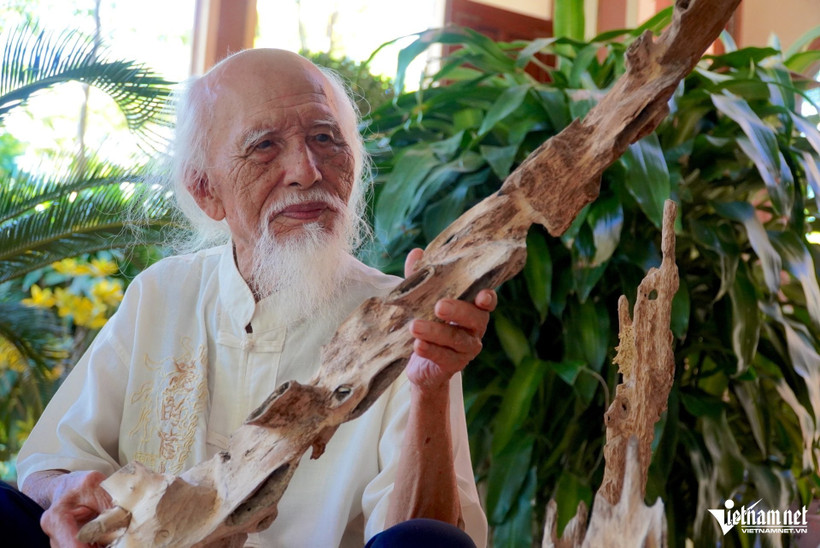
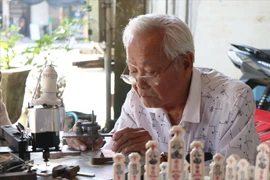
Now 98 years old, Dinh Cong Anh remains sharp-minded and vividly recounts his first days in the agarwood trade. (Photo: vietnamnet.vn)

Hanoi (VNA) - From a once-impoverished rural community in central Vietnam, Phuc Trach commune in Ha Tinh province has emerged as one of the country’s leading centres for agarwood production, generating hundreds of billions of Vietnamese dong in revenue each year.

At the heart of this transformation is Dinh Cong Anh, a 98-year-old villager widely regarded as the pioneer who introduced the craft of agarwood extraction to the locality.

Today, visitors to Phuc Trach inhale the gentle fragrance of agarwood carried in the wind and the rhythmic sound of chisels from small workshops scattered throughout the village.

Born in 1928, Anh grew up in a region known for its harsh climate, with scorching summers and frequent floods during the rainy season. Agarwood trees, locally known as “do bau,” grew naturally in surrounding forests, but for many years their economic value was largely unrecognised. In difficult times, villagers often cut the trees for firewood simply to exchange for rice.

A turning point came around 1980 when traders from Hue began arriving in the area to purchase agarwood trees. Sensing a new opportunity, Anh and his wife ventured deep into the forests of the Truong Son range to search for the valuable resource. Having previously served in wartime and being familiar with the mountainous terrain, Anh knew where old agarwood trees were likely to be found.
agarwood2.jpg
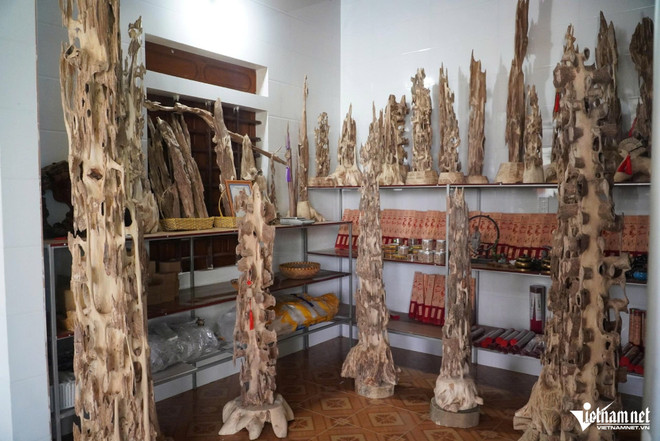
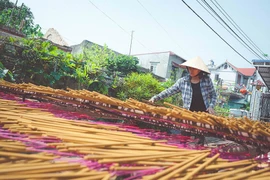
Agarwood products (Photo: vietnamnet.vn)

In the early days, lacking experience, he often cut down entire trees to sell. Over time, after observing other craftsmen, he gradually learned the delicate techniques required to identify and extract agarwood hidden inside the trunk. The work demanded patience and precision, as not every tree contained the prized resin that forms only when a tree is naturally damaged, and the resin accumulates over many years.

As his skills improved, Anh began purchasing agarwood trees and processing them at home. Long nights were spent carefully carving the wood to isolate the precious resin. The words of his craftsmanship spread, attracting villagers eager to learn. Rather than keeping his knowledge secret, Anh willingly shared techniques and practical experience with others.

Just as importantly, he urged residents to grow agarwood trees rather than depend on wild harvesting, fostering a sustainable local industry.

Over time, agarwood products from Phuc Trach have been sold across Vietnam, bringing rising incomes and improved living standards. Workshops have multiplied, and many families are now able to build new homes and invest in better livelihoods.

According to local authorities, Phuc Trach now has around 1,000 hectares of agarwood trees, generating approximately 200 billion VND (7.6 million USD) in annual revenue. Several enterprises have recently invested heavily in modern equipment to produce agarwood essential oil, further increasing the value of the industry.

At 98, Anh has stepped back from active work but continues to witness the remarkable transformation of his hometown. For many residents of Phuc Trach, he remains not only the founder of a thriving craft but also a symbol of perseverance that helped reshape the future of an entire community./.
VNA

See more

Ho Chi Minh City officially enters the “ageing population” phase in 2017, when people aged 60 and above accounted for 10.28% of the population (889,178 people). (Photo: VNA)

Ho Chi Minh City provides care for more than 1.5 million elderly residents

Ho Chi Minh City is drafting a long-term plan to develop elderly care facilities through 2030 and beyond, based on a four-tier care ecosystem prioritising home- and community-based care, followed by support for independent living, specialised nursing and dementia care, and hospital-based treatment combined with workforce training.

A social housing complex in My Hao ward, Hung Yen province, has been put into operation. (Photo: VNA)

Resolution 79: Social housing needs state-owned “locomotive”

The Politburo's Resolution No. 79-NQ/TW on the development of the state economic sector affirms its leading role as a key material force for guiding, regulating, and stabilising the economy. In social housing, which is closely tied to social welfare and labour market stability, this role must be reflected in concrete projects and measurable outcomes.

A performance at the celebration of the International Francophonie Day in Hanoi on March 20 (Photo: VNA)

International Francophonie Day celebrated in Hanoi

Under the theme “Generation Peace: The Contribution of Youth to a More Peaceful World”, this year’s celebration delivered a strong message about the youth’s pioneering role in fostering social cohesion and peacebuilding.

The Top 10 Vietnamese Outstanding Young Faces of 2025 (Photo: vietnamnet.vn)

Top 10 Vietnamese Outstanding Young Faces of 2025 announced

The Vietnamese Outstanding Young Faces award, presented by the Ho Chi Minh Communist Youth Union, honours individuals under 35 with exceptional achievements and strong social impact, contributing to the promotion of learning, research, innovation and workforce development among the country’s youth.

A social housing project in Thanh Sen ward, Ha Tinh province (Photo: VNA)

Gov't leader directs expanding beneficiaries of social housing policies

PM Chinh instructed relevant agencies to continue revising the decree toward expanding beneficiaries and adjusting income ceilings. Proposed thresholds include a maximum average monthly income of 25 million VND (950 USD) for single individuals, 35 million VND (1,330 USD) for single parents raising minor children, and a combined monthly income of up to 50 million VND (1,900 USD) for married applicants.

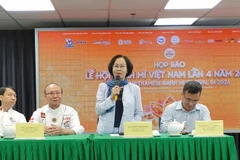
The organising committee answers reporters’ questions at the press briefing. (Photo: nhandan.vn)

Over 200,000 visitors expected at fourth Vietnam bread festival

This year’s festival is set to feature around 150 booths, with nearly 100 already registered. Visitors will have opportunities to explore diverse culinary experiences, enjoy promotional programmes at sponsor booths, and participate in various cultural and trade activities.

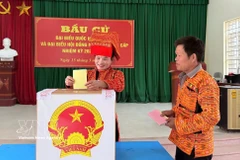
Dao ethnic minority people cast their votes. (Photo: VNA)

📝OP-ED: Responsibility, trust demonstrated in general election

The success of the election of deputies to the 16th National Assembly and People’s Councils at all levels for the 2026–2031 term goes beyond the scope of a routine political event. It is an occasion for people nationwide to exercise their right to mastery and place their trust in the representatives chosen for the country’s new stage of development.

The working session between the Belgian delegation and the Party Committee of Hung Yen province on March 19 (Photo: VNA)

Belgian fund proposes investment, support projects in Hung Yen

Belgium and the Aquitara ecosystem called on the province to facilitate the implementation of their programmes and projects, including allocating cleared land with full legal status within planned eco-industrial parks or economic development zones.

An urban area in Phan Rang ward, Khanh Hoa province (Photo: VNA)

Vietnam has potential for integrated urban development

Industry insiders said the country’s urbanisation processes are being reshaped, with focus shifting from simple expansion to integrated urban development linked by modern infrastructure and higher value creation.

First Secretary of the HCYU Central Committee Bui Quang Huy speaks at the forum (Photo: VNA)

Vietnamese youth forum amplifies young voices for action in new era

Huy emphasised that Vietnam’s new development phase requires rapid yet sustainable growth, mastery of science and technology, and enhanced innovation and digital transformation. In this context, young people are expected to play a pioneering role, and the youth union must strengthen its guidance and support mechanisms.