Agro-forestry-fishery trade surplus jumps over 62% in 10 months

The agricultural, forestry, and fishery trade surplus reached 15.21 billion USD in the first 10 months, up 62.2% compared to the same period last year, the Ministry of Agriculture and Rural Development has reported.

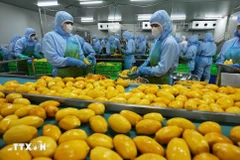
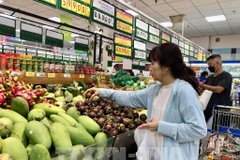
The farm produce enjoys a trade surplus of 4.6 billion USD in the last 10 months, up 4.2 times year-on-year. (Photo: VietnamPlus)

Hanoi (VNA) – The agricultural, forestry, and fishery trade surplus reached 15.21 billion USD in the first 10 months, up 62.2% compared to the same period last year, the Ministry of Agriculture and Rural Development has reported.

According to the ministry, the forestry, fishery and agricultural industries have recorded respective trade surplus of 11.75 billion USD, 6.21 billion USD, and 4.67 billion USD, up 18.8%, 17.2% and 4.4 times, respectively, from the same period last year.

Meanwhile, the three groups of inputs for production, livestock products, and salt witnessed trade deficits of 4.75 billion USD, 2.64 billion USD and 24.6 million USD in the period.

The sector’s total export revenue amounted to 51.74 billion USD, an annual increase of 20.2%.

SS2.webp
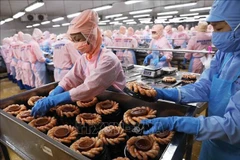
Photo: The export value of aquatic products in 10 months hits 8.33 billion USD, marking a 12% increase. (Photo: VNA)

Of the sum, agricultural exports contributed the most with 27.38 billion USD, up 25.6% year-on-year; livestock products earned 423.5 million USD, a 2.7% rise; fishery and forestry export turnovers grew by 12% and 19.9% to stand at 8.33 billion USD and 4.05 billion USD, respectively; and salt exports brought in 4.6 million USD, a slight decline of 0.2%.

Currently, six agricultural goods maintain trade surpluses exceeding 1 billion USD. They are wood and woodwork products with a surplus of 10.91 billion USD, fruits and vegetables with 4.47 billion USD, coffee with 4.33 billion USD, rice with 3.68 billion USD, shrimp with 2.92 billion USD, and Tra fish with 1.54 billion USD.

By region and territory, Asia was the biggest importer of Vietnamese agro-forestry-aquaculture products, accounting for 48.2% of the market share. The Americas and Europe remain the second and third largest buyers of the products, with market shares of 23.5% and 11.5%, respectively. Africa and Oceania have smaller shares, ranging from 1.4% to 1.8%.

Vietnam's export value of these items increased by 17.2% in Asia, 24.7% in the Americas, 34.1% in Europe, 2% in Africa, and 14.5% in Oceania, respectively, compared to the first ten months of 2023.

The US was Vietnam’s largest market, occupying a 21.6% share, followed closely by China at 21.5%, and Japan at 6.5%. Compared to last year, Vietnamese agro-forestry-fishery exports to the three markets were 25.9%, 11.4%, and 5.9% higher, respectively.

In the ten-month period, the sector imports worth 36.53 billion USD, a year-on-year growth of 8.5%.

The country spent 22.71 billion USD, 3.06 billion USD, and 2.31 billion USD on importing respectively agricultural, livestock, and forestry products, up 9.8%, 6.6%, and 25.4% year-on-year.

Vietnam imports the most agricultural, forestry, and aquatic products from markets in Asia and the Americas, with shares of 28.8% and 24.1%, respectively. Compared to the same period last year, the import value from Asia, the Americas and Europe rose by 11.1%, 11.4%, and 31.9%, respectively. Meanwhile, imports from Oceania and Africa decreased by 35.5% and 6.5%.

China, Brazil, and the US are the three largest suppliers of agricultural, forestry, and aquatic products for Vietnam, with market shares of 9.6%, 8.0%, and 7.7%, respectively. The country’s import value of these items in the reviewed period from the three markets increased by 28.3%, 8%, and 5.8%./.

VNA

See more

Can Tho, Belarus eye trade, investment opportunities

Can Tho, Belarus eye trade, investment opportunities

Belarusian Consul General in Ho Chi Minh City Alexander Sidoruk said his working visit to Can Tho city exposes ample untapped economic potential. The Belarus side brings strengths in exporting fertilisers, crop protection chemicals, agricultural equipment, and high-tech products, and is interested in importing Vietnamese rice, coffee, rubber, seafood, and dairy products.

Retail fuel prices are simultaneously reduced from 15:00 on May 14. (Photo: VNA)

Retail fuel prices cut from May 14 afternoon

Retail fuel prices were simultaneously reduced from 15:00 on May 14 following the latest adjustment by the Ministry of Industry and Trade (MoIT) and and the Ministry of Finance, with E5RON92 biofuel recording the sharpest decline.

A chip assembly and testing plant of Intel at the Saigon Hi-Tech Park in Ho Chi Minh City (Photo: VNA)

Intel deepens engagement in Vietnam’s semiconductor industry

According to the Saigon Hi-Tech Park (SHTP) management board, Intel has relocated part of its production line from Costa Rica to SHTP as part of its global manufacturing restructuring strategy aimed at improving efficiency and competitiveness.

A customer purchase E10 biofuel petrol at a PVOIL filling station on Thai Thinh street in Hanoi. (Photo: VNA)

Biofuel ready for nationwide rollout

For biofuels, particularly E10, to develop successfully, stronger and more coordinated policies are needed, especially pricing mechanisms capable of creating a sufficiently attractive gap between E10 and mineral-based petrol, an expert has said.

An automobile assembly line of the THACO Truong Hai Group in Da Nang. (Photo: VNA)

Da Nang promotes investment attraction to achieve over 11% growth

Da Nang's foreign direct investment (FDI) attraction showed strong growth, reaching 237.7 million USD, double the level recorded a year earlier. The city granted licences for 47 new FDI projects, approved capital adjustments for 16 projects and recorded 10 transactions involving capital contributions and share acquisitions in economic organisations.

Deputy Prime Minister Nguyen Van Thang speaks at the forum. (Photo: vneconomy.vn)

Vietnam pivots to selective, high-quality FDI attraction for sustainable growth: Deputy PM

The FDI sector remains a key pillar of Vietnam’s economy, with more than 46,500 valid projects and total registered capital exceeding 543 billion USD so far. Disbursed capital has reached around 357.6 billion USD. The FDI sector contributes over 20% of GDP, accounts for around 70% of total export turnover, and creates jobs for millions of workers. Vietnam continues to rank among ASEAN’s leading FDI destinations despite global investment slowdowns.