ASEAN affirms central role in regional security architecture: Malaysian PM

ASEAN always has connectivity and stability, cooperation and development, especially in terms of economy. Not only within the association, ASEAN also cooperates with external partners in the fields of economy, investment, energy, cyber security, food security, and culture.

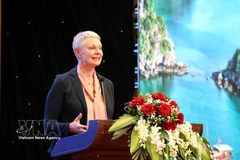
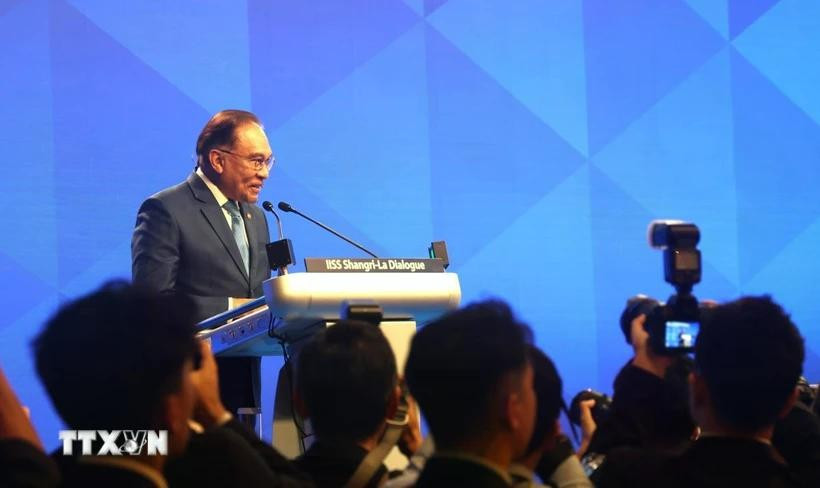
Malaysian Prime Minister Datuk Seri Anwar Bin Ibrahim delivers a special address at the 22nd Shangri-La Dialogue in Singapore. (Photo: VNA)

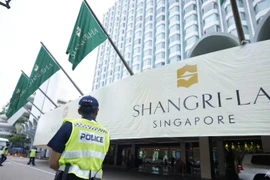
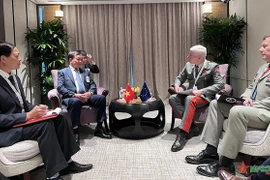
Singapore (VNA) – Malaysian Prime Minister Datuk Seri Anwar Bin Ibrahim delivered a special address at the 22nd Shangri-La Dialogue in Singapore, affirming the central role of the Association of Southeast Asian Nations (ASEAN) in the regional security architecture, supporting an open, transparent, inclusive, and rules-based regional architecture.

In his role as ASEAN Chair 2025, Ibrahim mentioned some advantages and disadvantages for ASEAN at present.

Regarding advantages, he emphasised that ASEAN always has connectivity and stability, cooperation and development, especially in terms of economy. Not only within the association, ASEAN also cooperates with external partners in the fields of economy, investment, energy, cyber security, food security, and culture. He also announced that ASEAN has agreed to admit Timor-Leste as ASEAN’s 11th member in October.

Regarding difficulties, according to Ibrahim, although the situation in Myanmar remains grave, ASEAN is not standing still. ASEAN does not seek to engineer outcomes in Myanmar. But they are equally clear that the Five-Point Consensus dictates that a resolution that excludes those most affected by this crisis will not endure. Myanmar’s nationhood must be forged through inclusion, not erasure.

He said the dispute in East Sea is far too complex and the concerned parties' objective is not achieved through escalation nor by provoking others into disproportionate responses. It is best pursued through steady, principled diplomacy: quiet, where necessary, but always firm.

According to the Malaysian PM, in addition to conflicts in many parts of the world, poverty, division, the risk of an arms race, the trade war also causes difficulties for the region, threatening to leading to instability in terms of security. The world needs to act to protect peace and stability, through clear, transparent, cooperative and long-term visionary policies, he noted./.
VNA

See more

Indonesia spots four Sumatran tigers at national park

Indonesia spots four Sumatran tigers at national park

Camera traps installed in Bukit Tigapuluh National Park of Indonesia have recorded four individual Sumatran tigers (Panthera tigris sumatrae), providing strong evidence that the conservation area's ecosystem remains well preserved.

Deputy Prime Minister and Agriculture Minister of Thailand Thammanat Prompao (Photo: The Nation)

Agricultural envoys ordered to boost Thai crop exports

Deputy Prime Minister and Agriculture Minister of Thailand Thammanat Prompao said that the ministry is prioritising a “market-led, innovation-supported, higher income” strategy, built on three key pillars: strengthening confidence in core, established markets to protect Thailand’s market share; targeting high-potential products to open new opportunities, including dried seahorses, dried geckos, live crocodiles for consumption, and breeding crocodile parent stock for farming; and expanding networks by deepening cooperation with key trading partners, including China, and widening sales channels, such as digital platforms, so Thai products can reach consumers more directly.

Illustrative image (Photo: Internet)

Thailand maps out national semiconductor strategy

Under the strategy, Thailand will prioritise power, sensor, photonics, discrete and analog semiconductors, which are closely linked to the country’s established electronics manufacturing base and supply chains serving the automotive, energy, data centre and industrial sectors.

MDEC headquarters (Photo: nabalunews.com)

Malaysia’s digital exports surge

Malaysia's digital exports recorded 6.8 billion RM (1.67 billion USD) between 2024 and the first half of 2025, marking a milestone in the country’s development journey of digital economy.

Malaysian Minister of Economy Akmal Nasrullah Nasir speaks at the Economy Minister Mandate 2026 on January 8. (Photo: Bernama)

Malaysia seeks to translate economic policies into practice

Malaysia enters the preparatory phase for the 13MP on the back of encouraging economic indicators in 2025. Gross domestic product (GDP) expanded by 5.2% in the third quarter of 2025, bringing average growth for the first nine months of the year to 4.7%.

The Lao National Convention Centre in Vientiane, the venue of the 12th National Congress of the Lao People’s Revolutionary Party. (Photo: VNA)

Laos steps up drive to move beyond least developed country status

The Lao Government will also work to foster strong development momentum by mobilising public participation, encouraging self-reliance among citizens and businesses, and improving the quality of human resources, while building an independent and self-reliant economy capable of deeper regional and global integration.

CEO of Bioeconomy Corporation Mohd Khairul Fidzal Abdul Razak (Photo: The Star)

Malaysia boosts bio-economy, targets high revenue in 2026

MOSTI Minister Chang Lih Kang said the Bioeconomy Corporation, the ministry’s lead development agency for Malaysia’s biotechnology industry, will drive this growth and steer the country’s bioeconomy toward greater global competitiveness.

Secretary of the Central Committee of the Lao People’s Revolutionary Youth Union (LPRYU) Thongly Sisoulith (Photo credit: Lao Youth Mass Media)

Lao youth ready to contribute to national socio-economic development goals

Secretary of the Central Committee of the Lao People’s Revolutionary Youth Union (LPRYU) Thongly Sisoulith said that the Youth and Adolescents Development Strategy, which is integrated into the 10th five-year socio-economic development plan, is a key component reflecting the Party and State’s clear orientation toward human resources development in service of the country’s sustainable development in the future.