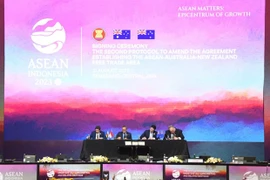
Australian Prime Minister Anthony Albanese unveiled "Invested: Australia’s Southeast Asia Economic Strategy to 2040 at the ASEAN Indo-Pacific Forum in Jakarta. (Photo: AFP/VNA)
 Kuala Lumpur (VNA) - Australia has identified fourkey sectors with the highest potential growth to further deepen economiccooperation with Malaysia under its “Invested: Australia’s Southeast AsiaEconomic Strategy to 2040”.
The four sectors areagriculture and food, resources, education and skills, and digital economy.
Currently, Australia is amajor supplier of food to Malaysia, with an estimated 10% of Malaysia’s dairy, 25%of its imported meat and two-thirds of its imported wheat.
Regarding the resourcessector, Australia wants to continue supporting Malaysia’s energy transitionplan by deepening institutional partnerships and expanding technical assistanceon decarbonisation pathways, and infrastructure funding among others.
Last year, natural gas,copper, and coal were among Australia’s key export items to Malaysia.
As for digital economy, Australiais committed to supporting Malaysia in realising the goal of becoming ahigh-income country by promoting digital development and application. The twonations signed a Memorandum of Understanding on digital collaboration in 2020 toenhance digital cooperation and reduce barriers to digital trade. They also hoped to include new provisions and collaborations in the digitaland green economies in the Malaysia-Australia Free Trade Agreement.
Regarding vocational education and training, Australiaand Malaysia have pledged to speed up cooperation relating to online tertiaryeducation delivery.
Australia is Malaysia's 7th largest trading partner whileMalaysia is the former's 8th largest trading partner in goods andservices. Last year, two-way trade between the twocountries was valued at 21.4 billion USD and two-way investment totaled 19.15billion USD.
Thestrategy was launched by Australian Prime Minister Anthony Albanese at theASEAN Indo-Pacific Forum in Jakarta on September 6 on the sidelines of the ASEANSummit. It identified 10 priority sectors offering the most potential foreconomic growth, including agriculture and food, resources, green energytransition, infrastructure, education and skills, tourism, healthcare,digital economy, professional and financial services, and creative industries./.