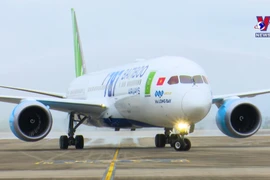
International flights carrying passengers to Vietnam have been suspended due to COVID-19 (Photo: Vietnamplus)
Hanoi (VNA) – The Civil Aviation Authority of Vietnam (CAAV) has submitted a plan on the reopening of international flights in three stages to the Ministry of Transport (MoT).
In the first stage, Vietnam will resume whole-package flights for Vietnamese passengers. Vietnamese airlines will collaborate with travel companies, Vietnam’s foreign commissions and local authorities to operate the flights and quarantine the passengers at hotels after they arrive in Vietnam.
Only ‘combo’ flights for Vietnamese citizens will be resumed in the first phase. Vietnamese carriers will work with partners, diplomatic missions, and localities arranging quarantine areas.
A combo ticket includes a flight ticket, COVID-19 testing, quarantine, living cost, and vehicle to pick passengers up from the airport to hotels for quarantine.
The second phase is set to begin from July, with regular flights bringing passengers to Vietnam restarted. After arrival, entrants including Vietnamese citizens and foreigners have to stay in quarantine.
Flights will initially be on routes between Vietnam and Japan, the Republic of Korea, and Taiwan (China). The number of weekly flights arriving in Vietnam will total 24, with up to 7,000 passengers going into quarantine.
The third phase may start in September, depending on the COVID-19 vaccination process in Vietnam and an assessment on herd immunity after that. Passengers on the flights need not go to quarantine upon arrival as “vaccine passports” will be in place.
The Civil Aviation Authority of Vietnam said that the plan will be applicable to countries and territories that accept the effectiveness of the COVID-19 vaccines Vietnam has authorised for use.
To do so, the airline must submit a flight plan that must include the local approved quarantine admission plan where the airport is located.
The Civil Aviation Authority of Vietnam said the deployment market included countries and territories that have announced the acceptance of the COVID-19 efficacy of the same vaccine that Việt Nam has announced for widespread application.
Accordingly, there will be no centralised isolation required for passengers who test negative for SARS-CoV-2 using Real-time PCR technique for between three and five days before entering Việt Nam and with the vaccinated certificate from their government-approved vaccination establishments or under the World Health Organisation (WHO) vaccination facility system for COVID-19.
Passengers after entry must declare to the local authorities their place of residence and isolate themselves for seven to 14 days while passengers who do not have a certificate of negative test for SARS-CoV-2 and vaccinated certificates must be on a paid quarantine package for fourteen days.
On March 17, Prime Minister Nguyen Xuan Phuc requested related ministries and branches to review and study the reopening of international routes step by step, preparing plans to deploy the application of "vaccine passports" and controlled trade.
A “vaccine passport" is known as an immunisation certificate in the form of a carry-on document or information published online to confirm an individual's vaccinated status. In that case the individual can be allowed to travel to another country with no quarantine requirements after entry.
China was the first country to recognise the application of COVID-19 vaccination results to remove all restrictions and quarantine requirements for people who have been vaccinated while travelling within China.
The United States and Europe also supported such a solution and they were working on an agreement on the effectiveness of one or more vaccines against COVID-19.
Responding to the plan, Vietnam Airlines said it would resume international routes between Hanoi - Narita (Tokyo, Japan), Hanoi - Incheon (Seoul, the Republic of Korea), Hanoi - Sydney and HCM City - Sydney (Australia), from April 1. In addition, the national airline also planned to launch package flights from Japan, the Republic of Korea, and Taiwan (China) after being licensed from the authorities./.