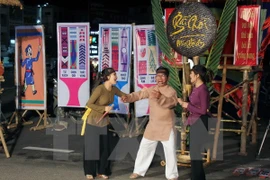
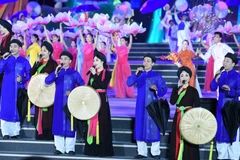
Bai choi is often seen at local spring festivals and resembles a game, using playing cards and village huts. (Source: VNA)
 Hanoi (VNA) – Bai Choi singing, a folk music genre practisedin Vietnam’s central region, has been added to the UNESCO Representative Listof the Intangible Cultural Heritage of Humanity, according to the Department ofCultural Heritage under the Ministry of Culture, Sports and Tourism.
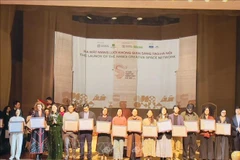
The recognition was made during the 12th session of the UNESCOInter-governmental Committee for the Safeguarding of the Intangible CulturalHeritage in Jeju, the Republic of Korea (RoK), on December 7.
With the recognition, Bai Choi singing has become the 10th Vietnamese heritage honoured as representative cultural heritage of humanity.
The committee considered 35 nominations for inscription on the RepresentativeList of the Intangible Cultural Heritage of Humanity, including Bai Choi, andsix nominations for inclusion on the List of Intangible Cultural Heritage inNeed of Urgent Safeguarding.
Xoan singing, another form of Vietnamese folk music, is expected to be removedfrom the List of Intangible Cultural Heritage in Need of Urgent Safeguardingand added to the Representative List of the Intangible Cultural Heritage ofHumanity.
Bai Choi signing was highly valued by 24 members of the committee.
The folk singing genre is popular in the central provinces of Quang Binh, QuangTri, Thua Thien-Hue, Quang Nam, Quang Ngai, Binh Dinh, Phu Yen and Khanh Hoa,and Da Nang city.
Bai choi is often seen at local spring festivals and resembles a game, using playingcards and village huts.
The stage for Bai choi performances encompasses nine cottages, each containingfive or six ‘players’. One of the cottages, the central house, contains atroupe of musicians and instruments. A deck of playing cards is split in half,with one stack distributed amongst the players, and the other placed in thecentral house. The cards are stuck onto bamboo poles and erected outside thecottages.
The game singer delivers a flag to each cottage, all the while singing Baichoi, and then draws a card from the central house. Whoever holds the cardclosest in value to the game singer’s card wins.
The Bai choi songs are about festivals, daily life and work, and areaccompanied by musical instruments.
The game and songs were developed by Mandarin Dao Duy Tu (1572-1634) to helplocals protect their crops.
According to the Inter-governmental Committee for the Safeguarding of theIntangible Cultural Heritage, Bai Choi is an important cultural activity inVietnamese villages and communes, meeting the demand for entertainment and artsof the community.
Bai Choi songs are moral lessons, demonstrating patriotism, connectivity in thecommunity and living experience of people.
The Ministry of Culture, Sports and Tourism recognised Bai Choi as nationalintangible cultural heritage during 2014-2016.
Apart from Bai Choi, the UNESCO Representative List of the Intangible CulturalHeritage of Humanity includes other eight Vietnamese heritages – the traditional practice of “Tho Mau Tam Phu” (Worship of Mother Goddesses), tug-of-war game, which is also played in Cambodia, the RoK and the Philippines,Nghe Tinh province’s Vi-Giam folk singing, Don ca tai tu (amateursinging in southern Vietnam), Hung King worship ritual, Giongfestival and Soc temples in Hanoi, Bac Ninh province’s Quan ho (love duetsinging), the space of Gong culture in the Central Highlands and Hue'sroyal court music.-VNA
VNA