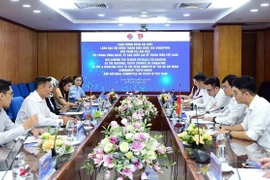
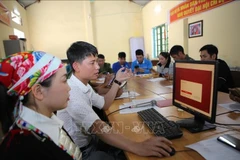
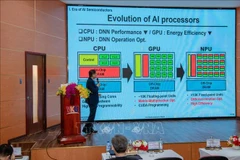
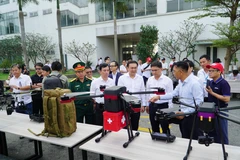
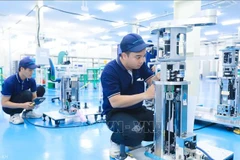
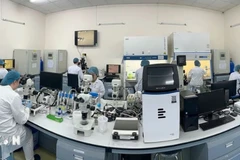
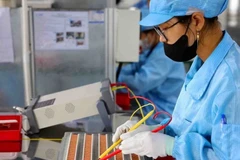
At the cyber security centre in the Vietnam-Singapore Innovation Centre (Photo: nhandan.vn)
 Binh Duong (VNA) - Chairman of the People's Committee of Binh Duong province Vo Van Minh on August 28 signed a decision approving the establishment of Vietnam-Singapore Innovation Centre in the southern locality.
Under the decision, the centre will implement activities to connect, build orientations and create an environment for sci-tech research; support enterprises to transform technology and production and business models to meet the trend of the 4th Industrial Revolution.
It will also support and promote innovation and creativity programmes, focusing on research and development fields and creating new ecosystems for the business community; and attract social resources to create models, products and projects in order to promote Binh Duong’s future development.
The centre also aims to implement Binh Duong province's orientation in pioneering economic development based on innovation, science and technology.
 At the start-up and advanced production centre in the Vietnam-Singapore Innovation Centre (Photo: nhandan.vn)
It is positioned as a platform to attract active participation and cooperation between the players of the innovation ecosystem, creating favourable conditions for businesses, institutes and universities to promote potential and improve their capacity through sci-tech commercialisation, transfer and application.
The centre is expected to help businesses make deeper inroads into the global value chain, towards producing products with higher technology content adapting to the world's green and sustainable development trend.
It will play a strategic role in promoting important changes of Binh Duong, creating new growth platforms to maintain sustainable growth in the journey to overcome the middle-income trap.
It will continue to build and develop a close and sustainable relationship between Vietnam and Singapore in which Becamex IDC Corporation and Sembcorp are founding shareholders, which have contributed to developing the Vietnam - Singapore Industrial Park (VSIP) model across the country for more than 27 years.
Based on the strategic cooperation relationship between the two countries, the centre will continue to create new opportunities to promote the sharing of knowledge and experience on innovation with Singaporean partners, including National University of Singapore, Singapore Polytechnic, Nanyang Polytechnic, and Enterprise Singapore.
The centre is hoped to open up opportunities for investment and development, thus meeting the demand of businesses and the economy through training, and attracting high-quality, dynamic and creative human resources to Binh Duong; improve scientific and technological research and development capacity, support enterprises to improve productivity and speed up technology transformation towards developing a science and technology industrial park model in the locality./.
 At the start-up and advanced production centre in the Vietnam-Singapore Innovation Centre (Photo: nhandan.vn)
 It is positioned as a platform to attract active participation and cooperation between the players of the innovation ecosystem, creating favourable conditions for businesses, institutes and universities to promote potential and improve their capacity through sci-tech commercialisation, transfer and application.
The centre is expected to help businesses make deeper inroads into the global value chain, towards producing products with higher technology content adapting to the world's green and sustainable development trend.
It will play a strategic role in promoting important changes of Binh Duong, creating new growth platforms to maintain sustainable growth in the journey to overcome the middle-income trap.
It will continue to build and develop a close and sustainable relationship between Vietnam and Singapore in which Becamex IDC Corporation and Sembcorp are founding shareholders, which have contributed to developing the Vietnam - Singapore Industrial Park (VSIP) model across the country for more than 27 years.
Based on the strategic cooperation relationship between the two countries, the centre will continue to create new opportunities to promote the sharing of knowledge and experience on innovation with Singaporean partners, including National University of Singapore, Singapore Polytechnic, Nanyang Polytechnic, and Enterprise Singapore.
The centre is hoped to open up opportunities for investment and development, thus meeting the demand of businesses and the economy through training, and attracting high-quality, dynamic and creative human resources to Binh Duong; improve scientific and technological research and development capacity, support enterprises to improve productivity and speed up technology transformation towards developing a science and technology industrial park model in the locality./.
VNA