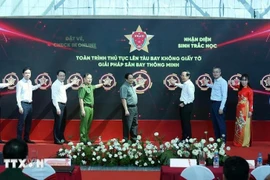
Biometric check-in rolled out at Tan Son Nhat International Airport

Under this system, passengers are guided by police and airline staff to complete online check-in via the VNeID app.

A passenger undergoes facial biometric recognition during the check-in process. (Photo: VNA)

HCM City (VNA) – A biometric identification and digital authentication system integrated with the VNeID application officially began operation at Terminal T3 of Tan Son Nhat International Airport, streamlining passenger procedures from check-in to boarding.

Under this system, passengers are guided by police and airline staff to complete online check-in via the VNeID app. They are then verified using facial recognition scanners. Once authenticated, they can bypass traditional security, ticket, and document checks. Facial recognition scanners placed at security checkpoints now allow passengers to proceed through the airport in a matter of seconds.

Nguyen Vu Khuong Duy, a resident of Tan Thoi Nhat ward in Ho Chi Minh City, noted that the usual airport process would take 30 to 45 minutes, but with the new biometric solution, the entire procedure only takes 10 to 15 minutes. It’s faster and more convenient, like what we see in modern international airports in developed countries, he said.

Nguyen Duy Khang from Dong Hung Thuan ward, who was travelling with a friend to Phu Quoc island, said the biometric system was “quick and time-saving,” adding that air travel has become significantly more convenient.

This initiative marks the second phase of a broader plan to fully implement digital technologies in Vietnam’s civil aviation sector. By integrating biometric data such as facial recognition into the VNeID system, the plan gradually replaces traditional paper-based procedures. The move aims not only to enhance the passenger experience but also to improve aviation security and accelerate national digital transformation.

In the long term, the adoption of biometric technology represents a major shift towards a fully digitalised air transport system, paving the way for a smart, paperless airport ecosystem that offers passengers a more civilised, modern, and efficient travel experience. This transition is particularly timely given the growing demand for air travel among Vietnamese citizens.

The application of VNeID and facial biometrics at airport security checkpoints stands as a concrete example of Vietnam’s transition from traditional document verification to digital authentication. It reflects the core objective of Project 06, which seeks to build a comprehensive digital ecosystem that serves people in everyday life./.

VNA

See more

The particularly serious coach accident, which occurrs at 00:20 in Chuong Duong commune on the Phap Van–Cau Gie–Cao Bo–Mai Son–National Highway 45–Nghi Son route. (Photo published by VNA)

PM orders urgent probe into deadly coach overturn on Hanoi expressway

An official dispatch, issued following the particularly serious coach accident, which occurred at 00:20 a.m. in Chuong Duong Commune on the Phap Van–Cau Gie–Cao Bo–Mai Son–National Highway 45–Nghi Son route, was sent to the ministers of Public Security and Construction, as well as the chairpersons of provincial and municipal People's Committees.

The story of Elza Le Floch, Celeste Perotteau-Giraud, and Wyatt Lelouche is published in the Nice Matin newspaper (Photo published by VNA)

Three young French volunteers embark on humanitarian journey to Vietnam

While many French students have just completed their secondary school examinations and are preparing for their summer break, Elza Le Floch, Celeste Perotteau-Giraud and Wyatt Lelouche have embarked on a different journey. On July 15, the three members of the Scouts and Guides of France group in Menton left Nice for Xuyen Moc in Ho Chi Minh City.

At a classroom for hearing-and-speech impaired children in Bac Ninh province. (Photo: VNA)

Legal assistance project nears finish line with 95% of goals met

Legal support policies only matter when citizens know they exist, can tap into them, and receive quality service. That’s especially true for the poor, the disabled, ethnic minorities, children, domestic violence victims, and those battered by disasters and disease outbreaks.

Efforts to safeguard religious values in digital age

Efforts to safeguard religious values in digital age

Digital transformation is changing not only how people work and communicate but also how they practice their faith. A Buddhist sermon can now attract tens of thousands of online viewers. A Protestant believer in a remote area can join a Bible study class via smartphone. Religious activities once closely tied to places of worship are increasingly taking place in cyberspace.

Delegates tour the facilities of the industrial innovation centre at Eastern International University in Binh Duong ward, Ho Chi Minh City (Photo: VNA)

Digital, AI competencies made mandatory for university graduates

Under Circular No. 54/2026/TT-BGDDT on higher education curricula, learning outcomes must be defined as measurable and assessable competencies, providing the basis for curriculum design, teaching, assessment, quality improvement, credit recognition and degree awarding.

Nguyen Thuy Hang, Director of the Writers Association Publishing House, is questioned at the security agency for investigation under the Hanoi Department of Public Security. (Photo published by VNA)

Publishers detained over alleged anti-State propanganda

The move was made as part of an expanded investigation into a criminal case involving Nguyen Thanh Nam, who is accused of “making, storing, distributing or spreading information, documents and items aimed at sabotaging the State of the Socialist Republic of Vietnam.”

Fishing boats at Quy Nhon Port of Gia Lai province (Photo: VNA)

Gia Lai digitises fishing fleet to strengthen fight against IUU fishing

Under Directive No. 16/CT-UBND, recently issued by the provincial People's Committee, combating IUU fishing has been identified as an urgent political priority requiring concentrated resources to address shortcomings in fishing fleet management, while holding agency heads and local leaders accountable for the results achieved.

The General Association of Vietnamese People in Laos, in coordination with Bang Long Pagoda, organises the “Mid-Autumn Festival Night” programme to celebrate the Mid-Autumn Festival. (Photo: VNA)

Vietnamese community organisation network completed across Laos

The official establishment of the Vietnamese Community Management Committee and the Vietnamese Association in Vientiane province on July 14 has completed the organisational network serving the Vietnamese community in all 18 provinces and centrally administered cities of Laos.