Border tensions affect Thai economy

The Thai-Cambodian Border Operations Centre on June 21 announced plans to support fruit farmers affected by border restrictions.

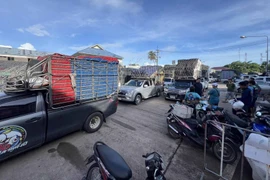
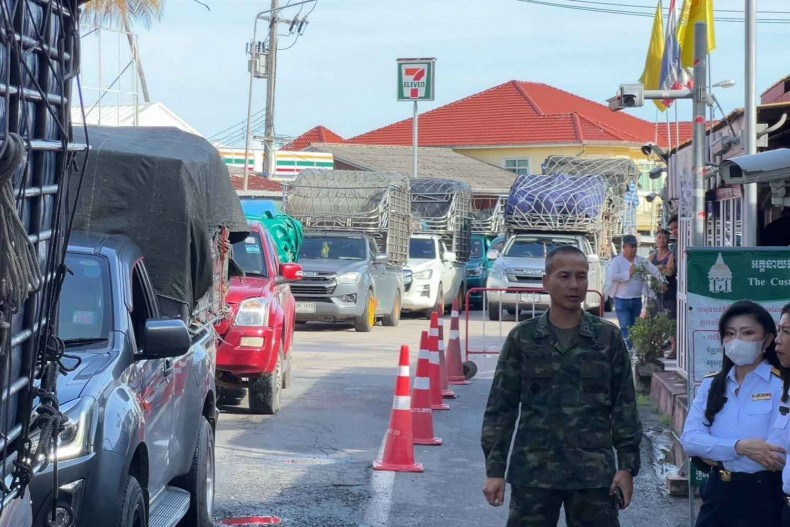
Cargo trucks wait at a border crossing in Trat province bordering Cambodia. (Photo: bangkokpost.com)

Bangkok (VNA) – Thailand’s business sector is urging a peaceful solution to the Thailand-Cambodia border tensions, warning that delays are harming the local economy, especially fruit exports.

Wipa Sunate, Chairwoman of the Trat Chamber of Commerce, recently said the eastern province of Trat has seen a drop in investor confidence and is facing a weakening economy.

The province’s exports to Cambodia are valued at 30 billion THB (909.5 million USD) while imports from the country are worth 3–4 billion THB, she said.

However, this trade arrangement is facing a decrease due to political instability and restrictions on border operating hours.

A decline in product flow and sales will further hit businesses and manufacturing, she said, adding if the border were to be permanently closed, the consequences would be even more severe.

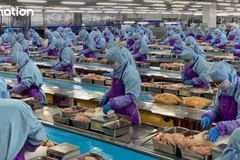
Wipa added fruit farmers in Trat are unable to export their products to Cambodia due to bans on cross-border fruit transport. Tourism has also been affected as travellers face restrictions entering Cambodia.

The Thai-Cambodian Border Operations Centre on June 21 announced plans to support fruit farmers affected by border restrictions.

These include organising the "Thai Fruit Festival 2025" with malls and wholesale markets, distributing mangoes as gifts at 1,097 gas stations in Bangkok and nearby provinces, selling fruit at state-run stores.

Other steps are promoting corporate social responsibility purchases by government and private organisations and partnering with companies like Tao Bin, the vending machines operator, and AirAsia to buy fruits for smoothies and in-flight meals.

Meanwhile, Commerce Minister Pichai Naripthaphan instructed the Foreign Trade Department to tighten import controls on cassava from Cambodia due to the border tensions. The ministry also aims to protect Thai farmers and stabilise local prices that might be affected by the low-quality products imported from Cambodia, he added./.
VNA

See more

Datuk Seri Anwar Ibrahim attends the National TVET Day 2026 celebration at Dataran Putrajaya today. (Photo: Bernama)

Malaysia strengthens vocational training in technology and energy sectors

Malaysia is ramping up technical and vocational education and training (TVET) as a cornerstone of its economic transformation and talent development strategy, preparing its workforce for emerging fields such as artificial intelligence (AI), cryptocurrency technology and the global energy transition.

Indonesia eyes trade breakthrough with EAEU via FTA

Indonesia eyes trade breakthrough with EAEU via FTA

Indonesia seeks to develop relations with all countries and sees itself as a bridge between different regions of the world. Against a backdrop of growing geopolitical and global economic uncertainty, strengthening international cooperation and building reliable supply chains have become more important than ever.

Thai Prime Minister Anutin Charnvirakul (R) at Nation TV’s 26th anniversary event on June 4, 2026. (Photo: nationthailand.com)

Thailand prioritises OECD accession

Thai Prime Minister Anutin Charnvirakul the country’s bid to join the Organisation for Economic Co-operation and Development, or OECD, is central to the government’s economic agenda.

ASEAN aims to become global digital economy hub

ASEAN aims to become global digital economy hub

Studies indicate that the ASEAN Digital Economy Framework Agreement (DEFA) could help raise ASEAN’s digital economy value to 2 trillion USD by 2030 while transforming the region into a connected, comprehensive and sustainable digital economy hub on the global stage.

Malaysian Deputy Prime Minister and Minister of Energy Transition and Water Transformation Seri Fadillah Yusof speaks at the Energy Transition Conference 2026 (ETCon26) in Kuala Lumpur on June 3. (Photo: VNA)

Malaysia accelerates energy transition

Malaysian Deputy Prime Minister and Minister of Energy Transition and Water Transformation Seri Fadillah Yusof noted that for both Malaysia and ASEAN, the transition is not only an environmental imperative but also an economic necessity and a strategic priority.

A pregnant woman receives a routine pregnancy check-up at a hospital. (Photo: VNA)

ILO report highlights gaps in maternity benefits across ASEAN

The report calls for extending maternity protection to all women, including workers in the informal economy; strengthening financing mechanisms to ensure sustainability and adequacy of benefits; and aligning maternity protection policies with broader social protection, health and care policies.

President of Timor-Leste José Ramos-Horta (L) at the leadership lecture in Jakarta on June 2 hosted by the ERIA School of Government under the Economic Research Institute for ASEAN and East Asia (ERIA). (Photo: ERIA)

Timor-Leste President shares vision for peacebuilding, ASEAN integration

Drawing on his experience as a diplomat and Nobel Peace Prize laureate, Ramos-Horta cited the reconciliation process between Timor-Leste and Indonesia as a model for peacebuilding. He paid tribute to former Indonesian leaders for their contributions to normalising bilateral ties, stressing that friendship and cooperation ultimately prevailed over past divisions and laid the foundation for Southeast Asia's stability today.

Southeast Asia tourism sustains rebound

Southeast Asia tourism sustains rebound

Indonesia welcomed 4.68 million foreigners in the first four months, an 8.24% hike from a year earlier and the highest tally for the period since the COVID-19 outbreak, its Central Bureau of Statistics said on June 3.

 Indonesia replaces free school meal programme chief after food poisoning scandals

Indonesia replaces free school meal programme chief after food poisoning scandals

The free meal initiative forms part of Indonesia’s broader effort to tackle chronic malnutrition, with more than 20% of children in the country still affected by stunting caused by inadequate nutrition. Jakarta’s long-term goal is to provide meals to around 82.9 million children, pregnant women and breastfeeding mothers, equivalent to more than 30% of the national population.