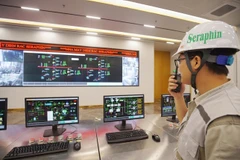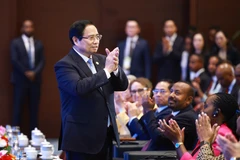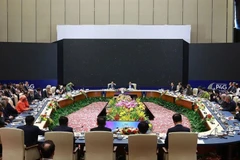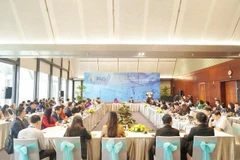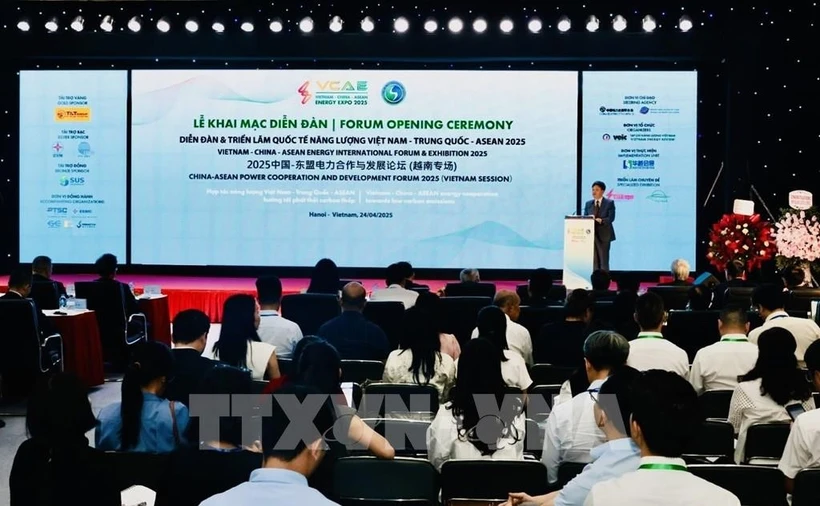
Hanoi (VNA) – Opportunities for collaboration in clean energy technology development took centre stage at the Vietnam–China–ASEAN international energy forum, held in Hanoi on April 24.
The event drew participation from representatives of ASEAN embassies, several European nations, and leading enterprises and corporations from Vietnam, other bloc member countries, and China. Co-hosted by the Vietnam Energy Association (VEA) and the China Electricity Council (CEC), the forum served as a vital platform for business networking and policy dialogue. It offered a space for industry leaders and policymakers to exchange insights, explore new technologies, and reinforce cooperation toward sustainable energy development, particularly in Vietnam.
Speaking at the forum, Vice Chairman of the Vietnamese National Assembly's Science, Technology and Environment Committee Ta Dinh Thi said that in the current context, Vietnam’s energy sector must strike a balance of ensuring robust economic growth and national energy security while simultaneously advancing the transition to green, clean energy and reducing greenhouse gas emissions in line with global trends. He also noted growing pressure on the nation to expand its power transmission network and the urgent need to strengthen regional electricity connectivity, particularly with China, Laos, Cambodia, and the wider ASEAN region.
According to him, China, a global leader in clean energy, currently generates 1,460 MW of renewable electricity out of a total system capacity of 3,400 MW, accounting for 43%. Meanwhile, ASEAN countries are intensifying their focus on renewable energy growth, aligned with their national capacities and green development strategies.
Thi remarked that the forum is expected to open new avenues for investment and cooperation in the energy sector, positioning Vietnam–China–ASEAN energy relations for substantial progress.
In her remarks, VEA Vice President Nguyen Thi Thanh Binh underscored the importance of fostering deeper partnerships with global and regional energy leaders, particularly through practical ASEAN–China cooperation models.
She identified Chinese technology providers, contractors, and equipment manufacturers as critical to accelerating Vietnam’s energy transition. To facilitate deeper engagement of Vietnamese firms in regional cooperation, Binh called for the enhancement of legal and institutional frameworks as well as more active participation in ASEAN energy mechanisms – such as the ASEAN Power Grid (APG) and the ASEAN energy community.
She also proposed the promotion of joint ventures with China and other ASEAN partners in renewable energy development, and the establishment of an annual Vietnam–China–ASEAN energy dialogue mechanism./.
VNA