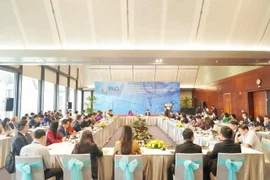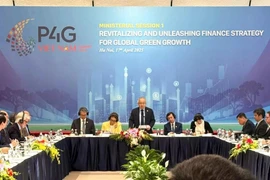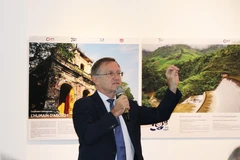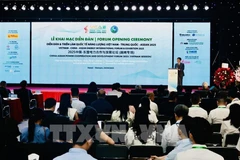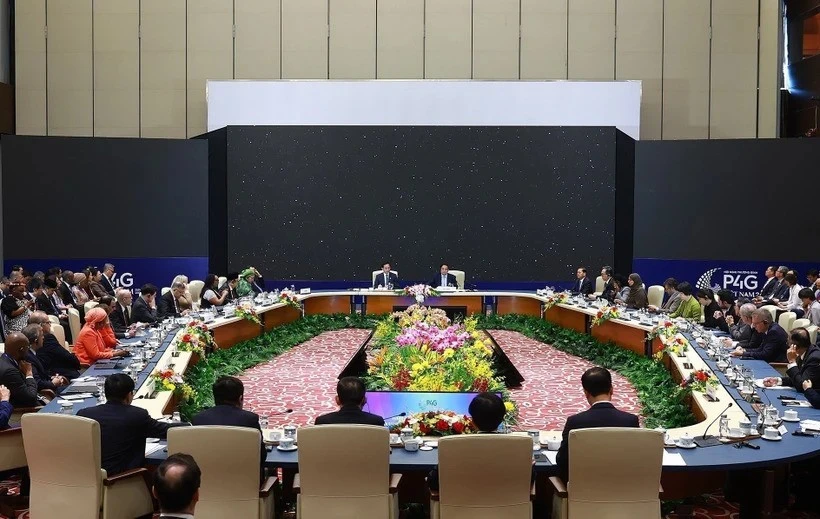
New Delhi (VNA) – Prof. Reena Marwah from Delhi University has hailed Vietnam’s hosting of the fourth Partnering for Green Growth and the Global Goals 2030 (P4G) Summit from April 14-17 as a timely and strategic move for both Vietnam and the global community.
In her recent analysis, Marwah stressed that the move signals the country’s proactive leadership at a time when climate commitments from major powers are wavering. By hosting the summit, Vietnam is positioning itself as a pioneer in advancing sustainable development.
The P4G Summit is more than a diplomatic gathering; it is a powerful call to action aimed at mobilising resources, strengthening global partnerships, and accelerating an equitable green transition, Marwah wrote. The event comes at a critical juncture when financing climate action, particularly in developing nations, faces significant challenges, making Vietnam’s role a beacon of hope.
The P4G platform focuses on market-based solutions to achieve the Sustainable Development Goals (SDGs), with key emphasis on climate adaptation, food system, water security, energy, and circular economy. For Vietnam, the summit offers a strategic opportunity to attract vital resources like financing, technology, and expertise while deepening ties with P4G member countries, including Denmark, the Republic of Korea, the Netherlands, and nations across Africa, Asia, and Latin America.
The significance of the 2025 P4G Summit is further amplified by its timing, as developing nations like India and Vietnam face the dual challenge of sustaining economic growth while adapting to and mitigating the impacts of climate change, often with limited domestic resources. In such context, P4G model, which promotes public-private partnerships, becomes an increasingly essential mechanism to mobilise innovation and finance, complementing traditional funding channels that often fall short.
Marwah hailed the event as a unique opportunity to foster more inclusive and equitable global partnerships. Key allies such as the European Union (EU), Japan, and India, with their technological expertise and strong investment capacity, are critical to Vietnam’s green transition.
The summit, she said, serves as an ideal platform for Vietnam to deliver a clear and compelling message: the country is ready for a new wave of green investment, ranging from renewable energy infrastructure and sustainable agriculture to electric transportation and circular economy models.
Vietnam is pioneering a new model of cooperation, one grounded in mutual respect, shared responsibility, and genuine commitment to climate action. In this model, a country’s value lies not in its GDP but in its concrete climate actions and collaborative spirit. Vietnam’s vision of fair and inclusive multilateralism could chart a new path - much-needed, and hopeful - for the global climate order, she concluded./.
See more
Vietnam, Germany step up collaboration on energy transition, green hydrogen
Schäfer-Gümbel praised the strong commitment of Vietnamese partners to sustainable energy goals. He noted that the long-standing development cooperation between Germany and Vietnam is evolving, with energy transition emerging as a strategic area of collaboration in addressing global challenges.
Belgian TV spotlight: Vietnam's wild nature reborn
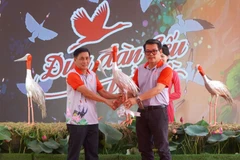
Through the lens of “Le Jardin Extraordinaire”, Vietnam was portrayed not simply as a travel destination but as a still-emerging realm of discovery: a nation whose nature, though heavily wounded in the past, demonstrates extraordinary powers of recovery, quietly upholding its pristine essence against the pressures of time.
Carbon credits - New resource for forest protection
With more than 841,000 hectares of forest and a forest coverage rate exceeding 61%, Quang Tri is among the provinces with the largest forested areas and carbon stocks in the north central region.
Quang Tri receives endangered stump-tailed macaque
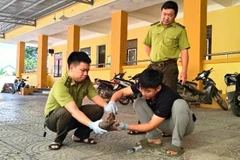
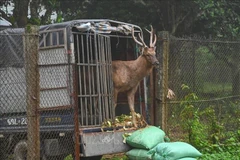
The Cam Lo-Dong Ha forest protection unit in the central province of Quang Tri has received a rare stump-tailed macaque, a species listed as endangered, precious and rare in the Vietnam Red Data Book.
Natural gas emerges as key bridge to Net Zero ambitions by 2050: Workshop
Gas output from Vietnam's 26 producing fields hit its peak between 2010 and 2015, followed by a steep fall-off after 2016. During 2021-2025, annual volumes hovered between around 5.95 and 8.08 billion cu.m.
Vietnam, Netherlands join forces to tackle saltwater intrusion in Mekong Delta
Dutch and international experts agreed that rather than attempting to completely prevent salinity, a smarter strategy is to manage it and learn to live with it. Areas that successfully develop profitable farming systems under saline conditions will gain a long-term competitive advantage.
14th National Party Congress: Environmental protection – driver of sustainable development
A notable new feature in the draft documents of the 14th National Party Congress is that environmental protection is no longer treated as an auxiliary task, but increasingly regarded as a foundation for the country’s sustainable development in the coming period.
PM chairs sixth meeting of COP26 National Steering Committee
Prime Minister Pham Minh Chinh stressed that climate action remains a global movement and trend, in which Vietnam is actively engaged.
Eight rare animals released into the wild in Dong Nai province
The species include three Macaca fascicularis (long-tailed macaques), three Nycticebus pygmaeus (pygmy slow lorises), one Python reticulatus (reticulated python) and one Manis javanica (Javan pangolin).
Tree planting programme spreads green momentum in islands
The Ho Chi Minh City Association for Conservation of Nature and Environment (HANE) on January 11 announced 10 outstanding green programmes and activities carried out in 2025, including a programme to plant 1 million trees in Vietnam’s island areas.
Wildlife conservation creates green livelihoods at Ben En National Park
Ben En National Park in the central province of Thanh Hoa has implemented a wide range of scientific studies and conservation projects aimed at safeguarding biodiversity, particularly rare and endangered wildlife species.
Ca Mau strives to put coastal, riverbank erosion under control by 2030
Solutions have been designed to suit local geological and hydrological conditions, combining traditional hard engineering works such as dykes and revetments with soft, nature-based and ecological solutions, including mangrove restoration.
Lam Dong releases hundreds of wild animals back into the wild
According to the Ta Dung National Park Management Board, the park has for years served as a trusted destination for authorities and residents to hand over and release wildlife. Such actions not only contribute to biodiversity conservation but also help reduce illegal hunting and captivity of wild animals.
Hanoi pilots early air quality forecasting system
The system can forecast air quality trends over time and across locations, helping authorities guide and implement pollution control measures.
Recycling fly ash into valuable resource: sustainable path towards circular economy
The rate of fly ash utilisation has steadily increased over the years, to 84% in 2021 from 37.5% in 2018. During 2022–2023, many plants managed to consume 100% of the daily fly ash produced while also processing a significant portion of long-stored stockpiles.
Hanoi targets 20% reduction in PM2.5 levels
Hanoi has affirmed its commitment not to trade environmental protection for economic growth. The city is moving to establish low-emission zones (LEZs) as a core measure to control emissions and promote green, sustainable urban development.
Forest protection, development stepped up from start of 2026
Localities are requested to encourage the participation of mass organisations, schools, businesses, armed forces and communities, while enhancing public responsibility for caring for and protecting trees after planting.
Vietnam takes actions to combat desertification, ensure sustainable land, resource management
Preventing and combating desertification is identified as a key task, helping with nature and biodiversity conservation, sustainable management of forests, water and land resources, and improvement of people's incomes and life quality.
Ca Mau approves investment policy for waste-to-energy plant
The waste-to-energy plant is planned for construction in Dat Moi commune, covering a total area of about 20 hectares. It will have a waste treatment capacity of approximately 600 tonnes of household waste per day and a power generation capacity of 6MW.
Hanoi to require household waste sorting, allow collectors to refuse unsorted trash
Under the new rules, household waste must be separated at source into recyclable materials, food waste and hazardous waste.