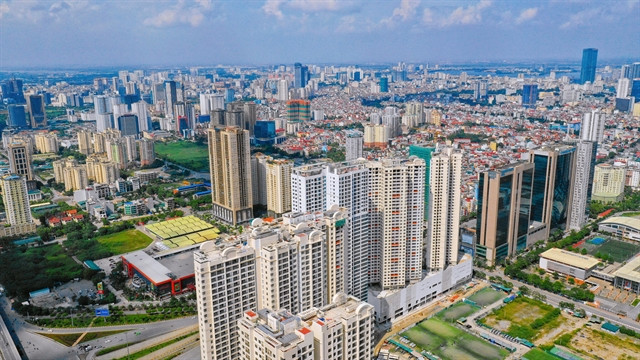
Hanoi (VNS/VNA) - Prices of condominiums in Hanoi are catching up with prices in Ho Chi Minh City in both primary and secondary markets, according to CBRE Vietnam’s report on the capital's real estate market in the first half of this year released on July 9.
In Hanoi’s primary market, the average selling price was about 60 million VND (2,360 USD) per sq.m (excluding VAT and maintenance fees), up by 6.5% quarter on quarter and nearly 25% year on year. That price was only 3 million VND lower than the average price in HCM City.
A large supply of the new high-end condominiums, along with more southern investors, caused the primary price in Hanoi to remain at a high level.
Around 15-20,000 condominiums have been handed over in the past two years, lower than the supply of 30,000-40,000 units in the period 2019-2020, while the demand for housing is constantly increasing. Those factors contributed to driving the primary selling prices up.
In the secondary market, after a period of strong growth in prices in the first quarter, the increase in sale prices in the second quarter slowed down to the growth rate to 5% quarter on quarter and more than 22% year on year.
The average secondary selling price of condominiums in Hanoi was about 38 million VND per sq.m (excluding VAT and maintenance fees). The primary supply becoming more abundant caused the secondary price to enter a more stable cycle.
In HCM City, the selling prices on the primary market continued to increase slightly by 3% quarter on quarter and six% year on year, to about 63 million VND per sq.m.
In the second quarter alone, more than 70% of new supply from two projects from foreign investors located near the city centre, were offered at prices two to three times higher than the average price on the market.
A large number of projects located in the city centre that first came on the market five to seven years ago, also offered a small number of remaining units at double the price they were at launch.
Those factors made the secondary selling price market of Ho Chi Minh City apartments record an increase of 4% quarter on quarter and 3% year on year.
Locations far from the city centre with a large supply of condominiums, also saw on-sale prices increasing by between two to 3% year on year, thanks to them offering more services and completing infrastructure for the projects in the second quarter.
Meanwhile, there was different performance in residential supply in Hanoi and HCM City in the first six months of 2024, especially in the condominium market.
In Hanoi, the new supply in the second quarter increased nearly four times, compared to the previous quarter, reaching about 8,500 condos.
In the first six months of the year, the total supply of new condominiums in Hanoi recorded 10,840 units from 17 projects, the highest six-month figure since 2020 in the city. Most of the new supply was in the west of Hanoi.
Meanwhile in HCM City, only 500 new condominiums were launched in the first quarter and 1,200 units located in the east and south of the city in the second quarter.
Most of the condos offered in the first half of the year were from the next phase of old projects.
Driven by abundant new supply, Hanoi’s condo market recorded a sharp increase in purchasing power, with the number of sold condos in the first half of 2024 exceeding the volume for the whole of 2023.
In the second quarter of 2024, 10,170 units were sold, five times higher than the sale in the previous quarter and the same period last year.
In terms of product types, small-sized apartments with affordable prices, such as studio condos with one bedrooms, recorded good liquidity in the market.
In HCM City, the new supply in the first half was only 40% of the new supply in the same period last year. While, 1,700 condos were sold in the first six months, or 80% of the sales in the same period of last year.
Duong Thuy Dung, managing director of CBRE Vietnam, said supply recovery, higher selling prices and positive liquidity were positive signs of the residential real estate market in the first half of 2024.
In the second half of 2024, signs of the economic recovery and new amended laws such as the Housing Law, Real Estate Business Law, and Land Law effective from August 2024 would contribute to removing legal obstacles and making investor sentiment ever more positive.
However, policies always have a certain lag. Therefore, 2025 would witness a clearer recovery of the housing market, in terms of supply, product quality and selling prices./.

Condo prices maintain an upward trend despite gloomy market
Condominium market prices in both Hanoi and Ho Chi Minh City maintain an upward trend this year, according to CBRE Vietnam.