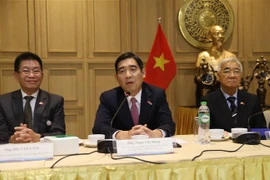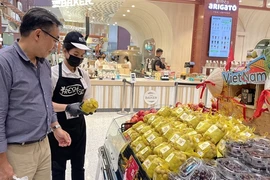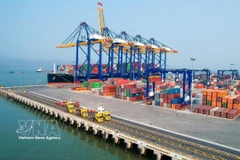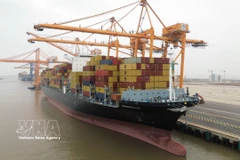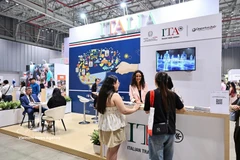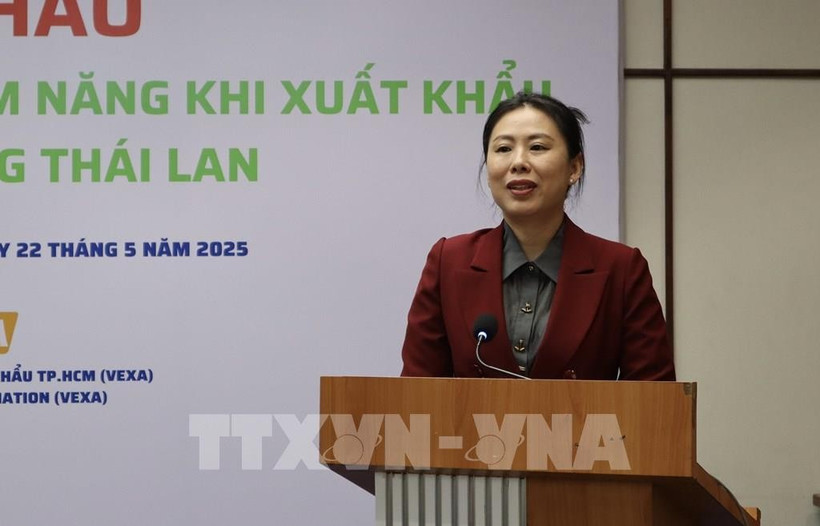
HCM City (VNA) – Understanding Thai consumer preferences and complying with strict regulatory standards will help Vietnamese firms effectively tap this potential market, experts said at a conference held by the Investment & Trade Promotion Centre of Ho Chi Minh City (ITPC) and Central Retail Vietnam on May 22.
ITPC Deputy Director Ho Thi Quyen laid stress on the robust Vietnam – Thailand economic cooperation, becoming a pillar in the strategic partnership between the two countries. With their proximity and convenient transportation links through East-West and Southern economic corridors, both countries have capitalised on their advantages to promote cooperation in trade, investment, and logistics.
Thailand consistently ranks as Vietnam’s top trade partner within ASEAN, while Vietnam is Thailand’s second-largest partner in the region. They have been signatories to various trade agreements, particularly the ASEAN Trade in Goods Agreement (ATIGA) and the Regional Comprehensive Economic Partnership (RCEP), which have helped reduce tariffs while facilitating enterprises’ establishment of supply and production chains as well as third-country market expansion.
Last year, two-way trade topped 20.26 billion USD, up 6.36% year-on-year. Vietnam's exports to Thailand totalled 7.81 billion USD, with key export items including mobile phones and components, machinery and equipment, iron and steel, computers, electronic products, and agricultural products such as fresh fruits, seafood, and coffee. Meanwhile, the country spent 12.45 billion USD on Thai imports, dominated by machinery and equipment, complete automobiles, electronic components, and household appliances. She said 2025 marks a milestone in the bilateral trade ties as the two countries eye to bring the two-way trade to 25 billion USD in a more balanced and sustainable manner. The two Governments are pushing ahead the three-connection strategy, including enhancing supply chain and distribution collaboration, strengthening links between industries, localities, and enterprises, and aligning both nations’ sustainable growth strategies.
Quyen noted that the recent upgrade of bilateral ties to a comprehensive strategic partnership ushers in a new chapter in the Vietnam-Thailand cooperation. With a population of over 70 million and rising purchasing power, Thailand presents a lucrative market for Vietnamese goods. However, Vietnamese businesses must navigate stringent technical barriers, competitive quality standards, and consumer tastes. Besides, they must improve product quality, update market knowledge, and plan sustainable strategies.
From a retailer perspective, head of communications at Central Retail in Vietnam Nguyen Thi Bich Van noted that since 2016, nearly 500 Vietnamese businesses have introduced their products to Thai consumers through the annual Vietnamese Goods Week in Thailand, a joint initiative with the Ministry of Industry and Trade and ITPC. The event has become a key platform for expanding exports and brand visibility. Complementary trade networking efforts have enabled seasonal Vietnamese fruits like lychee, longan, and dragon fruit to enter the Thai market through Central Group’s retail network.
Van also highlighted that during the Thai Prime Minister’s May visit to Vietnam, a strategic cooperation agreement for 2026–2028 was signed between the Vietnamese Ministry of Industry and Trade and Central Group and Central Retail, supporting Vietnamese businesses with international expansion.
Meanwhile, head of CSR & International Corporate Affairs at Central Retail Vietnam Chailermchai Pornsiripiyakool stressed that Vietnamese products with significant consumption potential in the Thai market include seafood, sweet potatoes, dragon fruit, coffee, sauces, and spices.
He underscored the significance of competitive pricing, seasonal promotions, and clear product information to stand out against local and international competitors, adding that labeling in Thai is encouraged to widen market reach.
For exports through Central Retail's distribution system, along with ensuring quality, those with environmentally friendly packaging will be given priority, he stated.
Experts recommended that Vietnamese enterprises study and follow Thailand’s electronic customs procedures. They can choose between direct export and leveraging Thai distributors operating in Vietnam. Entering transnational retail networks like Central Retail not only facilitates access to the Thai market but also serves as a gateway for Vietnamese products to expand globally./.
See more
Hanoi to host Thailand Week 2026 in late January
Visitors to Thailand Week 2026 will be able to enjoy a variety of attractive promotional programmes, lively trade promotion activities and daily lucky draws offering numerous quality Thai products.
Gia Lai province attracts 846 million USD in investment in early January
Industrial projects accounted for the bulk of new investment, with six projects worth nearly 19.8 trillion VND.
Vietnam’s economic rise hailed as proof of Party’s sound leadership
Sustaining broad-based consultations and listening to views from all walks of life, particularly those directly creating value, will be key to Vietnam’s even greater success, said an official of Germany’s Left Party.
AirAsia to launch Bali – Da Nang route
Operated exclusively by AirAsia, the new route is aimed at strengthening tourism connectivity across Southeast Asia.
German media group releases Vietnam outlook report 2026
The Germany-based international media group specialising in economic, financial and political coverage of emerging markets IntelliNews on January 11 published its annual Vietnam Outlook report 2026, highlighting prospects for economic growth and what problems lie in store.
Vietnam, Singapore enhance cooperation in IFC development
Permanent Deputy PM Nguyen Hoa Binh noted that as Singapore is a seasoned player in this field, the delegation wishes to learn its experience to support Vietnam’s IFC development.
PM pushes five strategic breakthroughs to fuel digital economy
Addressing the first meeting of the National Steering Committee on Data linked virtually with all 34 cities and provinces nationwide, PM Pham Minh Chinh, who is also head of the committee, stressed that the Party’s policies and guidelines and the State’s laws have long articulated a strategic vision for data development. He cited Resolution No. 57-NQ/TW and the recently enacted Law on Data, both of which designate data as a “new means of production” and a strategic resource that must be transformed into high-value assets.
Central bank aims for 15% credit growth in 2026
In 2026, monetary policy will continue to be implemented in a proactive, flexible, timely and effective manner to help stabilise the macroeconomy, keep inflation under control, support economic growth and advance the restructuring of banks under compulsory transfer.
Vietnamese business associations strengthen links across Europe’s key hubs
The closer coordination between the Vietnamese Business and Entrepreneurs Association in the UK (VBUK) and the Vietnam Business Association in Belgium (VBAB) would help enhance the standing of the Vietnamese business community in Europe.
Vietnam emerges as bright spot of growth, trusted and responsible partner
Despite a volatile global environment, Vietnam recorded solid gains in 2025. With flexible and proactive policies under the leadership of the Communist Party of Vietnam and the Government, all 15 key socio-economic targets were met or exceeded, while GDP expanded by about 8.02%, surpassing expectations.
Da Nang builds halal-friendly destination to tap into fast-growing market
In 2025, Da Nang implemented targeted promotion campaigns to attract Muslim travellers from Indonesia, Malaysia, CIS countries and the Middle East, welcoming more than 617,000 visitors from these markets, supported by newly opened direct and charter air routes.
CIS: Opportunity for game developers in Vietnam
The CIS region, which includes Eastern Europe and Central Asia, has potential for gaming developers from Vietnam as this market displays user behaviour patterns that are highly favourable for mobile gaming growth, particularly around major holiday periods.
Reference exchange rate down 2 VND at week’s beginning
With the current trading band of +/- 5%, the ceiling rate applicable for commercial banks during the day is 26,385 VND/USD, and the floor rate 23,873 VND/USD.
Financial scams surge ahead of Tet
As the Lunar New Year (Tet) approaches, financial and banking scams in Vietnam are showing a sharp upward trend, prompting banks and law enforcement agencies to issue repeated warnings.
Vietnam exports over 8 million tonnes of rice, earning 4.1 billion USD in 2025
Vietnam exported more than 8.06 million tonnes of rice in 2025, earning over 4.1 billion USD.
VASEP forecasts pangasius exports to hit 2.3 billion USD this year
VASEP forecasts that pangasius export turnover could reach around 2.3 billion USD in 2026, supported by tightening global whitefish supplies and improving demand in several key markets.
Hai Phong city targets 4.3 billion USD in FDI in 2026
Hai Phong’s investment appeal is underpinned by a rapidly expanding development space, including the Southern Coastal Economic Zone covering more than 20,000 hectares, a planned free trade zone, deep-water ports at Lach Huyen, and 12 industrial parks newly established in 2025.
Vietjet shifts domestic check-in at Tan Son Nhat from January 13
During the recent New Year 2026 holiday peak, Vietjet added 380 flights, equivalent to nearly 78,000 additional seats, on many key domestic routes linking Hanoi and Ho Chi Minh City with destinations such as Vinh, Thanh Hoa, Hai Phong, Da Nang, Phu Quoc, Nha Trang and Da Lat.
Capital sources expanded for sustainable growth
According to the State Bank of Vietnam (SBV), by the end of November 2025, outstanding green credit was estimated at around 750 trillion VND (28.55 billion USD), with an average growth rate exceeding that of overall credit in the economy.
Traceability emerges as protective shield for Vietnam’s exports
Traceability data are evolving into a critical layer of protection, helping exporters reduce tariff risks, shorten inspection times and strengthen proof of origin, thereby avoiding exclusion from formal distribution networks.