Cuba seeks further Vietnamese investment to push economic recovery

At a meeting with Ho Chi Minh City enterprises on October 3, President of the National Assembly of People’s Power and President of the Council of the State of Cuba Esteban Lazo Hernández stressed that Vietnam is not only a crucial partner in Asia but also one of leading investors of Cuba.

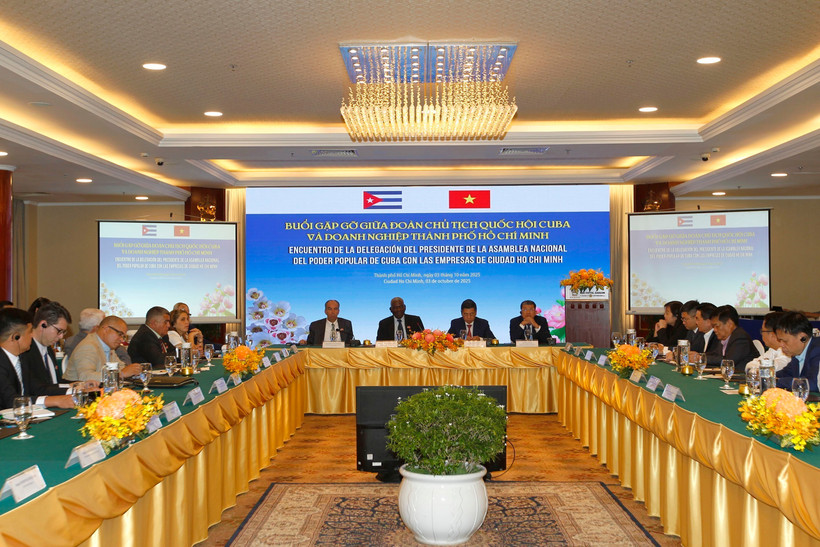
President of the National Assembly of People’s Power and President of the Council of the State of Cuba Esteban Lazo Hernández has a meeting with Ho Chi Minh City enterprises on October 3. (Photo: VNA)

HCM City (VNA) - Cuba has called on Vietnamese businesses to expand investment in areas where Vietnam boasts strengths and the Caribbean country has demand, such as agriculture, food processing, pharmaceuticals, tourism, and technology, as part of its 2025–2030 economic and social development strategy, with a view to revitalising production and overcoming longstanding difficulties.

At a meeting with Ho Chi Minh City enterprises on October 3, President of the National Assembly of People’s Power and President of the Council of the State of Cuba Esteban Lazo Hernández stressed that Vietnam is not only a crucial partner in Asia but also one of leading investors of Cuba, which has suffered severe losses and is grappling with formidable challenges due to prolonged sanctions.

Against the backdrop, Havana has introduced a series of measures beyond existing legal frameworks, designed to attract Vietnamese projects that could help stabilise its economy through 2030, particularly in finance, capital provision, and foreign currency liquidity.

The Cuban Government is working to remove bottlenecks for Vietnamese firms, with cumbersome administrative procedures to be handled in the coming time to support the investment process, he said.
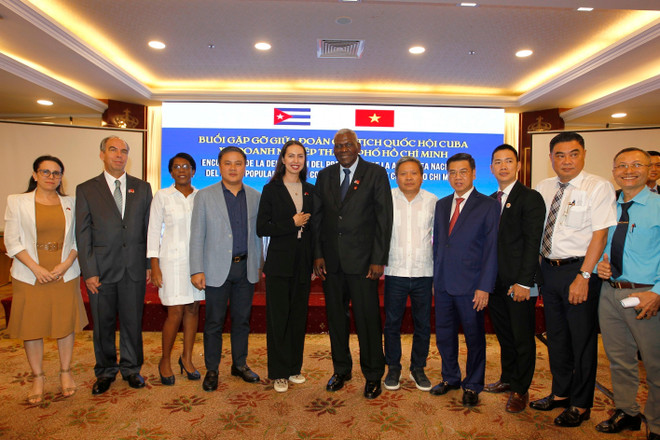
vna-potal-chu-tich-quoc-hoi-cuba-gap-go-doanh-nghiep-thanh-pho-ho-chi-minh-8314944.jpg
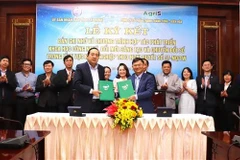
President of the National Assembly of People’s Power and President of the Council of the State of Cuba Esteban Lazo Hernández (sixth from right) and representatives from HCM City enterprises (Photo: VNA)

He laid stress on the Vietnam–Cuba rice cultivation pilot project, which now covers more than 1,000 hectares using Vietnamese seeds, inputs, and farming techniques, achieving yields of 7.3 tonnes per hectare. Cuba hopes to expand this model nationwide to strengthen food security.

Local authorities have already granted free land-use rights for agricultural production, with vast idle farmland available for Vietnamese enterprises, he said, adding investments in other crops for animal feed production and fertilisers are being encouraged, with potential to serve both domestic demand and export to other markets across the Caribbean and Latin America.

According to the Cuban top legislator, other potential areas for cooperation include biotechnology, health care, telecommunications, construction, advanced technology, and digital transformation. Cuba is facilitating investment in realty sector and developing a rational exchange system to support business activities. Cuba is particularly keen to learn from Vietnam’s household solar power projects to advance its clean energy transition.

Vice Chairman of the HCM City People’s Committee Nguyen Van Dung said that Cuba’s strategic location could serve as a gateway for Vietnamese goods into Latin America. At the same time, Cuba is improving its investment environment, offering incentives, and opening space for private-sector cooperation. However, he acknowledged that challenges remain, from legal procedures and payment systems to infrastructure and global market volatility. For this reason, he said, the role of investment promotion agencies is critical in supporting enterprises and ensuring the effective and sustainable operation of projects.

HCM City stands ready to act as a bridge to help businesses from both sides access information, share experience, and concretise cooperation plans. With strong political will from leaders, the dynamism of the enterprises, and the enduring friendship between the two peoples, the economic ties between Vietnam and Cuba are poised for robust growth, Dung expressed his confidence.

With nearly three decades of investing in Cuba, Chairman of Thai Binh Corporation Tran Thanh Tu said what drew him to make a long-term investment in Cuba stems from the affection the Cuban people hold for Vietnam. Coupled with Cuba’s ongoing reforms and incentives, it is the time for Vietnamese businesses to seize the opportunity, deepen their presence in Cuba, and use it as a springboard into the wider South American market, he added./.
VNA

See more

Key export sectors such as textiles – garments, footwear and furniture, along with many signature products of Da Nang, have strong potential to expand their markets through online export channels. (Photo: VNA)

Da Nang seeks to boost online exports

To help businesses go global, Da Nang is shifting from supporting individual online activities to developing an integrated ecosystem covering products, branding, platforms, payments, logistics, legal issues and market information. This is also part of the city’s e-commerce development orientation for 2026-2030, which identifies e-commerce as an important component of the digital economy.

Deputy Minister of Foreign Affairs Le Thi Thu Hang receives Rolf Mutzenich, a member of the Foreign Affairs Committee of the German Bundestag, in Hanoi on August 18. (Photo: baoquocte.vn)

Vietnam welcomes German firms’ expansion

Vietnam welcomes and stands ready to create favourable conditions for German businesses to expand their investment and operations in the country, particularly in infrastructure, smart seaports, renewable energy, high-speed railways, science and technology, and high-quality human resource training.

Khanh Hoa province has the largest sheep population in Vietnam, with around 100,000 individuals. (Photo: VNA)

Khanh Hoa province explores Halal ecosystem development

Khanh Hoa aims to estabish itself as a Halal-friendly destination while supporting businesses in expanding export markets, attracting strategic partners and investors, and drawing projects from countries with strong Halal logistics, tourism, manufacturing, processing and agriculture sectors.

The proportion of Vietnamese goods remains high at supermarkets. (Photo: VNA)

Vietnamese brands win over domestic consumers to go global

Amid increasingly fierce global competition, the goal is no longer simply to increase domestic consumption of Vietnamese goods, but to develop strong Vietnamese brands capable of winning consumers through quality, innovation and added value, thereby creating a stepping stone for expansion into international markets.

Illustrative image (Photo: VNA)

Automated VAT refunds to be rolled out from December

As of August 11, VAT refunds rose 32% from a year earlier, reaching 64.4% of the full-year estimate. Tax authorities issued 11,627 refund decisions totaling 111.726 trillion VND (4.26 billion USD), up 9% by volume. The payouts improved cash flow for companies and supported production, trade and exports.

ST25 rice is the centrepiece of the Vietnam Goods Week at Selgros. (Photo: VNA)

ST25 rice officially enters Selgros wholesale supermarket chain in Germany

The placement of ST25 rice on Selgros shelves not only creates an additional opportunity for German consumers to access Vietnamese rice products, but also contributes to efforts to increase the added value of Vietnamese agricultural products by shifting the focus from volume to quality, branding and value.

Trains on the elevated section of the Cau Giay – Nhon route in Hanoi provide convenient transportation for local residents. (Photo: VNA)

Multimodal connectivity to drive Vietnam’s transport infrastructure

Under the proposed approach, roads would serve mainly as connectors and for first- and last-mile transport; railways would handle large volumes over long distances; maritime transport would serve import and export cargo; inland waterways would carry large volumes at low cost; and air transport would focus on fast delivery and high-value goods.

Amata Industrial Park in Dong Nai city (Photo: VNA)

Green shift powers investment in southeast Vietnam

The Amata Industrial Park in Dong Nai City, established 32 years ago and covering more than 500ha, is home to over 160 domestic and foreign businesses. Selected in 2020 as one of three national pilot sites for conversion into an eco-industrial park, Amata has raised its compliance with the international eco-industrial park framework from 41% to 86% in 2024, and is working towards becoming Dong Nai's first certified eco-industrial park.

At a port in Ho Chi Minh City (Photo: VNA)

Multi-channel capital mobilisation needed to achieve double-digit growth

The Ministry of Finance estimates development investment for 2026-2030 at a minimum of 38.5 quadrillion VND (1.48 trillion USD), or about 40% of GDP. The state budget is expected to provide only about 20%, or more than 7.7 quadrillion VND, leaving over 80%, or more than 30 quadrillion VND, to be raised from the broader economy. That makes expanding capital mobilisation channels beyond bank credit essential.

An aerial view of the Nhieu Loc – Thi Nghe area in Ho Chi Minh City. The southern metropolis is home to the Vietnam International Financial Centre. (Photo: VNA)

Vietnam International Financial Centre launches membership registration system

Integrated into the official Vietnam International Financial Centre portal at vifc.gov.vn, the online system for registering and recognising members provides a unified online service channel through which investors, organisations and businesses can complete procedures related to membership, from new registration and recognition to information updates and termination of membership.