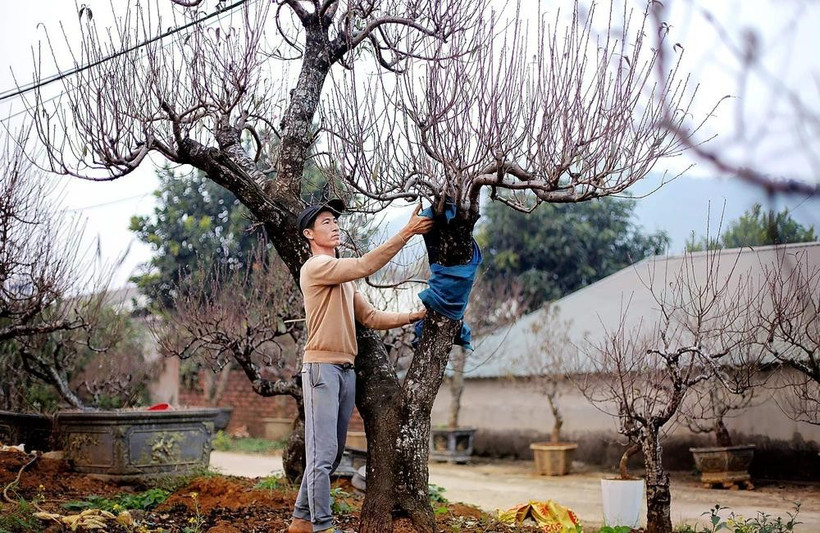
Phu Tho (VNA) – As the Lunar New Year (Tet) – the Year of the Horse approaches, peach growers in Da Bac commune, Phu Tho province, are busy tending and preparing distinctive peach trees for the Tet market.
Long renowned for their natural form, durable blossoms and harmonious colours, Da Bac’s ancient ornamental peach trees are increasingly favoured by traders and flower enthusiasts alike.
As each tree can be priced from several million to tens of millions of Vietnamese dong per tree, peach farming provides growers with a substantial source of income. Thanks to peach cultivation, many households have improved their livelihoods, reinvested in production, and contributed to agricultural development and sustainable new rural construction in the locality.
Ancient Da Bac peach trees possess unique characteristics that set them apart from those grown elsewhere. Most notable is their age: many trees are decades, even centuries old, with rugged trunks and moss-covered bark that reflect the passage of time and the cultural depth of the highlands. Equally appealing is their natural form. Rather than being elaborately trained, the trees grow in harmony with the mountainous terrain, creating distinctive shapes such as upright, cascading, dragon-descending or parent-and-child forms. Each tree is considered a unique “work of art”, admired for its rustic, untouched beauty.
The blossoms typically range from pale to deep pink, with thick petals that bloom evenly and last long, making them ideal for Tet display. The area’s cool climate and large day–night temperature variation help prolong flowering, allowing the trees to retain their fresh colours throughout the holiday. Beyond aesthetics, ancient Da Bac peach trees are closely linked to the cultural life of local ethnic communities, symbolising spring and wishes for future prosperity.
Thanh Tu Peach Garden now has more than 100 ancient trees, with prices ranging from 2–10 million VND (76- 380 USD) per tree, while particularly old specimens can fetch 20–30 million VND.
According to the garden owner Tran Thien Tu, pruning, shaping and regulating flowering at around 20 degrees celsius are the most crucial stages, with leaves stripped about 60 days before Tet to ensure timely blooming.
Meanwhile, Do Van Thinh, another garden owner, noted growing demand in recent years, particularly in the mid-range market segment.
Alongside expanding supply, growers are promoting products via social media platforms such as Facebook, Zalo and TikTok, while Tet peach tree rental services are also gaining popularity. Dao Duc Kien, Vice Chairman of the People's Committee of Da Bac commune, said that in recent years, Da Bac has developed into a concentrated peach-growing area with over 20 large gardens and more than 5,000 trees.
Growing peach trees for Tet has become a thriving seasonal economy that is steadily improving local living standards, he said./.
Nhat Tan peach blossom festival celebrates capital’s traditional craft
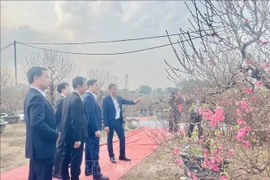
Nhat Tan is among the oldest craft villages of ancient Thang Long–Hanoi. Since the Le Dynasty, the village has been renowned for flower cultivation, with peach trees at its heart thanks to fertile alluvial soil along the Red River and the distinctive microclimate around West Lake.