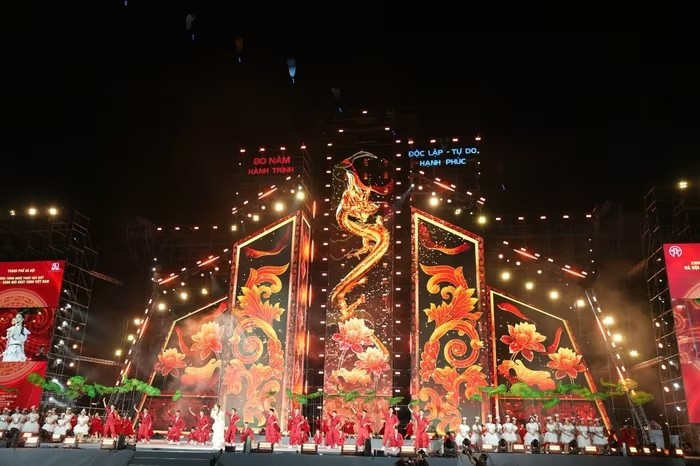
Hanoi (VNA) – The 2021–2025 period marked a turning point for Vietnam’s cultural industries as film, music, cultural tourism and video games surged into a new era of scale and sophistication, delivering billions of US dollars in revenue and while projecting a more confident, compelling vision of Vietnamese soft power to the world.
Economic impact and soft power gains
Over the past five years, Vietnam’s cultural industries have posted strong gains. According to the Ministry of Culture, Sports and Tourism’s review for the 2021–2025 term, average annual production value averaged 1.059 quadrillion VND (44 billion USD). The number of cultural businesses expanded at an annual rate of 7.2%, while employment in the sector grew 7.4% per year.
Cinema, in particular, staged a standout performance, moving beyond post-pandemic recovery into a phase of surging revenues and broader genre appeal. Domestic films shattered box-office records, with multiple titles surpassing 100 billion VND in ticket sales, including Mai, Detective Kien: The Headless Horror, Dia dao: Mat troi trong bong toi (Tunnel: Sun in the dark), and Tu chien tren khong (Hijacked). Towering above them all was the revolutionary war epic Mua Do (Red Rain), which amassed nearly 800 billion VND, the highest gross for a Vietnamese film to date, underscoring the commercial credibility of both state-backed and private productions. Elevated technical standards and refined storytelling brought local cinema closer to international benchmarks, transforming it into one of the country’s most competitive creative industries.
Vietnamese music, meanwhile, matured into a spearhead sector with export potential and tangible influence on cultural branding and music tourism. A professional ecosystem took shape around digital streaming and licensed platforms, shifting audiences decisively toward paid consumption. Reality hits such as Anh Trai Say Hi (Say Hi Never Say Goodbye) and Anh Trai Vuot Ngan Chong Gai (Call Me By Fire Vietnam) defined contemporary tastes, blending heritage with modern flair while nurturing a new generation of versatile performers. Stadium-scale outdoor concerts, drawing tens of thousands of fans, showcased world-class event management and the growing spending power of domestic audiences.
This creative momentum was reinforced at policy level. The Government rolled out the Cultural Development Strategy for 2021–2025 with a vision to 2030, the Strategy for Cultural Industry Development to 2030 with a vision to 2045, and the National Assembly approved the National Target Programme on Cultural Development for 2025–2035. These moves signal an unequivocal commitment to positioning culture as a core driver of sustainable growth.
Turning potential into “soft power”
Looking ahead, the draft Political Report of the 14th National Party Congress sets a clear course toward a new growth model, highlighting “cultural industries and heritage economy” and calling for an accelerated expansion of cultural industries and services to meet rising public demand.
Prof. Tu Thi Loan, Chairwoman of the Vietnam Community Cultural Development Association and former Acting Director General of the Vietnam Institute of Culture and Arts Studies, advocated for the creation of dedicated cultural industry hubs, creative clusters and cultural technology zones tailored to regional strengths and local identities. She also urged deeper integration of sci-tech and digital tools across content creation, marketing and distribution; wider domestic and international market access, stronger State facilitation of business-artist linkages, support for cultural start-ups, and branding of flagship products, from film, music, to fashion, handicrafts, cuisine, video games and digital content.
Dr. Nguyen Thi Thu Ha, Director of the Centre for Cultural Industries and Contemporary Arts at the Vietnam Institute of Culture, Arts, Sports and Tourism, stressed the need to refine institutional and policy frameworks to better match real-world conditions and sector potential. The State should lead by investing in infrastructure, funding creative activities, bolstering intellectual property protection and pooling resources for broader cultural advancement./.