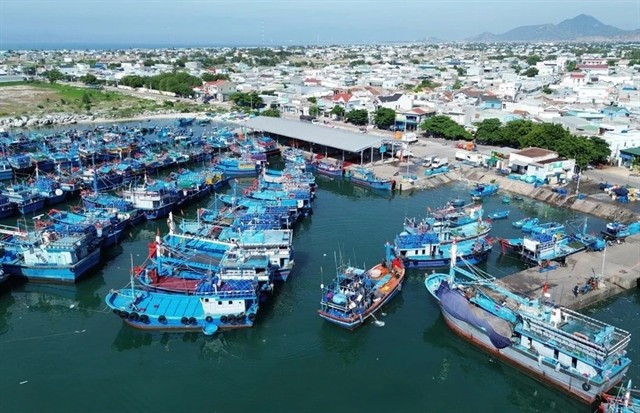
Hanoi (VNS/VNA) - Deputy Prime Minister Tran Hong Ha has stressed the need for a clear vision for how to grow the marine economy, with a drive to implement many more projects already defined under the strategic plan.
He made the comments as he chaired a meeting with ministries and agencies on inter-sectoral coordination mechanisms for the sustainable development of Vietnam's maritime sector.
Ha emphasised that an effective inter-sectoral, inter-regional and international coordination mechanism is a prerequisite for achieving sustainable marine economic development. Such a mechanism, he noted, forms the foundation for integrated resource management, conflict resolution and optimal decision-making among competing marine sectors.
“The key objective is to identify priorities, what issues require inter-sectoral, inter-regional, inter-provincial or even international coordination. Without clarity, we risk having to coordinate everything, which leads to overload, technical and financial inefficiencies, and hampers development,” he said.
He stressed that the coordination mechanism must follow the principle of decentralisation, only issues that truly require central-level coordination should be retained at the national level, with the rest delegated to local bodies.
He assigned the Ministry of Agriculture and Environment (MoAE) to take the lead, in collaboration with relevant ministries and agencies, in researching and proposing mechanisms to resolve development conflicts. These should prioritise criteria such as environmental efficiency, economic viability and job creation. The ministry was also tasked with developing decision-support tools for analysing and handling inter-sectoral conflicts, and establishing a coordination mechanism for marine environmental surveys and resource assessments to support the implementation of marine economic strategies and plans.
The MoAE was also urged to urgently review and finalise the operating regulations and scope of the National Steering Committee for the Implementation of the Strategy for Sustainable Marine Economic Development.
The committee should focus on resolving inter-provincial and inter-regional conflicts, national priority projects, and internationally relevant issues such as implementing international agreements, marine scientific research and addressing transboundary or large-scale marine environmental incidents.
According to a report presented by the MoAE, seven years after the launch of the Strategy for Sustainable Marine Economic Development of Vietnam to 2030, with a vision to 2045, key marine economic sectors, including marine tourism and services, maritime economy, oil and gas, fisheries, renewable energy, and emerging sectors, have made encouraging progress.
However, the implementation of specific tasks under the strategy remains behind schedule.
Of the 169 projects and tasks assigned by the Government to ministries and 28 coastal provinces and cities, only 35 are currently underway, accounting for just 20.7%. This shortfall has significantly impacted the overall progress and objectives of the national marine strategy.
Ministries, sectors, and local departments said they have encountered difficulties due to limited data sharing, coordination and reference to related materials. This has resulted in delayed implementation, duplicated efforts, and a failure to build on the outcomes of related projects, wasting public funds.
As numerous marine spatial and resource planning documents have now been approved, such as the National Marine Spatial Plan and the Master Plan for Coastal Zone Exploitation, the need for a cohesive and effective inter-agency coordination mechanism has become increasingly urgent. The marine environment, characterised by overlapping economic activities, demands a robust inter-sectoral mechanism to handle emerging cross-sectoral and cross-regional issues in implementing the strategy.
At the meeting, leaders and representatives from the ministries of Foreign Affairs, National Defence, Justice, Finance, and Industry and Trade agreed that the creation of an inter-sectoral coordination mechanism aligns not only with Vietnam’s marine economic development strategy but also with international trends, as many ASEAN and global partners have implemented similar models.
They stressed the need to build on and improve existing coordination frameworks, avoid introducing unnecessary new procedures, and review the operations and budget of the National Steering Committee to enhance the efficiency of sustainable marine economic development./.
See more
Vietnam exports over 8 million tonnes of rice, earning 4.1 billion USD in 2025
Vietnam exported more than 8.06 million tonnes of rice in 2025, earning over 4.1 billion USD.
VASEP forecasts pangasius exports to hit 2.3 billion USD this year
VASEP forecasts that pangasius export turnover could reach around 2.3 billion USD in 2026, supported by tightening global whitefish supplies and improving demand in several key markets.
Hai Phong city targets 4.3 billion USD in FDI in 2026
Hai Phong’s investment appeal is underpinned by a rapidly expanding development space, including the Southern Coastal Economic Zone covering more than 20,000 hectares, a planned free trade zone, deep-water ports at Lach Huyen, and 12 industrial parks newly established in 2025.
Vietjet shifts domestic check-in at Tan Son Nhat from January 13
During the recent New Year 2026 holiday peak, Vietjet added 380 flights, equivalent to nearly 78,000 additional seats, on many key domestic routes linking Hanoi and Ho Chi Minh City with destinations such as Vinh, Thanh Hoa, Hai Phong, Da Nang, Phu Quoc, Nha Trang and Da Lat.
Capital sources expanded for sustainable growth
According to the State Bank of Vietnam (SBV), by the end of November 2025, outstanding green credit was estimated at around 750 trillion VND (28.55 billion USD), with an average growth rate exceeding that of overall credit in the economy.
Traceability emerges as protective shield for Vietnam’s exports
Traceability data are evolving into a critical layer of protection, helping exporters reduce tariff risks, shorten inspection times and strengthen proof of origin, thereby avoiding exclusion from formal distribution networks.
Retail market expands sharply, sustainability challenges persist
According to a report on recently released by the Ministry of Industry and Trade’s Agency for Domestic Market Surveillance and Development, the size of the market reached more than 7 quadrillion VND (about 266 billion USD) in 2025, up around 10% compared with 2024.
Vietnam eyes Israel as promising rice market under free trade deal
The Vietnam - Israel Free Trade Agreement (VIFTA), which took effect in late 2024, is poised to provide a fresh boost to agricultural exports, with rice at the forefront.
Resolution 79: State economy to lead growth
Resolution 79 is described as a “clear action declaration” by the Politburo, saying the state economy is not only responsible for maintaining macroeconomic stability, but must also become the force leading a new growth model that is green and sustainable.
Vietnam leverages export advantages within RCEP region
In 2025, seafood exports to China alone exceeded 2.2 billion USD, up about 33% compared to 2024. Shipments to Japan fetched nearly 1.7 billion USD, a year-on-year increase of 14.6%, while those to the Republic of Korea and Australia grew by 9.6% and 3.2%, respectively.
Da Nang continues targeted investment promotion approaches
According to Chairman of the Da Nang People’s Committee Pham Duc An, the city prioritises building sustainable economic ecosystems and focuses on key breakthrough sectors with strong spillover effects, including high technology and digital transformation, logistics, urban infrastructure, finance, processing and manufacturing industries, high-tech agriculture, and the pharmaceutical and medicinal herb industry.
📝OP-ED: Resolution 79 – Launchpad for national aspirations
Resolution 79 is not only about SOEs. At a deeper level, it is about how Vietnam reorganises its development drivers in a world that is changing at breakneck speed.
UOB raises Vietnam’s 2026 GDP growth forecast to 7.5%
In 2025, Vietnam’s GDP grew by 8%, beating UOB’s forecast of 7.7% but still falling short of the Government’s target of 8.3–8.5%, which would have needed an extraordinary boost in the final quarter.
Reference exchange rate up 4 VND on January 10
With the current trading band of +/- 5%, the ceiling rate applicable for commercial banks during the day is 26,388 VND/USD, and the floor rate 23,874 VND/USD.
Infrastructure key to unlocking tourism’s role in double-digit growth target
With transport links running smoothly, urban infrastructure upgraded and digital platforms built out in a more systematic way, tourism would move beyond a purely consumption-driven sector to become a deeper, more durable engine of growth.
Hyundai sales in Vietnam rise almost 23% in December
In 2025, sales reached 53,229 vehicles across the market, a result considered a testament to the efforts by TC Group, Hyundai Thanh Cong, and the entire Hyundai dealership network nationwide amidst a volatile market.
Da Nang approves plan key infrastructure developers at FTZ
The Da Nang FTZ is expected to contribute 17.9% to the city’s gross regional domestic product and create 127,000 jobs by 2040, with total investment needs estimated at 40 trillion VND (1.6 billion USD).
HCM City accelerates shift toward ecological urban agriculture
The city’s agricultural sector is undergoing a strong transformation, restructuring toward higher value-added and sustainable development. In recent years, the sector has maintained steady growth, with agricultural, forestry and fisheries output rising by an estimated 2.5% annually.
Vietnam records biggest trade surplus with Netherlands among European partners
Vietnam’s exports to the Netherlands totalled 13.5 billion USD last year, up 3.7% compared to 2024, while imports stood at 825 million USD, rising 5.2%.
Footwear-leather industry seeks new drivers to sustain growth
Vietnam currently ranks third globally in footwear production, with around 1.4 billion pairs manufactured annually, behind China and India, and second in exports with approximately 1.3 billion pairs a year.