Deputy PM requires efforts to maintain exchange rate, boost economic growth

It is important to exercise strict oversight to maintain the stability of the banking system and continuously monitor and assess restructured credit institutions as well as potentially weak banks in order to implement timely and effective solutions, said Deputy Prime Minister Ho Duc Phoc.

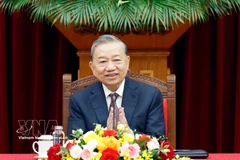
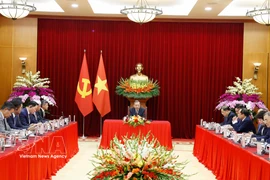
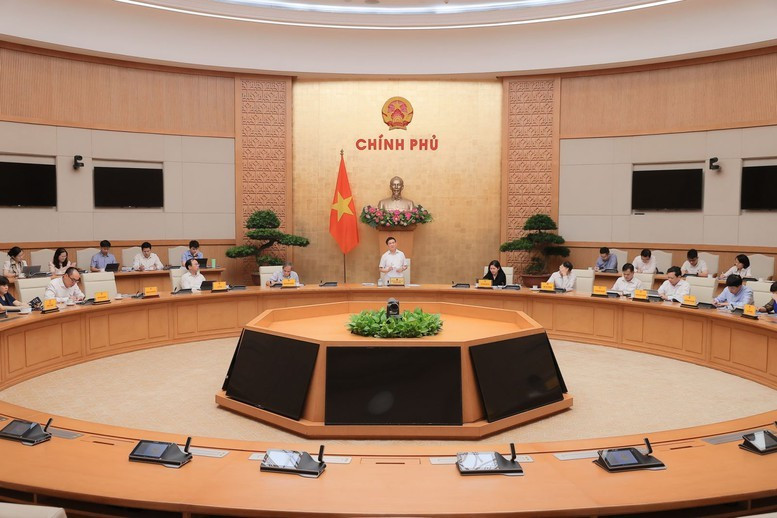
Deputy Prime Minister Ho Duc Phoc speaks at the meeting of the steering committee for the restructuring of credit institutions and handling bad debts (Photo: VNA)

Hanoi (VNA) - Deputy Prime Minister Ho Duc Phoc on August 1 emphasised the importance of effectively managing monetary policy, maintaining macroeconomic stability, curbing inflation, stabilising the exchange rate, and promoting economic growth.

Chairing a meeting of the steering committee for the restructuring of credit institutions and handling bad debts, the Deputy PM said that the steering committee has implemented the restructuring of credit institutions, with four banks successfully transformed. The restructuring of the Sai Gon Joint Stock Commercial Bank (SCB) is currently underway.

Appreciating the opinions and recommendations of representatives from relevant ministries and agencies, he requested the State Bank of Vietnam to incorporate the feedback and finalise a report to continue implementing effective measures for managing the operations of credit institutions in the time ahead.

It is important to exercise strict oversight to maintain the stability of the banking system and continuously monitor and assess restructured credit institutions as well as potentially weak banks in order to implement timely and effective solutions.
ho-duc-phoc-2.jpg
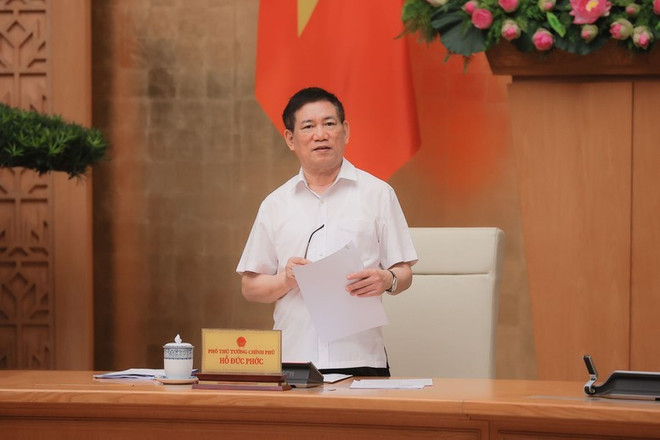
Deputy Prime Minister Ho Duc Phoc (Photo: VNA)

Emphasising the need for a harmonious, balanced, and synchronised combination of monetary and fiscal policies, Phoc also highlighted the importance of accelerating digital transformation in payment activities, ensuring the effective implementation of monetary policy, and securing capital supply for production and business. He emphasised the need to manage the foreign exchange market effectively, maintain the stability of the exchange rate against the US dollar, and propose solutions for issuing bonds in the US dollar.

Regarding credit growth limits (credit room), the Deputy PM emphasised that while this remains a necessary short-term management tool, increasing credit room is essential in the current context.

For banks operating efficiently, the credit room should be expanded to increase capital flow into the economy, he noted.

In addition, it is important to design and effectively implement preferential credit packages, such as loans for social housing and poverty reduction, while closely managing cash flows and directing credit towards production and business activities, thereby promoting rapid and sustainable economic development, Phoc stated.

He also called for more focused banking inspections and supervision, effective prevention of cross-ownership, and strong, decisive efforts to resolve bad debts./.
VNA

See more

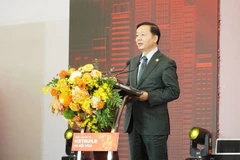
Officials visit a booth at the festival. (Photo: VNA)

Vietnam OCOP Festival 2025 opens in Hanoi

The festival functions as a space to bring together regional OCOP excellence, a forum connecting OCOP stakeholders with distributors, investors, experts and consumers, and a platform to spread pride in indigenous culture, local knowledge, and the aspiration for legitimate prosperity.

Prime Minister Pham Minh Chinh (third from right) and officials launch the Ministry of Construction’s new information technology systems at the conference on December 21. (Photo: VNA)

Modern, comprehensive infrastructure – a need for fast, sustainable development: PM

The Party and State continue to define infrastructure development as one of the three strategic breakthroughs, with priority given to building comprehensive and modern infrastructure, particularly transport facilities, technological infrastructure, and green – digital transition infrastructure, to help realise the national target of double-digit growth, the PM said.

Prime Minister Pham Minh Chinh addresses he third meeting of the National Steering Committee implementing the Politburo’s Resolution 68 in Hanoi on December 20. (Photo: VNA)

PM pushes trust, breakthroughs to accelerate private sector growth

Prime Minister Pham Minh Chinh noted that since the rollout of Resolution 68, alongside supporting resolutions from the National Assembly (NA) and Government, there has been a marked change in understanding the private sector’s critical position and role in Vietnam’s socialist-oriented market economy.

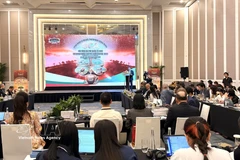
PM Pham Minh Chinh chairs the meeting (Photo: VNA)

Private sector thrives eight months after Resolution 68’s launch: PM

The private sector has shown marked progress eight months after the launch of Resolution 68, registering about 18,000 new enterprises monthly and pushing the nationwide total to nearly 1.1 million, Prime Minister Pham Minh Chinh told the third meeting of the National Steering Committee in Hanoi on December 20.

Phin Ho Tra – a national five-star OCOP product. (Illustrative photo: VNA)

Hanoi to host Vietnam OCOP Festival 2025

The festival is seen a practical activity celebrating the achievements made by the capital and the country in 2025, affirming OCOP’s role in rural economic development, contributing to realising Vietnam’s aspiration for strong economic growth in the context of deep integration.

The expanded Hoa Binh Hydropower Plant (Photo baochinhphu.vn)

EVN launches major power projects

Among the flagship projects inaugurated was the expanded Hoa Binh Hydropower Plant with a total installed capacity of 480MW per year and average annual output of about 488 million kWh.

An ultra-intensive shrimp farming model linked with environmental protection in Ca Mau province. (Photo: VNA)

Fisheries take the lead in the Mekong Delta’s green transition

Across the Mekong Delta, leading aquaculture producers, processors and exporters, along with suppliers of inputs, are transitioning to circular, high-tech and clean production models that cut greenhouse gas emissions and comply with international certification standards.