Diplomacy in Ho Chi Minh Era: 80 years of devotion to nation

Over the past 80 years, Vietnam’s diplomacy, shaped by the vision of President Ho Chi Minh and guided by the principles of the Communist Party of Vietnam (CPV), has remained committed to serving the country and its people.

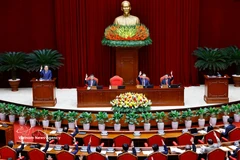
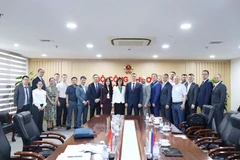
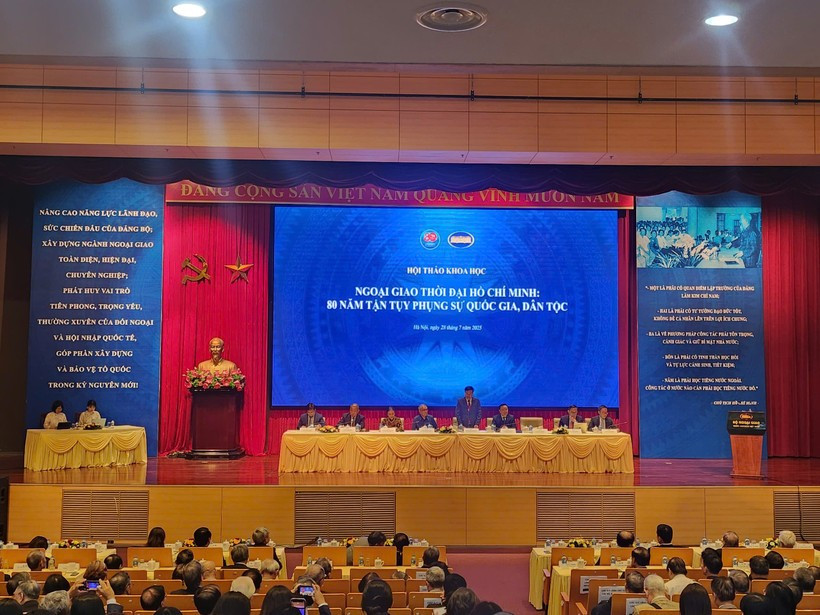
Scientific seminar “Diplomacy in the Ho Chi Minh Era: 80 Years of Devoted Service to the Nation. (Photo: VietnamPlus)

Hanoi (VNA) - Over the past 80 years, Vietnam’s diplomacy, shaped by the vision of President Ho Chi Minh and guided by the principles of the Communist Party of Vietnam (CPV), has remained committed to serving the country and its people.

The sector has played a pivotal role in many of the nation’s most important achievements, from securing independence to building Vietnam’s place on the global stage.

In the eyes of the international community today, Vietnam is no longer a peripheral player but a middle power with growing influence in ASEAN and across the wider region. The country’s voice is increasingly heard in addressing shared challenges of the global community.
lienxo.jpg
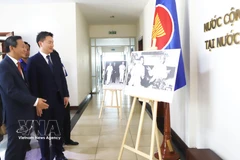
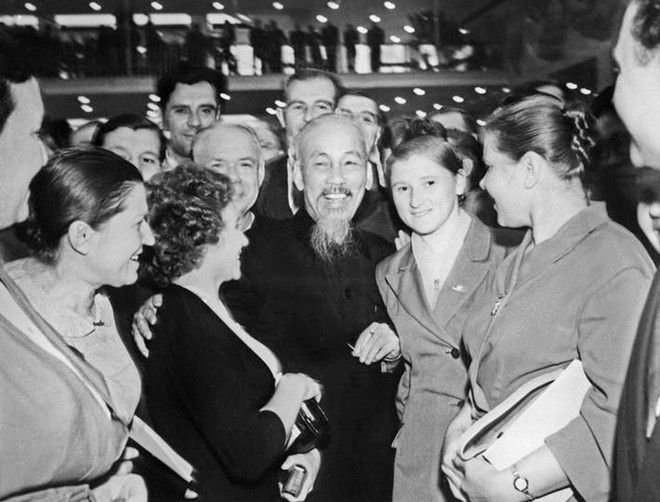
President Ho Chi Minh with Soviet and international delegates attending the 22nd Congress of the Communist Party of the Soviet Union, October 1961. (Photo: VNA)

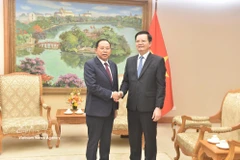
These views were echoed during a scientific symposium titled “Diplomacy in the Ho Chi Minh Era: 80 Years of Devotion to the Nation”, held in Hanoi on July 28, where Deputy Prime Minister and Minister of Foreign Affairs Bui Thanh Son reflected on the journey of Vietnam’s diplomatic service.

At the symposium’s opening, Minister Son noted that the Ministry of Foreign Affairs enjoys a unique historical honour, it was personally led and mentored by President Ho Chi Minh, who served as the nation’s first foreign minister.

Drawing on the deep well of Vietnam’s thousand-year-old diplomatic tradition, and illuminated by Ho Chi Minh’s diplomatic thought, the foreign service has, over eight decades, made contributions of lasting historical significance. It was instrumental in securing national independence and reunification, maintaining peace, attracting foreign resources, and creating favourable external conditions for development and defence.

Following reunification, diplomacy played a central role in ending isolation, lifting embargoes, and advancing the policy of independence, self-reliance, and multilateralisation and diversification of foreign relations. Vietnam gradually entered the regional and global arena, joining ASEAN, APEC, and the WTO, and signing or acceding to hundreds of treaties and agreements.

Thanks to these efforts, the country’s standing has risen remarkably from a time when it was almost absent on the world’s political map to a position of growing influence in global politics, the world economy, and international cultural exchange.

Vietnam now maintains diplomatic relations with 194 countries, strategic or comprehensive partnerships with 37 of them, including all major powers and the five permanent members of the UN Security Council, and is an active member of over 70 international and regional organisations.

According to the diplomat, this progress was made possible by a set of enduring lessons, as in combining national strength with the spirit of the times, balancing national interests with international responsibilities, and holding firm to principles while remaining flexible in execution. Above all, it is important to ensure the Party’s comprehensive leadership and the State’s unified management over foreign affairs.

While achievements are significant, challenges remain. Implementation of some international commitments has yet to reach desired levels, strategic forecasting has at times lagged behind rapid global developments, and resources for foreign affairs have not always matched the country’s rising profile or the increasing demands of diplomacy.

In the coming time, Son stressed that the foreign service must continue to play a pioneering role in safeguarding peace and stability, attracting resources, and creating favourable conditions to achieve Vietnam’s strategic development goals for 2030 and 2045.

The recent consolidation of the Party Central Committee’s External Relations Commission with parts of the National Assembly’s External Relations Committee offers opportunities to more fully integrate the three channels – Party, State, and people’s diplomacy - thereby strengthening its overall effectiveness.

Former Foreign Minister Nguyen Dy Nien reinforced the importance of continuing the principle of “staying firm in policy, yet flexible in its execution”, while ensuring Vietnam remains a symbol of peace, reconciliation, unity, and cooperation.

With Hanoi’s recognition as a “City for Peace” by UNESCO, the capital is well positioned to host regional and international dialogues that further elevate the nation’s standing.

Former Vice Chair of the National Assembly’s External Relations Committee Ton Nu Thi Ninh called for maintaining Vietnam’s strengths in proactive and flexible diplomacy in the face of shifting geopolitical and economic landscapes. She emphasised the need for strategic intelligence and resilience, with an unwavering focus on protecting sovereignty, security, economic interests, and cultural identity.

Hoang Binh Quan, former head of the Party Central Committee’s External Relations Commission, highlighted the “three-legged stool” of Vietnamese diplomacy – Party, State, and people’s diplomacy - as equal pillars of a comprehensive foreign policy.

He underscored the need for close coordination among these channels to ensure unity, coherence, and maximum impact, with People’s diplomacy fostering societal goodwill abroad and supporting the other two channels in advancing national interests./.
VNA

See more

A view of the 15th National Assembly's ongoing 10th session. (Photo: VNA)

15th NA’s 10th session discusses enhanced power delegation for Hanoi

The promulgation of a resolution allowing Hanoi to pilot some special mechanisms and policies for implementing major and important projects is necessary and urgent, aiming to remove legal bottlenecks, attract investment, and create breakthroughs for faster and more sustainable development, with greater spillover effects for the Red River Delta and the whole country.

☀️ Morning digest on December 8

☀️ Morning digest on December 8

The Government meeting that reviewed the socio-economic situation in November and the first 11 months of 2025, a trade surplus of 20.53 billion USD recorded in the first 11 months, and Da Nang named Vietnam’s Smart City of 2025 are among news highlights on December 6 and 7.

Delegates at the ministerial-level bilateral conference between the Ministries of Public Security of Vietnam and Laos on December 6, 2025 (Photo: VNA)

Vietnamese, Lao police forces foster security cooperation

The two ministries reviewed the crime situation, social order and safety issues, and drug-related cases concerning both countries; evaluated the implementation of the Memorandum of Understanding signed on August 9, 2021, and other bilateral agreements, treaties, and cooperation plans; and discussed coordination in combating human trafficking, social-order crimes and drug offences along the Vietnam–Laos border.

PM Pham Minh Chinh chairs the Government’s regular meeting on December 6. (Photo: VNA)

Government convenes meeting to review 11-month situation

Despite numerous difficulties, thanks to efforts by the entire political system and all people under the leadership of the Party, headed by General Secretary To Lam, the socio-economic situation remains positive with better results recorded in most fields month over month and over the same period last year.

Deputy Le Thu Ha from Lao Cai province speaks at the 10th session of the National Assembly in Hanoi on December 5, 2025. Photo: VNA

Legislature scrutinises specialised court model at int’l financial centre

Establishing a specialised court at the International Financial Center is necessary to institutionalise the Party’s policies and conclusions of the competent authorities. The court aims to provide a fast and effective mechanism for resolving disputes arising from business and investment activities at the centre.

Prime Minister Pham Minh Chinh speaks at the meeting of the Government Party Committee’s Standing Board and permanent Cabinet members on December 5 (Photo: VNA)

PM pushes comprehensive financing for Mekong Delta climate response

Land subsidence, landslides, flooding, drought, and saltwater intrusion have directly affected the livelihoods and daily lives of people in the Mekong Delta that accounts for 12.8% of the country’s area and nearly 18% of its population, and contributes 95% of the nation’s rice exports, 60% of its aquatic exports, and 65% of its fruit exports.

The National Assembly votes to pass the revised Law on Judicial Expertise. (Photo: VNA)

National Assembly passes several draft laws on December 5

The National Assembly (NA) on December 5 afternoon voted to pass the Law amending and supplementing several articles of the Law on Judicial Records, the revised Law on Civil Judgment Enforcement, and the amended Law on Judicial Expertise.

☕ Afternoon briefing on December 5

☕ Afternoon briefing on December 5

The NA's discussion on the plan to merge three national target programmes into one, the Vietnam Economic and Financial Forum, and Hanoi named a member of UNESCO’s Global Network of Learning Cities are among news highlights on December 5.

Chairman of the Communist Party of Vietnam (CPV) Central Committee's Commission for Information, Education, and Mass Mobilisation Trinh Van Quyet (right) meets with Standing Vice President of the Lao Front for National Construction Central Committee Inlavan Keobounphanh in Hanoi on December 5. (Photo: VNA)

Vietnam, Laos deepen cooperation in front work, mass mobilisation, religious affairs

The same day, the CPV Central Committee's Commission for Information, Education, and Mass Mobilisation held a working session with the Lao delegation, during which, the two sides exchanged experience in the front work, mass mobilisation, ethnic and religious affairs, reviewed recent cooperation and outlined priorities for the time ahead.

Minister of Agriculture and Environment Tran Duc Thang speaks at the session. (Photo: VNA)

Lawmakers demand flexible rules as Vietnam merges anti-poverty schemes

Addressing lawmakers’ concerns over merging the three programmes into a single framework, Minister of Agriculture and Environment Tran Duc Thang said the move demonstrates the Government’s resolve to meet the Party and State’s goals of improving living standards for all people, especially those in ethnic minority and mountainous areas.