Lawmakers demand flexible rules as Vietnam merges anti-poverty schemes

Addressing lawmakers’ concerns over merging the three programmes into a single framework, Minister of Agriculture and Environment Tran Duc Thang said the move demonstrates the Government’s resolve to meet the Party and State’s goals of improving living standards for all people, especially those in ethnic minority and mountainous areas.

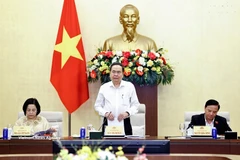
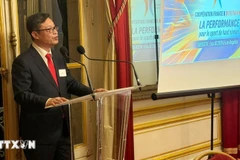
Minister of Agriculture and Environment Tran Duc Thang speaks at the session. (Photo: VNA)

Hanoi (VNA) - The Government’s plan to merge three national target programmes into one drew broad debate at the 15th National Assembly’s ongoing 10th session in Hanoi on December 5, with deputies insisting that the move will not diminish support for ethnic minority and mountainous communities.

In a plenary discussion on the investment policy for the national target programmes on new-style rural development, sustainable poverty reduction and socio-economic development in ethnic minority and mountainous areas through 2035, deputy Vuong Thi Huong from Tuyen Quang province said extending the disbursement deadline to the end of 2026 is critical to allow localities to complete assigned tasks and relieve pressure on capital allocation.

Pointing to the deteriorating state of many general hospitals in ethnic minority and mountainous areas, where facilities often lack functional rooms and basic equipment yet remain ineligible for funding under the current programme, Huong argued that sweeping healthcare improvement requires the policy framework to explicitly cover upgrades, renovations, repairs and equipment procurement for these hospitals.

Deputy Nguyen Thi Thu Ha from Quang Ninh proivince urged more appropriate special mechanisms for production development projects, calling for streamlined administrative procedures and fewer conditional hurdles. She proposed the Government establish only broad principles, criteria and support frameworks while delegating appraisal, approval and implementation authority to provincial and communal administrations to better match local conditions.
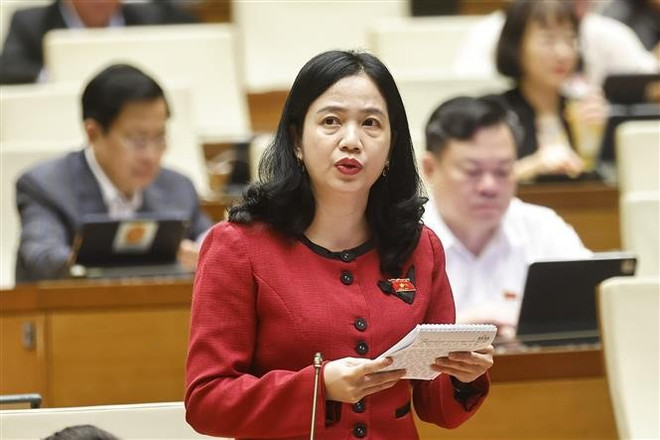
sa.jpg
Deputy Dieu Huynh Sang of Dong Nai province speaks at the event. (Photo; VNA)

Ha advocated direct cash transfers to poor, near-poor and recently escaped-poverty households through a registered task-based system tailored to forestry livelihoods, noting that afforestation projects with two- to three-year cycles should receive payments upon registration and verified completion.

She further recommended the draft resolution on the merger explicitly permit integration of local budgets, other legal capital sources and funding from separate projects into the national target programme, backed by flexible coordination mechanisms.

Addressing lawmakers’ concerns over merging the three programmes into a single framework, Minister of Agriculture and Environment Tran Duc Thang said the move demonstrates the Government’s resolve to meet the Party and State’s goals of improving living standards for all people, especially those in ethnic minority and mountainous areas.

The merger will not cut existing policies or narrow beneficiary coverage, Thang said, adding it will instead sharpen focus and prioritise resources for ethnic minority and mountainous regions, which remain Vietnam’s most impoverished areas./.
VNA

See more

Delegates join group discussions at the ongoing 14th National Party Congress (Photo: VNA)

14th National Party Congress: Delegates eye reforms in new era

During the discussions, Prime Minister Pham Minh Chinh summed up key lessons drawn from the Government’s management during the previous term, stressing the need to turn Party resolutions into laws and renewing growth drivers for the next development phase.

PM Pham Minh Chinh visits the press centre serving the 14th National Party Congress (Photo: VNA)

PM urges media to spotlight key outcomes of 14th Party Congress

During a visit to the press centre amid a break in proceedings, PM Pham Minh Chinh met with reporters and inquired about their working conditions. He described the press as a hardworking and vital force, so that all possible support should be offered to them, including adequate infrastructure, reliable internet connectivity, and a conducive work environment to enable timely, comprehensive, accurate, diverse, and engaging coverage.

Andrey Klimov, member of the Presidium of the Supreme Council of the United Russia Party (UR), grants an interview to the Vietnam News Agency. (Photo: VNA)

14th National Party Congress: Russian political party expresses confidence in future of comprehensive cooperation

Andrey Klimov, member of the Presidium of the Supreme Council of the United Russia Party (UR), emphasised that the Communist Party of Vietnam (CPV) holds a vital role in every aspect of national life. Therefore, the 14th National Congress will not only set the main course for Vietnam’s development but also influence the country’s governance style and administrative approach.

☕ Afternoon briefing on January 20

☕ Afternoon briefing on January 20

The 14th National Congress of the Communist Party of Vietnam (CPV) solemnly opened at the National Convention Centre in Hanoi on January 20 morning.

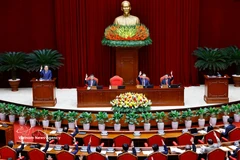
A panoramic view of the opening session of the 14th National Congress of the Communist Party of Vietnam. (Photo: VNA)

Political parties, int'l organisations, friends, OV send congratulatory messages to 14th National Party Congress

These messages constitute a significant source of encouragement and support for Vietnam’s renewal process initiated and led by the CPV. They also vividly reflect the increasingly deep and substantive relations of friendship and cooperation between the CPV and political parties, organisations and friends around the world, as well as the growing attachment of overseas Vietnamese communities to their homeland.

Vietnam - An exemplary model of development for Cuba: Cuban journalist

Vietnam - An exemplary model of development for Cuba: Cuban journalist

Wennys Díaz Ballaga, a special correspondent of Granma - the official newspaper of the Communist Party of Cuba - has highly praised the professional organisation of the 14th National Congress of the Communist Party of Vietnam, affirming that Vietnam’s socio-economic development model serves as an important reference for Cuba and other socialist countries.

Russia’s financial and economic news portal at https://1prime.ru/news/ reported that the congress will focus on discussions and approve Vietnam's socio-economic development strategy through 2030. (Photo: screenshot)

14th Party National Congress draws international attention

The international media stressed that the 14th National Congress of the CPV is not only a major political event for the country but also marks the beginning of a new development period, shaping Vietnam’s vision and motivation for the decades ahead.

Ivo Sieber, former Swiss Ambassador to Vietnam, speaks at an event in Zurich. (Photo: VNA)

14th National Party Congress comes at pivotal moment for Vietnam: Swiss expert

On Vietnam–Switzerland relations, which were established in 1971 and upgraded to a comprehensive partnership in January 2025, Ivo Sieber, a member of the Swiss–Vietnamese Economic Forum (SVEF) and former Swiss Ambassador to the country, expressed confidence that, as the two countries mark the 55th anniversary of diplomatic ties this year, existing links and cooperation will be further strengthened.

Nguyen Hai Nam (far right) attends the second Congress of the Union of Vietnamese Associations in Europe. (Photo: VNA)

14th National Party Congress: New momentum from reform, integration, OV resources

The 14th National Party Congress is expected to continue to expand and further specify policies aimed at attracting overseas Vietnamese, particularly the Vietnamese community in France—one of the largest and longest-established communities in Europe, numbering around 350,000 people and exceeding 600,000 when including French citizens of Vietnamese origin.

Tourists in Hue city. (Photo: VNA)

Hue advances heritage city vision, global cultural tourism profile

By 2030, Hue aims to become a distinctive heritage city of Vietnam, while emerging as one of Southeast Asia’s leading and unique centres for culture, tourism and specialised healthcare. It also aspires to be among the country’s major hubs for science and technology, as well as for high-quality, multi-disciplinary education and training.