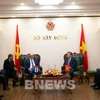
Vietnam Economic News talked with Chairman of Dong Nai province People's Committee Dinh Quoc Thai about the province’s socio-economic achievements obtained in the first nine months of this year as well as tasks, targets and solutions in the 2013-2015 period, a critical period for Dong Nai to become an industrialised and modernised province by 2015.
* Can you give your evaluations on Dong Nai’s socioeconomic developments and investment attraction in the first nine months of 2013?
Despite the variations in the domestic and global economies having negative impacts on the implementation of our tasks and goals, Dong Nai has made positive changes in the local socioeconomic developments with high concentration, good coordination and the efforts of the political system, the business community and people.
The province recorded gross domestic product (GDP) growth of 11.13 percent year-on-year to reach 35.722 trillion VND, equal to 69.6 percent of the year’s plan. From the beginning of this year to September 20, the total foreign investment capital reached 912.5 million USD, of which 520 million USD was invested in industrial zones; 62 newly-licensed projects with total capital of 398 million USD; 53 added capital projects (up 514.9 million USD) and the FDI capital disbursed in the above-mentioned period reached 709 million USD, equal to 78.8 percent of the year’s estimated plan.
by now, Dong Nai has 1,032 valid projects with total capital of 19.2 billion USD.
* In the difficult context of the domestic economy, Dong Nai is still one of the provinces that have the leading economic growth and investment attraction of the country. How did it adopt foreign relations policies to attract FDI resources?
Dong Nai has been developing its local image and trademark as an auspicious, safe and efficient investment destination. Coming to Dong Nai, investors will always find cooperation and support of authorities at different levels. The main aim of province is to create a healthy and transparent business environment through political, social and economic stability, good service and protection for entrepreneurs and workers, administrative reforms so that enterprises could focus on their businesses. The local authorities at different levels have done their foreign relations works well, but they have to continue the administrative procedure reforms and make better innovations, meeting the growing demand of organisations, individuals and enterprises.
To achieve expected results in FDI capital attraction, Dong Nai province has been well implementing foreign investment promotion, especially from Japan. Many Japanese enterprises have come to Dong Nai to seek for investment opportunities. In the first nine months, there were 20 licensed projects of Japanese investors with total newly registered and added capital of nearly 500 million USD.
The province has also actively organized foreign investment promotion programs in foreign countries. The initiative was highly appreciated by international friends and they also committed for their long term business in Dong Nai.
* What are the goals, tasks and solutions that the province has set in the 2013-2015 period?
The common goals that Dong Nai is targeting in the 2013-2015 period are to develop a rapid and sustainable economic growth, promote international integration, industrialisation and modernisation; improve people’s livelihoods, ensure social security and strive to become a industrial province by 2015.
Specifically, Dong Nai will strive to post a GDP growth of 13-14 percent per year and the average GDP per capita by 2015 will be from 2,900-3,000 USD. The economic structure by 2015 will be: industry-construction sectors accounting for 56-57 percent, service 38-39 percent , agriculture-forestry and fishery 4-6 percent and total export revenue will increase by 15-17 percent per year. As for the structure of Dong Nai’s labor market during this period: the industry-construction sectors accounting for 39-40 percent, trade and services 38-39 percent and the agriculture-forestry and fishery sectors 21-22 percent.
To achieve the above goals, Dong Nai will focus on investment in infrastructure, especially the traffic routes connecting urban areas and industrial zones. The province will develop high quality services such as finance, banking, transportation, communication, hotels and restaurants; attract investment to high-tech and added-value industries and will also develop the trademarks of local industrial products.
In agriculture, Dong Nai will develop rural infrastructure, improve the quality of agricultural products, train high quality human resources and organise vocational training courses for rural workers.
* In the current international integration process which poses many opportunities and challenges, what will the province do to help enterprises remove difficulties and stabilize their production and businesses?
The province will continue to promote the administrative procedure reforms to create a really open and healthy business environment for enterprises. Leaders of the provincial People's Committee, departments and sectors will keep on supporting and removing difficulties for enterprises such as providing information about market and approaches to credit sources. Imminently, the local departments and sectors will meet with enterprises once a month, instead of once a quarter to timely grasp information and provide suitable assistance.
On an overall view, according to the development planning of local industrial zones (IZs) approved by the prime minister, the province will have 34 IZs by 2015. In addition, the prime minister also approved to build Long Thanh High-tech IZ, an agricultural and industrial complex in Xuan Loc, Thong Nhat and the Cam My Bio-tech Park. Dong Nai province is also making preparations for investment in technical infrastructure and training high quality human resources.
The province is also starting big traffic projects such as the Ho Chi Minh City - Long Thanh - Dau Giay, Bien Hoa - Vung Tau and Ben Luc - Long Thanh highways, Phuoc An Seaport and Long Thanh International Airport. These construction works are opening more opportunities for investors coming to work in the province. What the provincial People's Committee wants is to see investors coming to explore opportunities to develop their businesses and contribute to the provincial socioeconomic development, orienting to build Dong Nai into an industrial province by 2015.-VNA
* Can you give your evaluations on Dong Nai’s socioeconomic developments and investment attraction in the first nine months of 2013?
Despite the variations in the domestic and global economies having negative impacts on the implementation of our tasks and goals, Dong Nai has made positive changes in the local socioeconomic developments with high concentration, good coordination and the efforts of the political system, the business community and people.
The province recorded gross domestic product (GDP) growth of 11.13 percent year-on-year to reach 35.722 trillion VND, equal to 69.6 percent of the year’s plan. From the beginning of this year to September 20, the total foreign investment capital reached 912.5 million USD, of which 520 million USD was invested in industrial zones; 62 newly-licensed projects with total capital of 398 million USD; 53 added capital projects (up 514.9 million USD) and the FDI capital disbursed in the above-mentioned period reached 709 million USD, equal to 78.8 percent of the year’s estimated plan.
by now, Dong Nai has 1,032 valid projects with total capital of 19.2 billion USD.
* In the difficult context of the domestic economy, Dong Nai is still one of the provinces that have the leading economic growth and investment attraction of the country. How did it adopt foreign relations policies to attract FDI resources?
Dong Nai has been developing its local image and trademark as an auspicious, safe and efficient investment destination. Coming to Dong Nai, investors will always find cooperation and support of authorities at different levels. The main aim of province is to create a healthy and transparent business environment through political, social and economic stability, good service and protection for entrepreneurs and workers, administrative reforms so that enterprises could focus on their businesses. The local authorities at different levels have done their foreign relations works well, but they have to continue the administrative procedure reforms and make better innovations, meeting the growing demand of organisations, individuals and enterprises.
To achieve expected results in FDI capital attraction, Dong Nai province has been well implementing foreign investment promotion, especially from Japan. Many Japanese enterprises have come to Dong Nai to seek for investment opportunities. In the first nine months, there were 20 licensed projects of Japanese investors with total newly registered and added capital of nearly 500 million USD.
The province has also actively organized foreign investment promotion programs in foreign countries. The initiative was highly appreciated by international friends and they also committed for their long term business in Dong Nai.
* What are the goals, tasks and solutions that the province has set in the 2013-2015 period?
The common goals that Dong Nai is targeting in the 2013-2015 period are to develop a rapid and sustainable economic growth, promote international integration, industrialisation and modernisation; improve people’s livelihoods, ensure social security and strive to become a industrial province by 2015.
Specifically, Dong Nai will strive to post a GDP growth of 13-14 percent per year and the average GDP per capita by 2015 will be from 2,900-3,000 USD. The economic structure by 2015 will be: industry-construction sectors accounting for 56-57 percent, service 38-39 percent , agriculture-forestry and fishery 4-6 percent and total export revenue will increase by 15-17 percent per year. As for the structure of Dong Nai’s labor market during this period: the industry-construction sectors accounting for 39-40 percent, trade and services 38-39 percent and the agriculture-forestry and fishery sectors 21-22 percent.
To achieve the above goals, Dong Nai will focus on investment in infrastructure, especially the traffic routes connecting urban areas and industrial zones. The province will develop high quality services such as finance, banking, transportation, communication, hotels and restaurants; attract investment to high-tech and added-value industries and will also develop the trademarks of local industrial products.
In agriculture, Dong Nai will develop rural infrastructure, improve the quality of agricultural products, train high quality human resources and organise vocational training courses for rural workers.
* In the current international integration process which poses many opportunities and challenges, what will the province do to help enterprises remove difficulties and stabilize their production and businesses?
The province will continue to promote the administrative procedure reforms to create a really open and healthy business environment for enterprises. Leaders of the provincial People's Committee, departments and sectors will keep on supporting and removing difficulties for enterprises such as providing information about market and approaches to credit sources. Imminently, the local departments and sectors will meet with enterprises once a month, instead of once a quarter to timely grasp information and provide suitable assistance.
On an overall view, according to the development planning of local industrial zones (IZs) approved by the prime minister, the province will have 34 IZs by 2015. In addition, the prime minister also approved to build Long Thanh High-tech IZ, an agricultural and industrial complex in Xuan Loc, Thong Nhat and the Cam My Bio-tech Park. Dong Nai province is also making preparations for investment in technical infrastructure and training high quality human resources.
The province is also starting big traffic projects such as the Ho Chi Minh City - Long Thanh - Dau Giay, Bien Hoa - Vung Tau and Ben Luc - Long Thanh highways, Phuoc An Seaport and Long Thanh International Airport. These construction works are opening more opportunities for investors coming to work in the province. What the provincial People's Committee wants is to see investors coming to explore opportunities to develop their businesses and contribute to the provincial socioeconomic development, orienting to build Dong Nai into an industrial province by 2015.-VNA