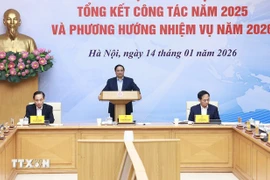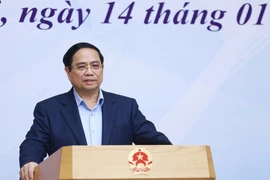
Hanoi (VNA) – Prime Minister Pham Minh Chinh has stressed the urgent need to enhance the effectiveness of the negotiation and implementation of international commitments and agreements so as to step up foreign affairs and international integration while strengthening Vietnam’s prestige and stature in the world to support the realisation of strategic development goals, including double-digit growth for 2026–2030.
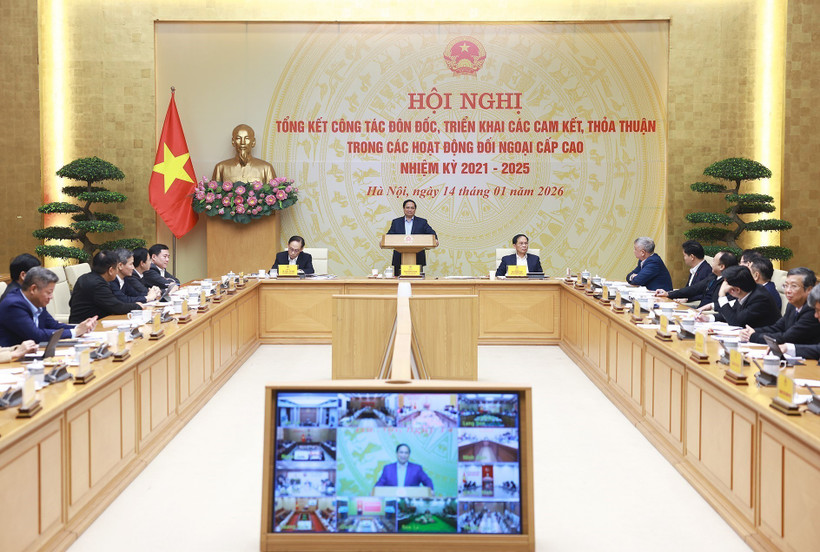
Chairing a conference on January 14 to review the follow-up and implementation of the international agreements and commitments made during high-level diplomatic activities over the last five years, the PM commended efforts by ministries, sectors, agencies and localities—particularly the Ministry of Foreign Affairs—to achieve the positive results in the period.
He stated that the signing and implementation of international commitments have consistently received special attention from the Party and State leadership.
The international commitments and agreements Vietnam has successfully signed in recent years are not only measurable evidence of its diplomatic success but also strategic instruments for expanding relations with countries and international partners, thus deepening integration into the world and mobilising resources for the realisation of national development goals, he stressed.
The Government leader noted that in a rapidly evolving and unpredictable global and regional context, leveraging external resources will be crucial for Vietnam to advance development and capitalise on opportunities when it comes to the country's strategic interests.
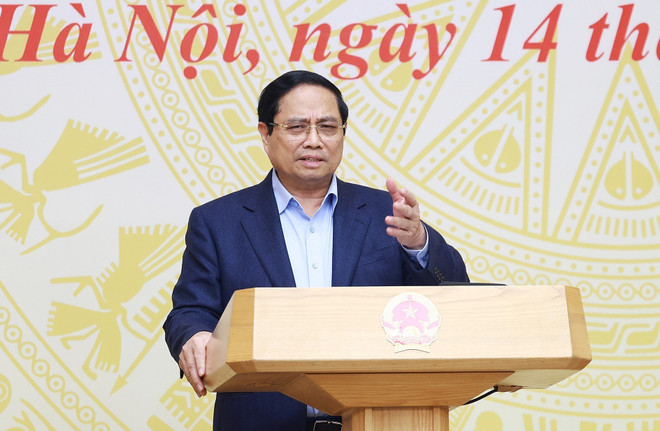
Emphasising the principles guiding the negotiation and implementation of international commitments and agreements, the PM asked for the establishment of specific KPI-based mechanisms to assess progress. He stressed the need for timely reporting to authorities on the implementation of international agreements and commitments, especially when challenges and obstacles arise, along with establishing a mechanism for continuous review.
Looking ahead, the PM asked ministries, sectors, agencies, and localities to effectively implement the Party and State’s policies and laws on diplomacy and international integration, as well as the Politburo’s breakthrough decisions, notably Resolution No. 59 on international integration in the new context and the Secretariat’s Directive No. 56 on strengthening the Party’s leadership over the signing and implementation of international commitments.
Ministries, agencies, and localities were requested to conduct a comprehensive review of all the international commitments already signed and being implemented, evaluate successes and shortcomings, and propose solutions. They were also tasked with assessing the compatibility between these commitments and Vietnam’s regulations, and preparing concrete implementation roadmaps to ensure more effective and precise implementation to support the development of each sector and locality.
Besides, relevant stakeholders must actively study partners, markets, and emerging global trends to give timely advice and proposals on the signing of new treaties and commitments that suit with Vietnam’s strengths, opportunities, competitive advantages, and match mutual cooperation demand, the PM said, adding that preparation and signing processes should be more structured, planned well in advance, and detailed enough to allow immediate implementation after signing.
The PM stressed the need to proactively prepare counterpart resources for signing and implementing international agreements and commitments, particularly financial and human resources, so as not to miss cooperation opportunities when international partners express interest. Given limited resources, allocation should be carefully balanced, quality prioritised over quantity in signing agreements, and resource dispersion minimised to ensure efficient execution.
He also called for proactive and decisive resolution of difficulties arising during implementation, stressing the necessity for firm determination, greater effort, and more decisive action.
He requested developing digital platforms and applying AI to identify new cooperation opportunities, optimise negotiation and signing processes, and manage information and implementation progress of existing commitments and agreements.
The PM urged ministries, agencies, and localities to strengthen coordination to enhance effectiveness, contributing to the country’s steady progress toward a prosperous, civilised, and thriving future.
Reports presented at the conference showed that during 2021–2025, Vietnam and its partners signed a total of 927 commitments and agreements, including nearly 350 in 2025, significantly higher than in the preceding period.
Vietnam upgraded relations with 24 countries, bringing the total number of partners at the comprehensive partnership level or higher to 42. It established diplomatic ties with 194 countries, including all UN member states, and comprehensive strategic partnerships with all five UN Security Council members and most G20 countries.
The scope and content of agreements and commitments have diversified and increasingly been aligned with Vietnam’s strategic priorities such as science and technology, innovation, digital transformation, and sustainable development. Notably, Vietnam inked two new free trade agreements with the UAE and Israel, helping to bring the country’s total import and export turnover in 2025 to a record high of 930 billion USD.
The commitments and agreements have been implemented efficiently after signing, significantly shortening the time from signature to execution./.