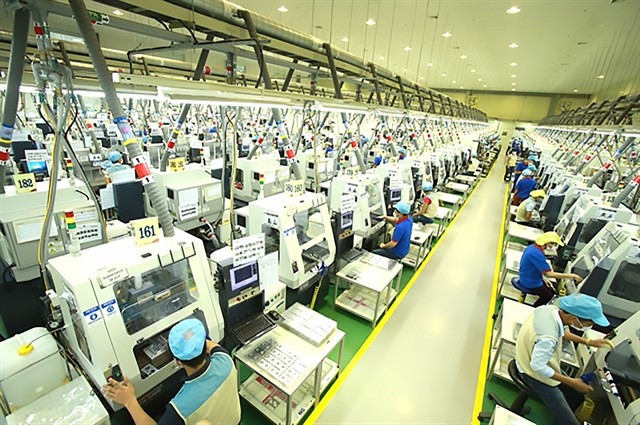
Hanoi (VNS/VNA) - Vietnam is gradually transforming from a manufacturing hub into a regional centre for high-tech innovation.
The country currently ranks fifth in the world for electronics, computers and components exports, and second globally for mobile phones and components exports.
Vietnam’s export turnover of electronics reached 134.5 billion USD last year.
The electronics industry continued its strong growth momentum with exports reaching 60.8 billion USD as of the end of May this year, a year-over-year increase of 39%, reinforcing its role as a key driver in the country's export economy.
Tai chinh (Finance) online newspaper quoted Tran Hong Quan, chief commercial director of RX Tradex Vietnam, as saying that major technology corporations such as Samsung, Apple, LG and Pegatron, were continuing to expand their large-scale investments in Vietnam.
Notably, Qualcomm has launched its R&D centre in the country, while NVIDIA recently signed a strategic partnership with the Government to establish a data centre and an AI R&D centre.
A significant highlight is the Government’s adoption of the semiconductor industry development strategy to 2030, with a vision toward 2050, marking a decisive move to strengthen domestic capabilities, from workforce training and localisation capacity to active participation in core technology research and production.
However, Quan pointed out that Vietnam’s electronics industry still faced several challenges.
He said: “100% of mobile phone export value comes from FDI enterprises, 80% of phone components are imported, and over 90% of Tier-1 suppliers are foreign companies. R&D within domestic firms remains limited, mainly focused on assembly.”
Quan emphasised that these challenges marked a turning point to evolve from a centre of assembly into a country with advanced, value-added manufacturing capabilities.
Experts highlighted three core issues that were shaping the future of the electronics industry.
First, the country is emerging as a strategic destination in the global supply chain. Second, the government is making strong efforts to promote the development of the semiconductor industry and R&D.
Third, the rapid advancement of artificial intelligence (AI) and automation is fundamentally transforming the nature of manufacturing, requiring both technological standardisation and investment in human resources.
Regarding the export market of the electronics industry, Do Thi Thuy Huong, Vice President of the Vietnam Association for Supporting Industries (VASI), stated that the US was Vietnam’s largest export market, accounting for approximately 29% of the country’s total export turnover.
In particular, the electronics industry accounts for more than 40% of exports to the US in certain segments.
Vietnam’s exports of electronic machinery, equipment and audio devices to the US reached 41.7 billion USD last year alone, making up 34.9% of the country’s total export turnover to the US.
High tariffs from the US could increase production costs for Vietnamese enterprises, affecting both profit and competitiveness, said Huong.
In this context, experts believed that Vietnam’s electronics industry had an opportunity to restructure its supply chain, accelerate digital transformation, and expand markets through free trade agreements (FTAs) and cross-border e-commerce.
A representative of IPC, an association connecting electronics industries based in Chicago, US, said that with its mission to strengthen the electronics supply chain and promote sustainable growth across the industry, the association had implemented several important initiatives to support the global electronics sector, including in Vietnam.
These efforts include updating IPC standards for electronics companies, advocating for public policy and providing training and certification.
Among these, IPC standards play a crucial role in ensuring the quality, reliability and consistency of electronic manufacturing.
Their implementation has helped improve production processes and contributed to the creation of higher-quality electronic products.
Adherence to international standards has opened up access to new markets for Vietnamese electronics manufacturers.
The association’s training programmes have helped build a highly skilled workforce capable of meeting the demands of advanced manufacturing technologies, enhancing the reputation and international recognition of Vietnamese enterprises./.
VNA