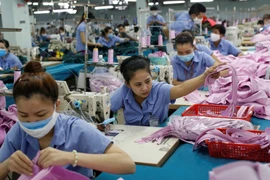
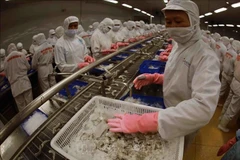
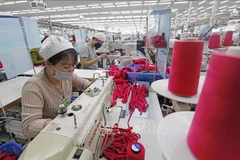
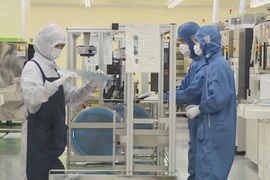
Workers process frog meat for export at a factory of the Tan Thanh Loi Co. Ltd in Long An province (Photo: VNA)
 Hanoi (VNA) - The EU-Vietnam Free TradeAgreement (EVFTA) and the Investment Protection Agreement (EVIPA), which wereratified by the National Assembly on the morningof June 8, will offer a golden opportunity for Vietnam to elevate its positionon the global trade map, especially in the context of the worldwide COVID-19 crisis,economic analysts believe.
The EVFTA is hoped to presentnew opportunities to Vietnamese businesses to fully tap into their potentialand strengths and bolster exports.
It will also help the country diversify its trading partners, reduce its dependenceon certain key markets in both exports and imports, and maintain its crucial rolein global supply chains.
Vietnam hopes to promote technology transfer and skills and knowledge in its youngworkforce, becoming a dynamic, creative, and sustainable economy in the future.
The textiles, footwear, agriculture, and retail sectors are forecast to benefitthe most from the agreements.
Enterprises have been advised to thoroughly understand the agreements andstrictly comply with rules of origin, quality standards, and product design.
Figures from the Ministry of Planning and Investment show that about 86 percentof Vietnamese businesses were affected by the COVID-19 pandemic, with the largerthe business the greater the impact.
A number of key industries are still facing difficulties, having seen revenue inthe first quarter and the first half of the second quarter dip nearly 70percent compared to the same period of 2019.
However, after social distancing measures were eased, the national economy witnesseda gradual recovery thanks to enterprises resuming operations stably.
More than 55 percent of businesses participating in a survey conducted by the VietnamChamber of Commerce and Industry (VCCI) said they will continue to maintain theircurrent production scale in the third quarter, while 22 percent of those saidthey intend to expand production and business.
This proves the vitality and resilience of Vietnamese enterprises, especiallyin these current difficult times, said VCCI Chairman Vu Tien Loc./.
It will also help the country diversify its trading partners, reduce its dependenceon certain key markets in both exports and imports, and maintain its crucial rolein global supply chains.
Vietnam hopes to promote technology transfer and skills and knowledge in its youngworkforce, becoming a dynamic, creative, and sustainable economy in the future.
The textiles, footwear, agriculture, and retail sectors are forecast to benefitthe most from the agreements.
Enterprises have been advised to thoroughly understand the agreements andstrictly comply with rules of origin, quality standards, and product design.
Figures from the Ministry of Planning and Investment show that about 86 percentof Vietnamese businesses were affected by the COVID-19 pandemic, with the largerthe business the greater the impact.
A number of key industries are still facing difficulties, having seen revenue inthe first quarter and the first half of the second quarter dip nearly 70percent compared to the same period of 2019.
However, after social distancing measures were eased, the national economy witnesseda gradual recovery thanks to enterprises resuming operations stably.
More than 55 percent of businesses participating in a survey conducted by the VietnamChamber of Commerce and Industry (VCCI) said they will continue to maintain theircurrent production scale in the third quarter, while 22 percent of those saidthey intend to expand production and business.
This proves the vitality and resilience of Vietnamese enterprises, especiallyin these current difficult times, said VCCI Chairman Vu Tien Loc./.
VNA