Hanoi (VNA) – The Government and Prime Minister, under the Party leadership, have focused on steering the country with a “proactive, flexible, creative, decisive and effective” approach, stressing action over retreat. They have pursued sweeping institutional, regulatory and policy breakthroughs designed to reverse setbacks and fundamentally reshape the country's development path.
Navigating headwinds to finish strong
Throughout 2025, the Party and State accelerated institutional reforms, easing constraints on production and business activities, while effectively unlocking and pooling all available resources to drive breakthroughs across multiple sectors.
The core policy priority was to bolster economic growth while preserving macroeconomic stability, keeping inflation under control, and maintaining key economic balances.
A hallmark of the year was the push to refine institutional framework, coupled with a major overhaul of state apparatus and the rollout of the two-tier local administration model. The Government coordinated and submitted proposals to the Politburo, resulting in the issuance of 10 breakthrough resolutions targeting key strategic areas.
Organisational restructuring was launched aggressively and effectively, tied to deeper decentralisation and delegation of authority. Administrative payrolls were cut by 145,000 positions, while recurrent state expenditure fell by roughly 39 trillion VND (1.5 billion USD) per year. The two-tier local administration model has largely stabilised, shifting from a command-and-control administrative model toward a service-oriented, development-enabling one.
The timeliness and efficacy of Party guidelines and policies and Government management in 2025 were reflected clearly in impressive figures that speak for themselves.
Vietnam's socio-economic performance continued to improve steadily, with each month outperforming the previous one and each quarter surpassing the last. The country met or exceeded all 15 major targets set for 2025.
Most strikingly, GDP growth reached 8.02% in 2025, a result that effectively dispelled skepticism from critics reluctant to acknowledge Vietnam’s progress.
How Vietnam stacks up globally and regionally?
According to a newly released report by the UK-based Centre for Economics and Business Research (CEBR), Vietnam outperformed the global average and ranked among the fastest-growing economies in the Asia-Pacific.
Specifically, the Organisation for Economic Co-operation and Development (OECD) projected global GDP growth at 3.2%, while the IMF and the European Union estimated 3.2% and 3.1%, respectively. In ASEAN, Singapore reported a 4.8% growth, Thailand 2%, and Indonesia 4.9%.
Vietnam's strong showing is especially notable, given its maintenance of macroeconomic stability, with inflation held at 3.31% and key balances, including budget deficits; public, government, and external debts, were kept well within legal limits.
Its GDP surpassed 514 billion USD in 2025, securing the 32nd global ranking, up five places from the prior year, and cementing Vietnam's place among the world's largest economies. Per capita GDP reached 5,026 USD, more than 1.4 times the 2020 level, officially elevating Vietnam into the upper-middle-income status.
Priority to development investment
As a fast-growing emerging market, Vietnam has placed strong emphasis on infrastructure as a cornerstone of sustained expansion. Key focus areas included integrated transport networks (roads and railways), digital backbone systems (5G, IoT, AI, big data) for smart cities, energy and logistics, all aligned with sustainable development goals, national modernisation, and the creation of new growth spaces.
The 13th National Party Congress’s Resolution identified modern, synchronous infrastructure as one of the three strategic breakthroughs, with transport serving as the “backbone” of economic growth, regional connectivity and national competitiveness.
In an interview granted to the Vietnam News Agency, PM Pham Minh Chinh stressed that large-scale, modern, and interconnected infrastructure projects, spanning transport, energy, logistics, healthcare, education, digital and urban development, have been completed. They are creating new development spaces, increasing land values, enhancing competitiveness, attracting investment, and establishing Vietnam as an emerging global and regional connectivity hub.
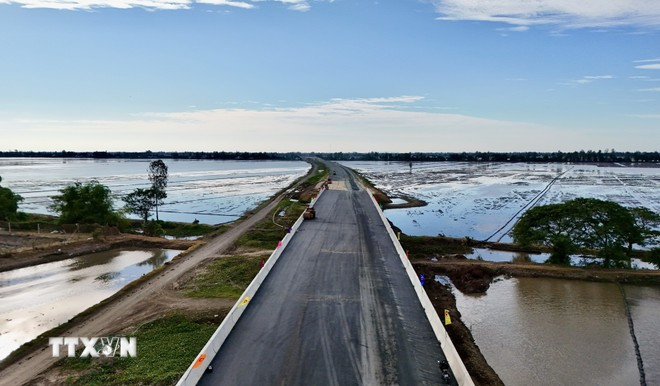
By late 2025, Vietnam completed and put into operation around 3,345km of expressways and 1,711km of coastal roads, exceeding targets set by the 13th National Party Congress.
The year featured three nationwide waves of groundbreakings and inaugurations, covering 564 major infrastructure projects totaling more than 5.14 quadrillion VND, nearly 75% of which came from private capital, demonstrating the success of pooling social resources for development.
Sci-tech, innovation and digital transformation advanced rapidly, yielding tangible early results. Following the Politburo’s Resolution 57, the Government submitted and secured the passage of 10 laws directly related to sci-tech, innovation and digital transformation and 19 guiding decrees by the legislature within one year. Vietnam now ranks second in ASEAN for AI investment, sixth among 40 countries on the AI Index, and 44th out of 139 on the Global Innovation Index.
Breakthroughs in modern, integrated infrastructure are seen as a foundational pillar to achieve double-digit growth in 2026, the first year of the new Party Congress term and start of the 2026–2030 five-year plan.
Accordingly, the PM directed all ministries and agencies to ensure progress of strategic and flagship infrastructure projects, concentrating resources on those with transformative socio-economic impact. Key priorities include the Lao Cai – Hanoi – Hai Phong railway, preparatory work for rail links with China, the North – South high-speed railway, energy infrastructure expansion to meet growth and energy security needs, nuclear power development, and investment in world-class cultural, sports, education, and healthcare facilities of national significance./.