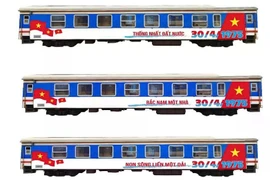
Hanoi (VNA) – In the memory of those who served in Vietnam’s railway sector, the first train to connect the North and South after the country’s reunification in 1975 remains a profound and emotional milestone — a journey that symbolised a nation’s longing for peace and unity.
Fifty years ago, tens of thousands of railway workers, soldiers, and civilians worked tirelessly, day and night, to lay the final tracks that would bind the country from Hanoi to Sai Gon (now Ho Chi Minh City).
Solidarity to restore national railway infrastructure
Recognising the strategic role of the North–South railway in reviving post-war economic and logistical activity, the then Government Council issued an urgent directive on November 14, 1975, to fully restore the line. The mobilisation spanned the length of the country, involving multiple ministries, the armed forces, and local communities.
Khuat Minh Tri, former head of the Vietnam Railway trade union recalled,
"For years, the railway had been a primary target of American air strikes, to sever the North’s supply lines to the South. Trains were much slower compared to other means of transport. So to restore the railway, tens of thousands were mobilised to donate materials and work on the ground non-stop – a testament to the solidarity and united will of the Vietnamese people."
Following the country's reunification, the rebuilding began step by step. One of the most critical undertakings was the rapid repair of the Binh Loi Bridge, whose central span had collapsed. It was restored in just ten days and nights, a remarkable pace.
On May 20, 1975, the first train departed from Sai Gon to Bien Hoa. By July 20, it reached Long Khanh. From there, the line continued to extend northwards through Nha Trang, Dieu Tri, Quy Nhon, Phu My, and Bong Son. By the end of 1975, 810 kilometres of railway in the South had been restored, along with dozens of locomotives and carriages.
Recounting the monumental efforts to connect more than 1,730km railway, Tri noted that in nine months, 100,000 workers, soldiers and civilians had taken to the tracks to work. Two million cubic metres of earth and stone were ultilised, a million tonnes of steel transported, 20 kilometres of new bridges constructed, 660 kilometres of track laid, 1,686 kilometres of telecom wires installed, and 70,000 cubic metres of timber harvested for rail use.
Tears of joy: when North and South were reunited
According to records from Vietnam Railways’ historical archives, the final rail joint was laid at 10:55am on December 4, 1976 at Km 446+885, between Minh Cam and Chu Le. That same day, the first test train departed from Hanoi and made its way uninterrupted to HCM City. By 12:30pm on December 13, a freight train from HCM City reached Hanoi, while a train carrying fertiliser-grade apatite left the capital bound for the South.
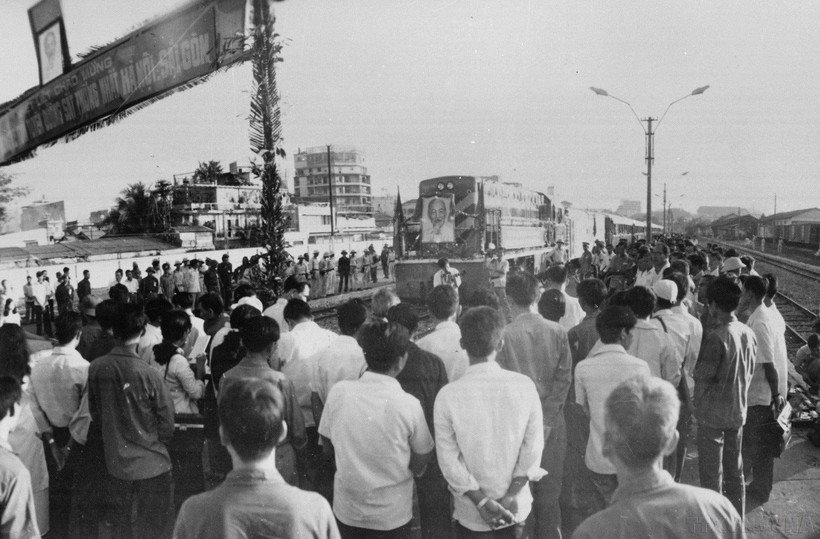
Then, on December 31, 1976, the Government inaugurated the first two official Reunification trains, departing simultaneously from Hanoi and HCM City. The Ministry of Transport marked the occasion with a ceremonial launch, celebrating the achievement in conjunction with the 4th National Party Congress.
Nguyen Minh Quang, then an official of the railways general department and one of 200 delegates aboard the train from Hanoi, recalled the moment vividly that at 7am on the 31st, a moving farewell ceremony took place at Hanoi Station. Among those on board were southern students evacuated during the war, and veterans who had fought in the South. Emotions ran high as they sat side by side. At every stop along the way, crowds gathered to greet the train with flags, flowers, and cheers. The joy was indescribable.
After an 80-hour journey, on January 4, 1977, the reunification express rolled into Sai Gon Station. Awaiting it were crowds of officials and residents, overwhelmed with emotion. As passengers stepped off the train, there were embraces, tears, and the sheer joy of families reuniting after years of separation.
Since that historic first journey in 1976, Vietnam’s railway sector has continued to modernise. Today, the North–South journey takes approximately 33 hours. Plans for a high-speed North–South railway are underway, which could shorten the trip to just over 5 hours with limited stops, and about 6.6 hours with 23 station calls./.