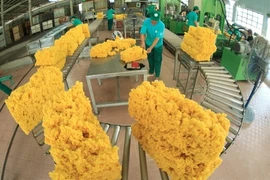
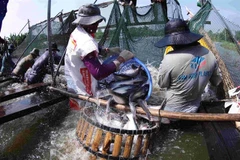
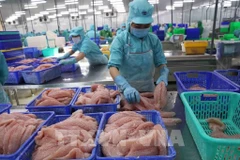
Workers process tra fish for export at the factory of the Sao Mai Group in the Mekong Delta province of An Giang (Photo: VNA)
 HCM City (VNA) – The fisheriessector of Vietnam is facing an array of difficulties as the acute respiratorydisease caused by the novel coronavirus (COVID-19) has led to contractedexports.
According to the Vietnam Association of SeafoodExporters and Producers (VASEP), aquatic exports in January fell 25 percentfrom the same period last year to 556 million USD.
Except for shrimp exports which increased by 7percent year on year to 251 million USD, tra fish shipments nosedived by 64percent to only 75 million USD. Seafood exports also decreased by 22 percent to230 million USD, including about 40 million USD worth of tuna (down 30 percent)and 33 million USD worth of squid and octopus (down 50 percent).
Among the key markets, aquatic exports to Japandropped 20 percent to 98 million USD, the US down 36 percent to 75 million USD,and China (including Hong Kong) – where COVID-19 is raging – down 45 percent to51.5 million USD.
The only highlight last month was the EU, towhich aquatic exports grew 13 percent to 127 million USD.
VASEP Secretary General Truong Dinh Hoe saidexports plummeted from the same period last year partly because Januarycoincided with the Lunar New Year holiday, which interrupted export activitiesfor about 10 days.
Additionally, the strong COVID-19 outbreak inChina in early February has caused serious impact on multiple fields liketransport, tourism, retail, as well as the production and export of aquaticproducts.
In 2019, China was the largest importer ofVietnamese tra fish with the value of 622.7 million USD, equivalent to 31percent of total tra fish exports. Thanks to stable export growth, good pricesand diverse segments, many domestic processors continue to see China as theirstrategic market for 2020. Therefore, when Vietnam-China trade is interruptedby the COVID-19 epidemic, tra fish is the hardest-hit commodity, Hoe noted.
Tran Van Hung, Director of the Hung Ca Co. Ltd,said for those companies that have diversified their markets, the discontinuityin tra fish shipments to China only affects part of their operations. However,for those that mainly target the Chinese market, they will suffer heavy lossesif the epidemic is not curbed soon.
Compared to tra fish, shrimp products arebelieved to face fewer impacts as China mainly imports large-sized black tigershrimp and the shrimp crop already ended.
However, some shrimp exporters said goodspreviously ordered by Chinese partners now have to be kept in storage asimporters have to delay delivery dates. Meanwhile, demand in the Republic ofKorea, the US and the EU show signs of decrease due to fears of COVID-19.
VASEP noted in the most positive scenario thatthe epidemic is put under control during the first quarter of 2020, aquaticexports to China in the first three months will shrink by at least 40 percentfrom Q4 of 2019. They will continue recovering in the following quarters andreturn to normal in the second half of this year.
In case the epidemic lingers, exports to Chinawill plummet, leading to declines in shipments to other markets, and Vietnam’saquatic exports in 2020 may grow by only 3 – 4 percent from last year, theassociation added.
In this context, VASEP has recommended businessesto keep updated with information from Chinese partners to ship the previouslyordered batches immediately when customs clearance is permitted to minimisepreservation and storage expenses.
Firms have also been suggested to adjustprocessing and farming plans to avoid excessive supply of materials.
VASEP is also set to propose the Ministry ofAgriculture and Rural Development and the Government issue policies supportingaffected businesses and farming households such as by reducing lending interestrates and extending loan payment deadlines./.
VNA