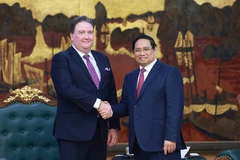
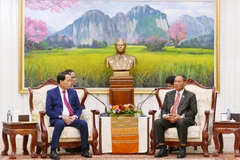
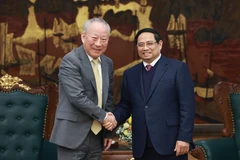
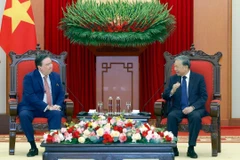
Minister of Foreign Affairs Bui Thanh Son (R) and his RoK counterpart Park Jin in Hanoi on October 18 (Photo: VNA)
 Welcoming his guest, Son said Park’s official visit to Vietnam holds great importance amid the 30th anniversary of the countries’ diplomatic ties this year.
The officials agreed to coordinate closely to promote all-level mutual visits and meetings in flexible forms, pay more attention to enhancing ties in diplomacy, defence and security, and maximise existing bilateral dialogue and cooperation mechanisms.
Minister Son highly valued the sustained economic partnership, especially in investment and trade, amid adverse impacts of the COVID-19 pandemic.
He asked both sides to maintain efforts to achieve the trade target of 100 billion USD by 2023 and 150 billion USD by 2030 in a balanced manner through bilateral and multilateral cooperation mechanisms like the Vietnam - RoK Free Trade Agreement (VKFTA) and the Regional Comprehensive Economic Partnership (RCEP).
The Vietnamese Government always welcomes Korean businesses expanding investment in Vietnam, with priority given to digital technology, electronics, renewable energy, infrastructure development, and construction of high technology complexes, industrial parks, and high-quality agricultural zones, he said.
Son called on the RoK Government to increase non-refundable aid for Vietnam; reduce and gradually lift requirements in terms of contractors and goods origin when it comes to loans from the Economic Development Cooperation Fund (EDCF); and boost the effectiveness of collaboration in science, technology, healthcare, labour, culture, education, and people-to-people exchanges.
Speaking highly of Vietnam’s achievements in the COVID-19 fight and socio-economic development, Minister Park affirmed that the Korean Government attaches importance to Vietnam’s role in the region and wishes to develop all-round relations with the Southeast Asian nation.
Sharing Vietnam’s concern about the promotion of balanced trade, he asked the Vietnamese Government to create more favourable conditions for Korean enterprises in the country to stabilise supply chains after the pandemic.
He stated that the RoK’s Ministry of Foreign Affairs will continue working closely with its Vietnamese counterparts and other agencies of the two countries to achieve their targets in all aspects.
At the talks, the ministers also discussed international and regional issues of common concern.
Son affirmed that Vietnam always pays attention to the situation in the Korean Peninsula and hopes the parties concerned will exercise self-restraint, avoid escalation, persist in dialogue, and take into account each other’s concerns and interests as well as common interests of the region and the world, thereby contributing to peace and stability in the Korean Peninsula, the region, and the world at large.
Vietnam is ready to help with the promotion of dialogue, cooperation and denuclearisation in the peninsula, he said.
Minister Son also called on the RoK to continue supporting and sharing the common vision of ensuring security, safety and freedom of navigation and overflight in the East Sea.
Park said navigation security in the East Sea is critically important to regional peace and development, voicing his country’s support for the maintenance of peace, stability, and freedom of navigation and overflight, legal order, peaceful settlement of disputes, and compliance with international law, including the 1982 United Nations Convention on the Law of the Sea (UNCLOS).
Minister Son also asked the RoK to continue advocating ASEAN’s efforts to enhance solidarity and cooperation, stressing that Vietnam and ASEAN are actively seeking solutions to stabilise the situation in Myanmar.
Vietnam and the RoK established their diplomatic ties in 1992. Since then, their relations have been flourishing surprisingly in multiple areas, from diplomacy, security, trade, investment, culture, society, and people-to-people exchange. Notably, bilateral trade stood at about 80 billion USD in 2021, surging 160 times from 30 years ago./.
VNA