French President concludes state visit to Vietnam

This marks the first visit to the Southeast Asian nation by a French President in nearly a decade, and the first high-level exchange between the two countries since the upgrade of bilateral ties to a Comprehensive Strategic Partnership in October 2024.

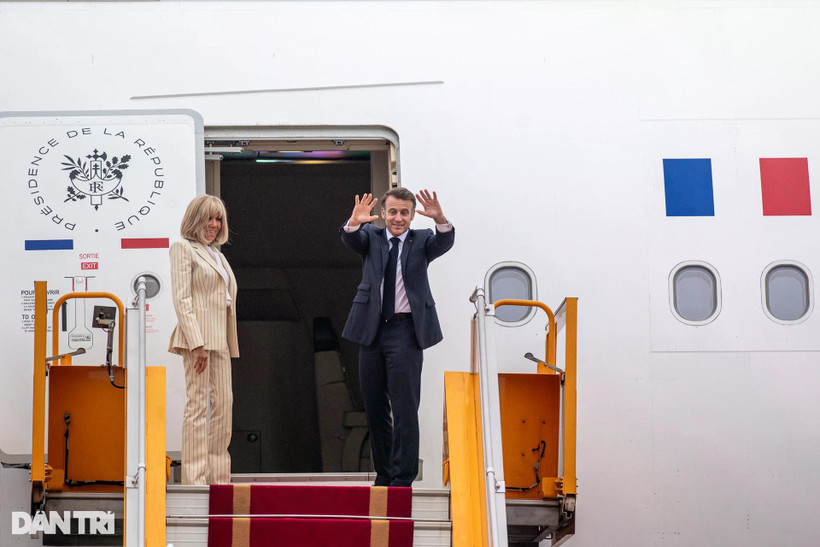
French President Emmanuel Macron and his spouse bid farewell to Vietnam before their aircraft departs from Noi Bai International Airport on May 27 afternoon. (Photo: dantri.com.vn)

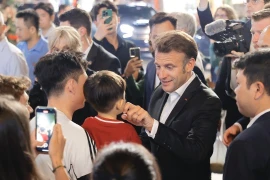
Hanoi (VNA) – French President Emmanuel Macron and his spouse departed Hanoi on May 27 afternoon, concluding their state visit to Vietnam from May 25 to 27, made at the invitation of Vietnamese President Luong Cuong.

During the visit, President Macron and his spouse, Brigitte Macron, laid a wreath and paid tribute to President Ho Chi Minh at his mausoleum, and also paid homage to war heroes and martyrs at the monument on Bac Son street in Hanoi.

Party General Secretary To Lam and President Macron visited the Ho Chi Minh Relic Site at the Presidential Palace and jointly planted a friendship tree at the site.

The Vietnamese Party leader and the French President, together with their spouses, visited the Temple of Literature. There, they viewed a photo exhibition highlighting key milestones in bilateral relations, organised by the Vietnam News Agency; toured the historical relic site; and enjoyed a performance of Nha nhac (Royal Court Music of Hue) by artists from the Hue Royal Traditional Arts Theatre.

General Secretary Lam hosted a reception for President Macron. President Luong Cuong chaired the official welcome ceremony and state banquet in honour of President Macron and his spouse. The two Presidents held talks and a joint press meeting, and together witnessed the handover of 14 cooperation documents between the two countries. National Assembly Chairman Tran Thanh Man also met with President Macron and accompanied the guest on a tour of the underground archaeological exhibition space at the National Assembly building.
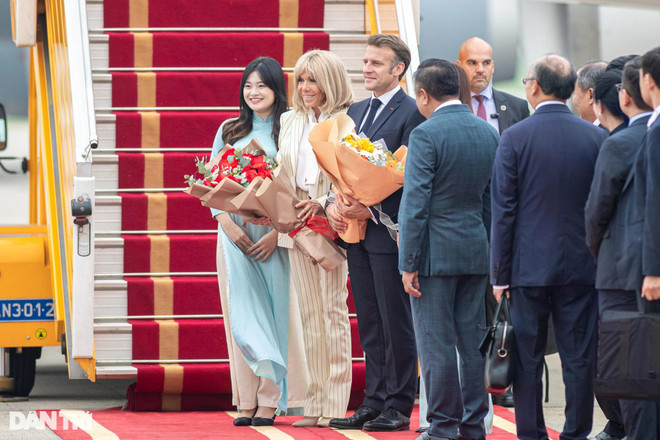
President Emmanuel Macron and his spouse receive flower bouquets from the Vietnamese farewell delegation. (Photo: dantri.com.vn)

President Emmanuel Macron and his spouse receive flower bouquets from the Vietnamese farewell delegation. (Photo: dantri.com.vn)

At the meetings and talks, the Vietnamese leaders welcomed President Macron and the high-level delegation of France on their state visit to Vietnam. This marks the first visit to the Southeast Asian nation by a French President in nearly a decade, and the first high-level exchange between the two countries since the upgrade of bilateral ties to a Comprehensive Strategic Partnership in October 2024.

President Macron congratulated Vietnam on its growing role and stature in the region and globally, affirming that France wishes to further strengthen cooperation with Vietnam in traditional areas such as health care, education, and culture, while also expanding to new areas including infrastructure, urban transport, aerospace, new energy, and historical memory, aligning with the current Comprehensive Strategic Partnership.

The two sides shared updates on their respective countries' economic and social development, reviewed recent progress in bilateral ties, and discussed key directions for future cooperation. They also exchanged views on international issues of mutual interest.

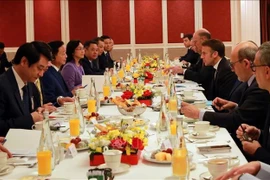
As part of the visit, President Macron and Deputy Prime Minister Tran Hong Ha engaged in a working breakfast with business representatives from both countries in the energy sector to exchange perspectives, visions, and cooperation needs during each country's energy transition process, aiming to foster collaboration in this field.

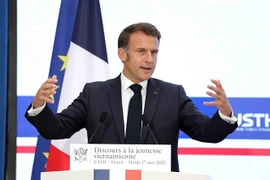
President Macron and his spouse, accompanied by Vice President Vo Thi Anh Xuan, visited and talked to students at the University of Science and Technology of Hanoi. They also attended the groundbreaking ceremony for the VNVC vaccine and bioproduct manufacturing plant, the largest and most modern vaccine production facility in Vietnam to date, developed with technology transferred by French pharmaceutical giant Sanofi.

The French guests also toured Hanoi’s Old Quarter and Hoan Kiem Lake. Ngo Phuong Ly, spouse of General Secretary To Lam, joined Brigitte Macron in a trip to the Vietnam Fine Arts Museum.

On this occasion, the two countries’ leaders issued a joint statement affirming their determination to deepen bilateral relations to meet the aspirations of both peoples./.
VNA

See more

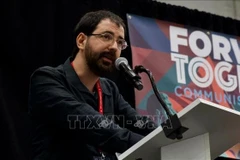
Assaf Talgam, a historian and a journalist of Zo HaDerekh, the official newspaper of the Communist Party of Israel. (Photo: VNA)

CPV's leadership - central factor shaping Vietnam’s enduring stability, impressive achievements: Israeli historian

Talgam said that from a comparative and historical perspective, the CPV’s leadership has been the central factor underpinning the country’s enduring political stability and impressive development trajectory. In a world marked by rapid and unpredictable changes, few political organisations have been able to maintain continuity of leadership while simultaneously adapting their governance approach as effectively as the CPV.

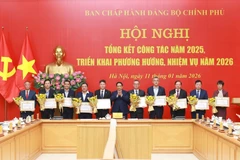
Prime Minister Pham Minh Chinh presents Certificates of merit from the Government’s Party Committee to individuals with outstanding achievements. (Photo: VNA)

Prime Minister outlines five specific strategies for Government’s Party Committee

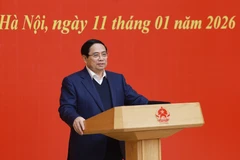
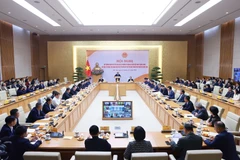
PM Chinh noted that the Government’s Party Committee exercised comprehensive leadership over the Government's operations, proactively and effectively responded to emerging issues, with a particular focus on socio-economic development. As a result, 2025 witnessed high economic growth, sustained macroeconomic stability and ensured major balances.

Politburo member, Standing member of the Party Central Committee’s Secretariat Tran Cam Tu attends the rehearsal. (Photo: VNA)

Security forces stage rehearsal for 14th National Party Congress

The People’s Public Security forces have been praised for their core role in closely working with the army and relevant ministries and agencies, with success in thwarting hostile plots at an early stage, drastically combating fake news and disinformation surrounding the 14th National Party Congress.

Senior Lieutenant General Le Quoc Hung (L), member of the Communist Party of Vietnam (CPV) Central Committee and Deputy Minister of Public Security, and General Vilay Lakhamfong, Politburo member and permanent member of the Secretariat of the Lao People’s Revolutionary Party (LPRP) Central Committee. (Photo: VNA)

Deputy Minister of Public Security congratulates Lao officials following succesful 12th National Party Congress

Deputy Minister of Public Security Senior Lieutenant General Le Quoc Hungconveyed the warmest congratulations of the Central Public Security Party Committee, the Ministry of Public Security leadership, and the Vietnamese People’s Public Security Forces to Lakhamfong and other Lao public security leaders on the congress’s success and their election to key leadership positions for the new term.

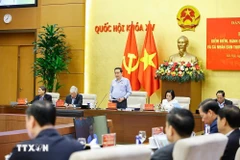
A session of the National Assembly Standing Committee. (Photo: VNA)

NA Standing Committee's key work agenda for 2026 approved

A major focus will be preparations for the election of deputies to the 16th NA and to People’s Councils at all levels for the 2026–2031 term. The NASC will coordinate with the National Election Council, the Government, the Vietnam Fatherland Front Central Committee, and relevant agencies and organisations to continue implementing the election plan, organise oversight of the electoral process, and carry out its duties and powers as prescribed.

Party General Secretary To Lam receives US Ambassador Marc Evans Knapper in Hanoi on January 9, 2026. (Photo: VNA)

Party leader receives outgoing US Ambassador

Vietnam always values its relationship with the US and looks forward to continuing close cooperation with the US government to deepen bilateral relations based on mutual respect for each other’s independence, sovereignty, territorial integrity, and political institutions, contributing positively to peace, stability, cooperation, and development regionally and globally.