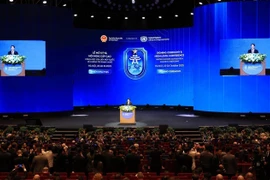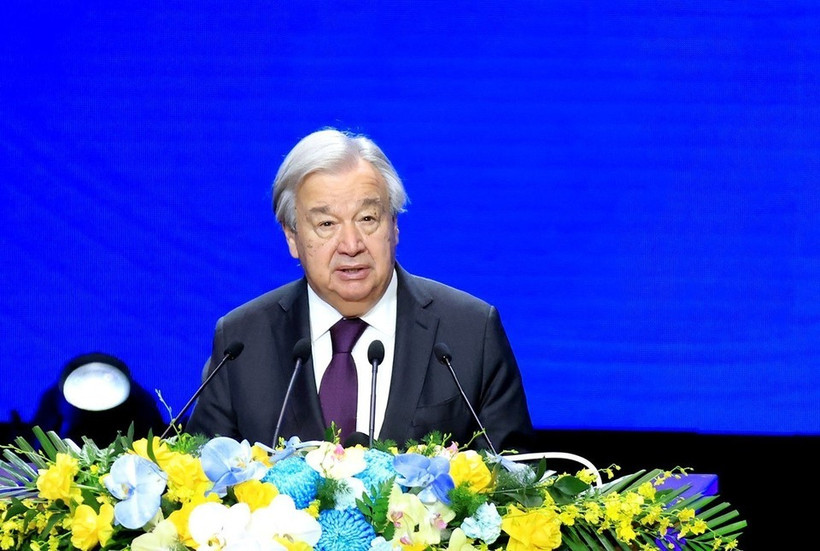
Hanoi (VNA) - UN Secretary-General Antonio Guterres described the UN Convention against Cybercrime (Hanoi Convention) as a powerful, legally binding instrument to strengthen collective defences against cybercrime, while addressing its signing ceremony in Hanoi on October 25.
The following is the full text of his remarks.
Your Excellency,
Mr. Luong Cuong, President of the Socialist Republic of Vietnam,
Excellencies,
Distinguished delegates,
Ladies and gentlemen,
I am honoured to join you here in Hanoi on this historic occasion.
I would like to thank Vietnam for hosting this signing ceremony and for its leadership in bringing us together.
When I last visited this proud country in 2022, I was reminded of its inspiring future focus, and the vital role it plays in the global electronic supply chain.
This makes Hanoi a fitting host for this moment. It is a city that embodies the spirit of the digital age –– innovation, possibility, and connection.
The United Nations is proud to partner with Vietnam in making this day possible.
Excellencies,
We are living in a time of extraordinary technological change.
Goods and services are moved with the click of a button.
Ideas cross the globe faster than we can process them.
And the devices in our pockets link us instantly across continents and oceans.
The digital age has shrunk the distances between us while expanding the opportunities before us.
But every technological revolution casts a shadow.
Over the years, cyberspace has become fertile ground for criminals, giving them unprecedented reach and the ability to move at speeds unimaginable just a decade ago.
Every day, sophisticated scams defraud families, steal livelihoods, and drain billions of dollars from our economies.
Horrific child sexual abuse material leaves behind lifelong trauma.
Illicit flows of money, concealed through cryptocurrencies and digital transactions, finance the trafficking of drugs, arms, and terror.
And businesses, hospitals, and airports are brought to a standstill by ransomware attacks.
The damage is beyond financial: it erodes trust in our institutions, undermines the rule of law, and causes real-world harm.
In cyberspace, nobody is safe until everybody is safe.
One vulnerability anywhere can expose people and institutions everywhere.
That is why we need a strong, collective, global response.
Until now, the world has lacked a common legal framework to unite our efforts.
But after five years of complex negotiations, Member States have delivered the first criminal justice treaty in more than two decades.
The UN Cybercrime Convention is a powerful, legally binding instrument to strengthen our collective defences against cybercrime.
It is a promise that fundamental human rights such as privacy, dignity, and safety must be protected both offline and online.
It is a testament to the continued power of multilateralism to deliver solutions.
And it is a vow that no country, no matter their level of development, will be left defenceless against cybercrime.
The Convention delivers a number of major breakthroughs.
One of the most significant is the sharing of digital evidence across borders.
This has long been a major obstacle to justice — with perpetrators in one country, victims in another, and data stored in a third.
The Convention provides a clear pathway for investigators and prosecutors to finally overcome this barrier.
It is also a victory for victims of online abuse.
For the first time in any international treaty, the non-consensual dissemination of intimate images is recognised as a criminal offence.
The Convention also encourages strong protections for victims — including access to recovery, compensation, and the removal of illicit content.
By creating binding obligations, the Convention turns our commitments into practical safeguards.
It complements the Pact for the Future and the Global Digital Compact, which seek to bridge the digital divide, and strengthen global digital cooperation.
And it is consistent with the objectives of the recently established Global Dialogue on AI Governance and the Independent International Scientific Panel on AI.
Together, these commitments and mechanisms form a strong foundation to make digital spaces safe and secure.
Excellencies,
Today’s signing is an important milestone in our shared journey to a safer digital world.
But it is only the beginning.
The true power of the Convention will lie in turning signatures into tangible action.
It must be ratified and entered into force, without delay.
It must be implemented, effectively and in full.
And it must be lived up to every day, by every party.
The United Nations is here to walk this path with you.
Through the UN Office on Drugs and Crime — the Secretariat of the Convention — and the UN Office of Legal Affairs, we will help countries bring this treaty into force, build capacity, strengthen investigations, and deepen cooperation across borders.
Let us seize this moment, and maximise the potential of this landmark agreement.
Let us build a cyberspace that respects everyone’s dignity and human rights.
And let us ensure that the digital age delivers peace, security, and prosperity for all.
Thank you.
VNA