Ho Chi Minh City to reboot industrial development strategy

The southern metropolis of Ho Chi Minh City needs to focus on improving domestic supply capacity and key market links with the southern economic region in order to promote industrial production and maintain the industrial sector's pillar role in the economy.
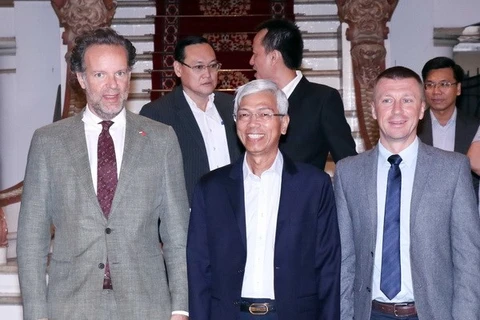
Ho Chi Minh City to reboot industrial development strategy ảnh 1Ho Chi Minh City to reboot industrial development strategy (Photo: VNA)

HCM City (VNA) – The southern metropolis of Ho Chi Minh City needs to focus on improving domestic supply capacity and key market links with the southern economic region in order to promote industrial production and maintain the industrial sector's pillar role in the economy.

Vo Van Hoan, Vice Chairman of the municipal People’s Committee said that over the past years, the economic structure of the city has changed, basically in line with the general development trend. Currently, the service sector accounts for a high proportion of the economy, at 65%, while industry and construction make up 31%, and agriculture about 1%.

However, a sustainable economic sector must be based on industrial production and agricultural production to create goods for consumers. An economy that focuses too much on services without a solid base in industrial production is at the mercy of outside economic swings.

Therefore, although the economic structure of the city is transforming towards modernity, the locality also needs to pay attention to promoting the development of production to create a balance and ensure long-term economic sustainability.

According to Hoan, the city developed industry quite early, as it is home to many industrial parks and export processing zones operating since the 1990s. This means that many technologies are now outdated. These industrial parks use a lot of resources, and labour with low added value, even in large manufacturing enterprises of the city.

Meanwhile, new and potential industries have not been invested in and developed, such as the fashion, film, cultural, and supporting industries. Thus, the local economy requires a drastic change in the mindset and actions of leaders at all levels. This is especially the case in the business community in order to create a revolutionary breakthrough for the city in industrial production in the coming years.

Dr. Truong Minh Huy Vu, Deputy Director of the Ho Chi Minh City Development Research Institute, said the locality is one of the major industrial hubs, making an important contribution to the industrial development of the country.

However, the industrial density of the city and the industrial structure of the country is experiencing a downward trend. In 2010, the city's industrial sector accounted for 15.38% of the country's industrial value-added. By 2021, the share dropped to only 8.7%, down 6.68 percentage points compared to 2010.

In fact, the city does not have available resources for industrial development, especially land resources. In addition, the city's policy to limit the attraction of investment projects in labour-intensive industries, coupled with the trend of industrial production relocation from the city to other provinces, also slow down the growth of the industrial sector.

According to Vu, in the coming time, the city needs to focus on exploiting local potential and advantages as a hub of science, technology, and innovation of the country for industrial development. The hub needs to effectively exploit the land and high-skilled human resources while applying the achievements of the 4.0 revolution to improve productivity, quality, and efficiency of sectors and industrial products.

HCM City also needs to support the development of priority industries, develop an industrial land fund, support capital and attract investment, and support the development of science-technology and the market, and trade promotion, Vu suggested./.
VNA

See more

Online event promotes Vietnamese products in Canada (Photo: VNA)

Online programme promotes Vietnamese products in Canada

Vietnam’s exports to Canada have doubled over the past five years to more than 13 billion USD, reflecting strong cooperation potential, especially as the Comprehensive and Progressive Agreement for Trans-Pacific Partnership (CPTPP) continues to take effect.

Vehicles transporting import and export goods at Mong Cai international border gate. (Photo: VNA)

Mong Cai smart border gate to open new era for cross-border trade

The smart border gate will be based on Industry 4.0 technologies, with cross-border data connectivity serving as its core. Beyond modernising a single customs checkpoint, the project aims to create a regional-scale “digital gateway” facilitating more efficient trade flows.

Vietnam’s Trade Counsellor in Italy Duong Phuong Thao. (Photo: VNA)

Spring Fair 2026: Trade fairs boost Vietnam–Italy trade connectivity

Vietnam’s Trade Counsellor in Italy Duong Phuong Thao said the bilateral relations are developing positively, providing a solid foundation for economic and trade ties. The Italian Government, financial institutions and business community regard Vietnam as a key market in Southeast Asia.

The booth of the Vietnam Trade Office at a trade fair in Morocco. (Photo published VNA)

Spring Fair 2026: opportunities for trade between Vietnam and Morocco

Tran Le Dung, Head of the Vietnam Trade Office in Morocco, said Morocco has accumulated extensive experience in hosting large-scale agricultural trade fairs and exhibitions. Flagship events include the annual International Agricultural Exhibition in Morocco (SIAM), alongside specialised shows covering food and beverages, textiles, handicrafts and logistics.

Prime Minister Pham Minh Chinh delivers closing remarks at the Spring Fair 2026. Photo: VNA

Prime Minister attends Spring Fair 2026 closing ceremony

After 12 vibrant and colourful days, the first Glorious Spring Fair 2026 vividly portrayed the vitality of the nation’s economic and consumer activities at the beginning of the new year, leaving a strong impression on the public and business community.

Vu Thi Thuy, Deputy Consul General and Head of the Vietnam Trade Office in Hong Kong Special Administrative Region (China). (Photo: VNA)

Hong Kong experience offers insights for Vietnam–Hong Kong trade cooperation

At this year’s Spring Fair, the Vietnam Trade Office in Hong Kong facilitated the participation of several Hong Kong enterprises in Vietnam to conduct market surveys, seek import sources and showcase their products. Notably, a company under the Hong Kong Productivity Council presented technological solutions for smart homes and smart manufacturing at the event.

People shop for Tet at a supermarket. (Photo: VNA)

Vietnamese goods dominate Tet market in Mekong Delta

In key retail hubs such as Can Tho, Long Xuyen and My Tho, high-quality Vietnamese goods account for 85–90% of Tet market share. Surveys at major supermarket chains and traditional markets show that consumers this year are prioritising locally-processed foods, confectionery and beverages.

Prime Minister Pham Minh Chinh strikes the gong to inaugurate the Vietnam International Financial Centre in Ho Chi Minh City. (Photo: VNA)

Int’l Financial Centre – A catalyst for Vietnam’s economic breakthrough: Deputy PM

Standing Deputy Prime Minister Nguyen Hoa Binh, who chairs the IFC’s Governing Council, said that the establishment of the centre in Ho Chi Minh City and Da Nang represented the initial realisation of a major task set out in the Resolution of the 13th National Party Congress. While characterising the launch as an early milestone rather than a final achievement, he underscored that it reflected meticulous, methodical and determined preparations at multiple levels of government.

Kobayashi Yosuke, Chief Representative of JICA Vietnam. (Photo: JICA Vietnam)

JICA hails milestones in Vietnam partnership amid green, digital push

In line with Vietnam’s development priorities and its goal of becoming a high-income country by 2045, JICA will continue to work with a wide range of partners in both Vietnam and Japan to mobilise technical and financial resources for more sustainable and inclusive cooperation