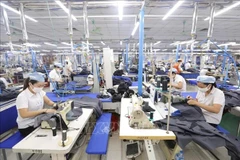
Vietnam is ahead of ASEAN in cutting interest rates. (Photo: VietnamPlus)
Hanoi (VNA) – HSBC Vietnam has forecast that the State Bank of Vietnam (SBV) will lower the policy interest rate by 50 basis points in the third quarter of 2023 before maintaining the rate throughout the year 2024.
Vietnam is ahead of ASEAN in cutting interest rates
According to a report released recently by HSBC's Global Research department, while economies in the Southeast Asian region are still closely monitoring actions from the Fed, Vietnam stands out as a special case by cutting interest rates as early as the first half of 2023.
HSBC’s experts said the reason Vietnam is cutting interest rates ahead of the US Federal Reserve (Fed) is due to lower inflation, current account surpluses, as well as the need for more growth in the second half of 2023.
Analysts predicted that in the future, Vietnam might exact another round of interest rate cuts.
HSBC expects Thailand to raise its interest rates by 25 basis points in the third quarter, and then maintain it throughout 2024. Indonesia is projected to keep its interest rate unchanged in the third quarter, but then proceed to sequentially cut it by 25 basis points in the following three quarters.
After the interest rate hike in the second quarter, HSBC believes that Malaysia will maintain its policy until the end of 2023. Meanwhile, the Philippines is forecast to retain its interest rate until the end of the second quarter of next year, then gradually ease it by 25 basis points every quarter.
According to HSBC experts, inflation in Vietnam tends to increase in 2024, but it's not anticipated to be sufficient to trigger an interest rate hike. Experts anticipate that inflation will rise by 3% in the second half of 2024.
 According to HSBC’s experts, inflation in Vietnam tends to increase in 2024, but it's not anticipated to be sufficient to trigger an interest rate hike. (Photo: VietnamPlus)
Within ASEAN, economic growth in Vietnam and Singapore is currently being challenged by trade-related issues. Meanwhile, economic growth in the Philippines and Thailand remains stable.
Vietnam is currently facing challenges in multiple aspects. Its GDP growth rate in the first half of 2023 rose by only 3.7% year-on-year, a significant slowdown from the 8% rate in 2022. Singapore is also dependent on global trade. Meanwhile, Singapore’s economy also depends on global trade.
Both economies have reasons to lower interest rates ahead of the Fed. However, the growth in Vietnam has slowed down to the extent that the central bank had to reverse its tightening policy in the first half of 2023.
Another reason prompting the central bank to take early action is the deterioration of the credit market. While most ASEAN economies are experiencing credit growth, Vietnam stands as an exception. Vietnam’s credit growth has slowed significantly since November 2022 and has yet to reach its lowest point. To address this situation, the SBV had to swiftly cut interest rates.
HSBC experts expressed concern that the early interest rate cuts by central banks within the ASEAN bloc, diverging from the Fed's trajectory, could potentially lead to a situation of massive capital outflows and sudden exchange rate drops as investors seek higher profits.
This is a core issue that policymakers need to carefully consider, perhaps only after inflation and growth.
 Vietnam is currently facing challenges in multiple aspects. (Photo: Vietnamplus)
According to HSBC, Vietnam is currently facing a situation where domestic demand is weakening and imports are decreasing, leading to a more favourable position of its current account.
To a certain extent this also helps stabilise the VND/USD exchange rate and provides some room for monetary management agencies to somewhat detach themselves independently from the Fed, focusing more on domestic issues, HSBC experts said./.