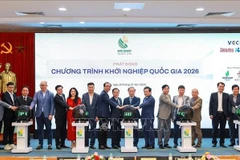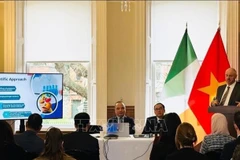
Speaking at the seminar titled "Institutions and planning – Opportunities for blue economy development", held on the morning of June 6 in Dong Hoi city (Quang Binh province), Deputy Minister of Agriculture and Environment Le Minh Ngan emphasised the need for a holistic implementation of the National Marine Spatial Planning, in coordination with sectoral plans such as those for fisheries, electricity, and renewable energy. These must be guided by a long-term vision, and closely aligned with sustainable development goals and major national strategies of the Party and State, he said.
Key among these are four recent resolutions: Resolution 57 on developing science, technology, innovation and digital transformation; Resolution 59 on international integration in the new context; Resolution 66 on legislative reform and law enforcement; and Resolution 68 on private sector development. These are referred to as the "Institutional Quartet"- pillars supporting Vietnam’s steady progress into a digital, innovative, and sustainable blue economy era.
Deputy Minister Ngan underscored that the Party and State have always regarded marine economic development as a key pillar of the national sustainable development strategy.
Central to this is Resolution No. 36 by the Party Central Committee on the Strategy for Sustainable Development of Vietnam’s Maritime Economy to 2030, with a vision to 2045. The resolution outlines a strategic vision and a comprehensive set of solutions to realise the national ambition: “Vietnam to become a strong maritime nation, and prosper from the sea.”
In 2025, the Central Committee issued Resolution No. 60 on reorganising provincial-level administrative units and developing a two-tier local government model. This reform is expected to have a direct impact on marine governance and coastal zone development.
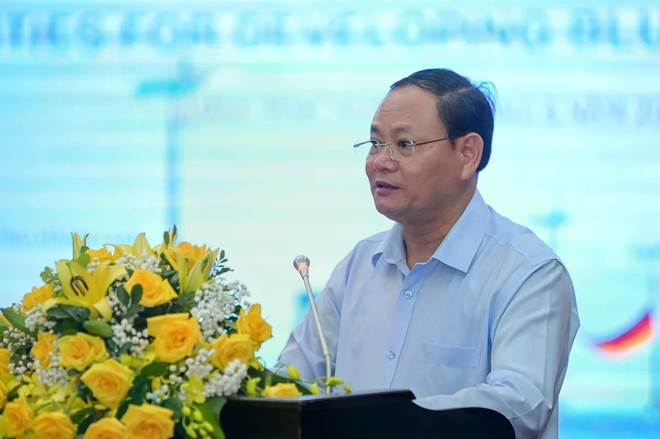
“These landmark resolutions are the ‘Institutional quartet.’ paving the way for Vietnam to firmly advance into the era of the blue economy, digitalisation, and innovation,” Ngan stressed.
At the seminar, participants agreed on several key perspectives to help Vietnam become a strong maritime nation enriched by the sea.
In particular, with regard to new institutions, especially the government’s Decree 65, delegates agreed that these legal documents are laying an important legal foundation for the development of offshore wind power.
However, for these policies to be effectively implemented, legal frameworks must be harmonised, enforcement capacity improved, and inter-agency coordination strengthened, they noted./.