Japan, UNICEF join hands to strengthen children’s resilience to natural disasters, climate change

Natural disasters in Vietnam have been increasing in both frequency and intensity. Typhoon No.3 in 2024 (Yagi), along with severe floods, inundation and landslides in 2025, caused significant human and material losses. This underscores the need for targeted and sustainable investments in disaster risk reduction and early warning, particularly for children and vulnerable communities.

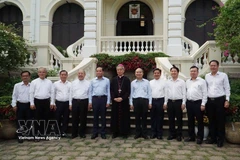
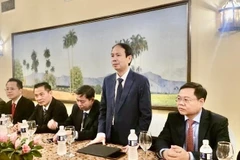
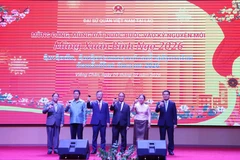
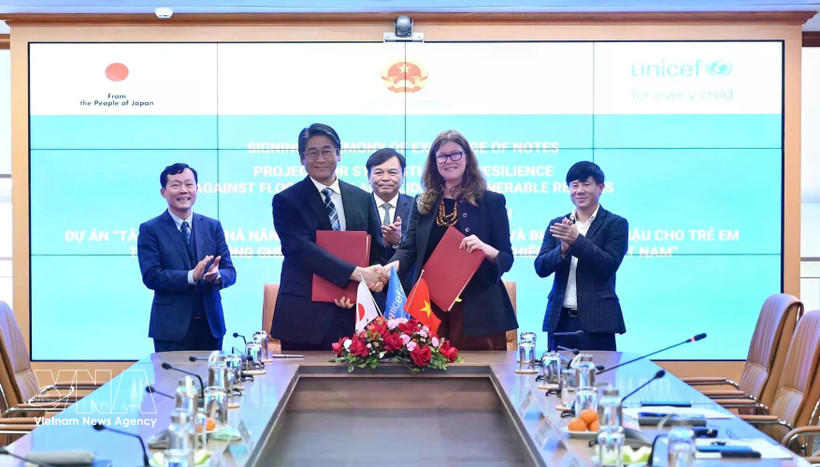
Japanese Ambassador to Vietnam Ito Naoki (first row, left) and UNICEF Representative in Vietnam Silvia Danailov exchange the notes at the ceremony. (Photo: VNA)

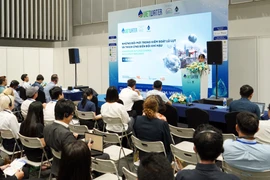
Hanoi (VNA) - The Japanese Embassy in Vietnam and the United Nations Children’s Fund (UNICEF) in Vietnam on February 10 jointly held a ceremony to sign an exchange of notes for a project to strengthen children’s resilience to natural disasters and climate change through integrating disaster risk reduction education in Vietnam.

The signing was witnessed by Deputy Minister of Agriculture and Environment Nguyen Hoang Hiep.

Funded by the Japanese Government and implemented through UNICEF in Vietnam, the project will be carried out by the Vietnam Disaster and Dyke Management Authority under the Ministry of Agriculture and Environment, with total funding of 6 million USD for the 2026–2030 period.

It aims to better protect children, families and communities in disaster-prone areas by improving access to information and enhancing knowledge and skills for disaster preparedness, response and recovery, while strengthening long-term resilience to natural disasters and climate change.

It is expected to benefit around 27 million children, families and communities nationwide through improved disaster risk reduction planning, early warning and prevention. Targeted activities in Cao Bang, Lao Cai, Nghe An and Ha Tinh are projected to directly support approximately 2.2 million children and 7 million people living in high-risk areas.

Addressing the ceremony, Deputy Minister Nguyen Hoang Hiep stressed that the project would help strengthen Vietnam’s disaster risk reduction system, with a particular focus on the most vulnerable groups, especially children.

He praised the long-standing cooperation with Japan and UNICEF, reaffirming the ministry’s commitment to enhancing resilience for children, families and communities in areas most exposed to climate-related disasters.

Japanese Ambassador to Vietnam Ito Naoki said Japan was pleased to continue its close cooperation with Vietnam and UNICEF in advancing disaster risk reduction efforts. Through improved risk identification and analysis, early warning systems, disaster risk governance and prevention, the project would help mitigate the impacts of floods, inundation and landslides, contributing to a safer and more resilient future for children and communities across Vietnam.

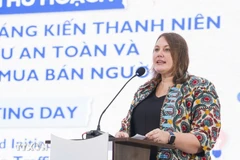
UNICEF Representative in Vietnam Silvia Danailov noted that children, while contributing least to climate change, were among those most severely affected by its impacts. A child-centred disaster risk reduction approach, she said, will help ensure disaster management systems and social sectors are inclusive and responsive to children’s needs, while strengthening prevention and resilience at the community level.

With support from the Japanese Government and close coordination with national partners, the project would contribute to better protecting children and ensuring that no child is left behind.

Natural disasters in Vietnam have been increasing in both frequency and intensity. Typhoon No.3 in 2024 (Yagi), along with severe floods, inundation and landslides in 2025, caused significant human and material losses, highlighting gaps in risk information systems, early warning mechanisms and local prevention efforts. This underscores the need for targeted and sustainable investments in disaster risk reduction and early warning, particularly for children and vulnerable communities.

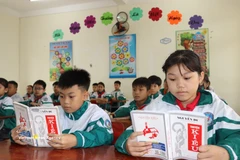
Through the project, Vietnam will strengthen disaster risk information systems to support policy-making, planning and early warning at both central and local levels; enhance disaster risk governance and risk-informed investments, including safer schools and community infrastructure; improve community-level prevention and resilience through local early warning mechanisms; integrate disaster risk reduction and climate change education into the national curriculum; and promote youth participation in disaster preparedness and response.

The project aligns with Vietnam’s commitments under the Sendai Framework for Disaster Risk Reduction 2015–2030, the Paris Agreement on climate change and the Sustainable Development Goals, while also reflecting Japan’s commitment to human security and dignity. It builds on the long-standing cooperation among the Japanese Government, UNICEF and the Vietnamese Government in advancing disaster risk reduction and resilience-building efforts./.
VNA

See more

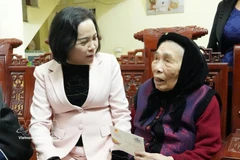
Vice Chairwoman Nguyen Thi Thanh visits Vietnamese Heroic Mother Nguyen Thi Thom. (Photo: VNA)

NA Vice Chairwoman presents Tet gifts in Ninh Binh province

Thanh handed over 1,564 gift packages, each worth 1 million VND (about 37 USD), to policy beneficiary families, the poor and those in difficult circumstances. The gifts were distributed through the provincial Vietnam Fatherland Front Committee, socio-political organisations, relevant associations and local authorities.

Nguyen Thanh Tung, head of the VEPH delegation, speaks at the meeting with Cuban Vice Minister of Higher Education Reynaldo Veláquez Zaldivar. (Photo published by VNA)

Vietnam, Cuba strengthen cooperation in educational publishing

During a working session with Cuban Vice Minister of Higher Education Reynaldo Veláquez Zaldivar, the two sides discussed coordination to support Cuba in printing and distributing books in the coming period, while enhancing information exchange and sharing experience in the publishing sector.

Vietnamese Ambassador to Laos Nguyen Minh Tam (third from left) and Lao Party and State leaders at the Tet gathering (Photo: VNA)

Vietnam–Laos solidarity highlighted in Tet gathering

Regarding bilateral ties, Ambassador Nguyen Minh Tam affirmed that Vietnam–Laos relations have been elevated to a new height as a great friendship, special solidarity, comprehensive cooperation and strategic cohesion framework following the state visit to Laos by Party General Secretary To Lam in December 2025.

Illustrative image (Photo: VNA)

Resolution 71 seeks to renew teaching, learning toward effectiveness

Dr Nguyen Thi Giang from the Institute of Linguistics under the Vietnam Academy of Social Sciences said that the practical implementation of Resolution No. 71 should focus on enhancing learners’ learning capacity, viewing this as the starting point for renewing teaching and learning toward substance and effectiveness.

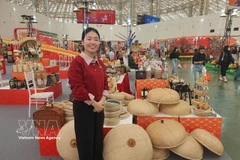
A booth showcasing bamboo and rattan handicrafts from Ninh So craft village in Hong Van commune (Hanoi) at the Spring Fair 2026. (Photo: VNA)

Spring Fair 2026: Keeping spirit of Vietnamese bamboo alive in modern life

In addition, bamboo and rattan products are highly versatile, meeting a wide range of daily needs - from household items to interior décor and gifts. Thanks to artisans’ skill, each product bears its own distinctive character, reflecting aesthetic value and Vietnam’s traditional cultural identity. This is why bamboo and rattan products are increasingly embraced by diverse consumer groups and are steadily making their way onto international markets.

Foreign tourists visit Pu Luong in Thanh Hoa province. (Photo: VNA)

Vietnam ranked among world’s top retirement destinations

Vietnam ranked 9th in the 2026 list, earning high marks for its affordable living costs, diverse living environment, and steadily improving healthcare system and urban infrastructure. While living costs may be slightly higher than in some other Asian destinations, the country is viewed as offering a balanced combination of affordability, living conditions and long-term development potential.

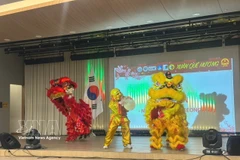
A lion dance performance by the Hwaseong Lion Dance troupe at the programme. (Photo: VNA)

Homeland spring gathering tightens Vietnam–Korea community links

Overseas Vietnamese, wherever they live and work, always turn toward the homeland and wish to contribute knowledge, experience, resources and responsibility to national development. Following the 14th National Party Congress, the community expects reform policies and strategic orientations to soon materialise, unlocking the collective strength of society to help Vietnam advance further.

Passengers travel on urban railway Line 2A Cat Linh-Ha Dong. (Photo: VNA)

Hanoi Metro adjusts peak hours, train schedules on two urban railway lines

Hanoi Railway Company Limited (Hanoi Metro) has announced that to better meet rising passenger travel demand, especially during peak hours, it will adjust peak-hour time frames and apply new train schedules on both urban railway Line 2A Cat Linh–Ha Dong and Line 3.1 Nhon–Hanoi Station from February 9.

Vietnamese Ambassador to Japan Pham Quang Hieu commends collectives that have made significant contributions to community work in 2025. (Photo: VNA)

Homeland Spring 2026 brings overseas Vietnamese together in Japan

The ambassador expressed his delight at the growing strength of the Vietnamese community in Japan and its active contributions to Vietnam’s development as well as to the bilateral ties. Currently, the Vietnamese community in Japan remains the second-largest of its kind in the world, with around 700,000 people and an average annual increase of 50,000–60,000.

Colonel Pham Le Xuan Binh, Commander of the Can Tho Border Guard Command, presents results of IUU fishing prevention efforts. (Photo: VNA)

Can Tho tightens controls on IUU fishing

Local officials reported that no “three-Nos” vessels that lack proper registration certificates, fishing licenses and inspection certifications remain in the locality.