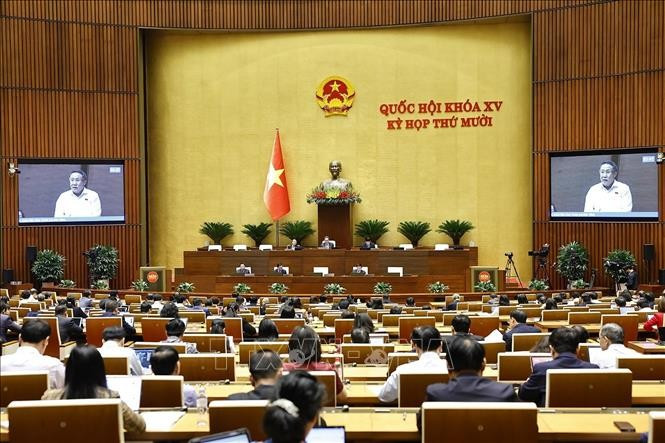
Hanoi (VNA) - National Assembly (NA) deputies discussed the draft Law on Investment (revised) on November 27 as part of their ongoing 10th session, with many supporting the proposal to ban nitrous oxide (N2O) and new psychoactive substances and add them to the list of prohibited business lines.
Deputy Pham Trong Nhan of Ho Chi Minh City said these substances are damaging health faster and more severely than e-cigarettes and should not remain legal in any form.
Deputy Nguyen Anh Tri of Hanoi welcomed the inclusion of e-cigarettes and heated tobacco products and proposed clarifying Article 6 to fully ban production, trading, import, storage, transport and use of these products and other addictive substances. He also urged an immediate ban on recreational N2O.
On conditional business lines in Article 7, some deputies called for further review and post-review quality control. Deputy Dao Chi Nghia of Can Tho supported shifting from pre-inspection to post-inspection, but suggested adding minimum quality requirements and reinstating mandatory professional certificates for highly specialised fields.
Deputy Le Hoang Anh of Gia Lai backed the removal of unsuitable business lines but recommended narrowing overly broad groups, including food trading, tightening the scope for e-commerce, introducing a three-year review cycle and removing “other vague requirements” to prevent hidden sub-licences.
Deputy Pham Van Hoa of Dong Thap urged continued review of 227 conditional business lines and said sector-specific requirements should be managed by competent ministries. He pointed out inconsistencies between auditing and accounting regulations and asked the Ministry of Finance to revisit this issue.
Deputies also discussed investment incentives. Deputy Ha Sy Dong of Quang Tri welcomed Articles 15-18 but stressed that incentives must be tied to technology transfer. He proposed that projects receiving special incentives must transfer technology at level 2 or higher and train at least 200 high-skilled workers annually, with penalties for non-compliance. Regarding Article 29, he called for clear eligibility criteria and suggested limiting special procedures to priority technologies like semiconductors, AI data centres, and renewable energy, with investments starting from 50 million USD.
Deputy Nguyen Hoang Bao Tran from Ho Chi Minh City said Article 14 needs a clearer distinction between incentives which reduce burdens such as tax and land and support measures that enhance capacity, such as training and R&D. Without this, she warned of duplication or ineffective implementation. She also recommended ceilings on certain incentives and mandatory impact assessments.
Concluding the session, Minister of Finance Nguyen Van Thang said the ministry will cut conditional business lines by around 50 from the initial 25.
He acknowledged deputy proposals of the addition of N2O and other psychoactive substances to the banned list and said ministries will coordinate to refine it. After the law takes effect, ministries would continue revising conditions and move fully to post-inspection to ensure business freedom for citizens and enterprises./.
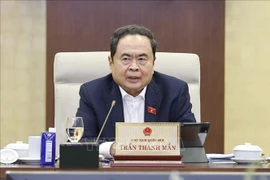
NA Standing Committee examines special incentives for HCM City, Da Nang
The National Assembly Standing Committee continued its 51st session in Hanoi on November 24 by reviewing draft resolutions that amend and supplement special incentives for Ho Chi Minh City and Da Nang.