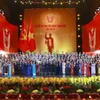
Legislators debate draft revised Law on Special Consumption Tax

Several NA deputies advocated higher special consumption rates for sugary drinks while other pushed for a phase approach so that enterprises could adjust their production and business plans.

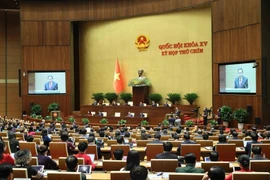
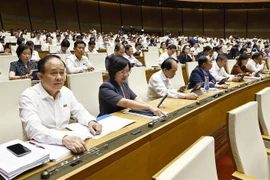
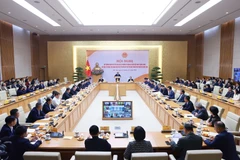
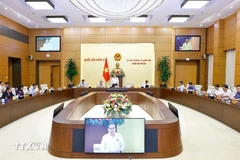
At the 9th session of the 15th National Assembly (Photo: VNA)

Hanoi (VNA) – The National Assembly (NA) is convening a plenum on May 9 morning to look into several bills, including the draft revised Law on Special Consumption Tax.

Following the presentation of an explanatory report on amendments, lawmakers will discuss several contentious issues in the draft.

According to the verification report delivered at the 43rd meeting of the NA Standing Committee, opinions remained divided on appropriate tax rates for sugary drinks. Several NA deputies advocated higher rates while other pushed for a phase approach so that enterprises could adjust their production and business plans.

The verification authority noted that sugary beverages are a new category added to taxable items. It recommended imposing reasonable tax rates to gradually limit the consumption of high-sugar products and encourage manufacturers to produce lower-sugar alternatives. Responding to legislators' concerns, it suggested either delaying the tax imposition by 1–2 years or introducing a tiered taxation schedule, enabling a smoother transition for businesses.

Meanwhile, the drafting body stood by its original proposal, maintaining that the suggested 10% tax rate is appropriate for a newly taxable item. They stated that the move will effectively encourage the production of lower-sugar beverages and raise consumer awareness of sugar consumption, with plans to evaluate the legislation's effectiveness over time and make reality-based proposals.

Regarding the tax rates for hybrid vehicles, the verification authority recommended maintaining current law provisions to avoid difficulties for businesses, specifically proposing tax incentives for gasoline-electric hybrid vehicles if gasoline accounts for no more than 70% of energy used.

Meanwhile, the drafting committee held that the non-plug-in hybrid electric vehicles primarily run on gasoline and harm the environment, and therefore should not qualify for preferential tax rates.

Also in the morning, legislators will consider the draft laws revising and supplementing some articles of the Law on Planning and the Law on Enterprises.

In the afternoon, they will listen to a report on amendments to the draft Law on Digital Technology Industry and discuss several areas of contention./.

VNA
See more

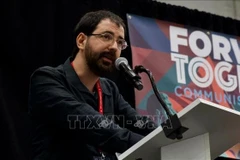
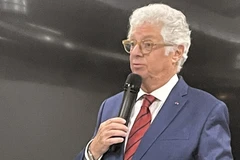
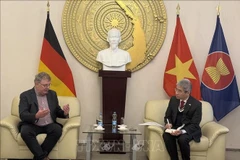
Assaf Talgam, a historian and a journalist of Zo HaDerekh, the official newspaper of the Communist Party of Israel. (Photo: VNA)

CPV's leadership - central factor shaping Vietnam’s enduring stability, impressive achievements: Israeli historian

Talgam said that from a comparative and historical perspective, the CPV’s leadership has been the central factor underpinning the country’s enduring political stability and impressive development trajectory. In a world marked by rapid and unpredictable changes, few political organisations have been able to maintain continuity of leadership while simultaneously adapting their governance approach as effectively as the CPV.

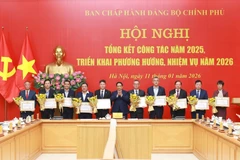
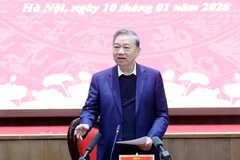
Prime Minister Pham Minh Chinh presents Certificates of merit from the Government’s Party Committee to individuals with outstanding achievements. (Photo: VNA)

Prime Minister outlines five specific strategies for Government’s Party Committee

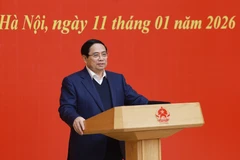
PM Chinh noted that the Government’s Party Committee exercised comprehensive leadership over the Government's operations, proactively and effectively responded to emerging issues, with a particular focus on socio-economic development. As a result, 2025 witnessed high economic growth, sustained macroeconomic stability and ensured major balances.

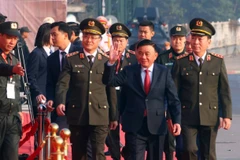
Politburo member, Standing member of the Party Central Committee’s Secretariat Tran Cam Tu attends the rehearsal. (Photo: VNA)

Security forces stage rehearsal for 14th National Party Congress

The People’s Public Security forces have been praised for their core role in closely working with the army and relevant ministries and agencies, with success in thwarting hostile plots at an early stage, drastically combating fake news and disinformation surrounding the 14th National Party Congress.

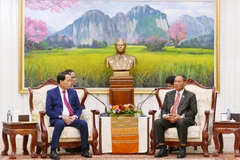
Senior Lieutenant General Le Quoc Hung (L), member of the Communist Party of Vietnam (CPV) Central Committee and Deputy Minister of Public Security, and General Vilay Lakhamfong, Politburo member and permanent member of the Secretariat of the Lao People’s Revolutionary Party (LPRP) Central Committee. (Photo: VNA)

Deputy Minister of Public Security congratulates Lao officials following succesful 12th National Party Congress

Deputy Minister of Public Security Senior Lieutenant General Le Quoc Hungconveyed the warmest congratulations of the Central Public Security Party Committee, the Ministry of Public Security leadership, and the Vietnamese People’s Public Security Forces to Lakhamfong and other Lao public security leaders on the congress’s success and their election to key leadership positions for the new term.

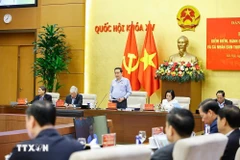
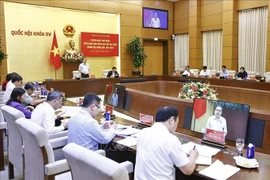
A session of the National Assembly Standing Committee. (Photo: VNA)

NA Standing Committee's key work agenda for 2026 approved

A major focus will be preparations for the election of deputies to the 16th NA and to People’s Councils at all levels for the 2026–2031 term. The NASC will coordinate with the National Election Council, the Government, the Vietnam Fatherland Front Central Committee, and relevant agencies and organisations to continue implementing the election plan, organise oversight of the electoral process, and carry out its duties and powers as prescribed.

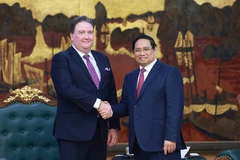
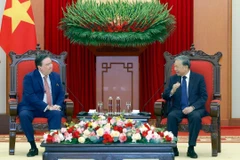
Party General Secretary To Lam receives US Ambassador Marc Evans Knapper in Hanoi on January 9, 2026. (Photo: VNA)

Party leader receives outgoing US Ambassador

Vietnam always values its relationship with the US and looks forward to continuing close cooperation with the US government to deepen bilateral relations based on mutual respect for each other’s independence, sovereignty, territorial integrity, and political institutions, contributing positively to peace, stability, cooperation, and development regionally and globally.