Manufacturing sector improves with business confidence hitting 16-month high

New orders increased for the second consecutive month, and at a much faster pace than in September. The rate of expansion was the quickest since July 2024, reflecting improved customer demand.

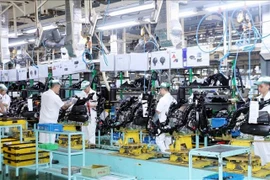
Manufacturers respond to higher new orders by ramping up production, which increased at the sharpest pace since July 2024. (Photo: VNA)

Hanoi (VNS/VNA) - Vietnam’s manufacturing sector saw a strong rebound in October as the S&P Global Vietnam Manufacturing Purchasing Managers’ Index (PMI) rose to 54.5, up sharply from 50.4 in September, signalling a solid improvement in sector health. Business conditions strengthened to the greatest degree since July 2024, according to the latest S&P Global survey.

All five components of the headline PMI contributed to the upward movement in October.

New orders increased for the second consecutive month, and at a much faster pace than in September. The rate of expansion was the quickest since July 2024, reflecting improved customer demand.

New export orders also contributed to overall growth, rising for the first time in a year, albeit modestly.

Manufacturers responded to higher new orders by ramping up production, which increased at the fastest pace since July 2024. Output has now risen in each of the past six months.

Alongside stronger production growth, firms were more optimistic about the 12-month outlook for output. Business sentiment reached a 16-month high amid confidence that new orders will continue to rise and plans to expand production capacity.

The rise in new orders and higher production requirements also drove employment growth in October, the first in just over a year. Manufacturers increased workforce numbers in response to emerging signs of pressure on operating capacity. Backlogs of work rose for the first time in ten months, at the fastest pace in over three and a half years. Some firms linked this accumulation to both higher orders and stormy weather conditions.

Adverse weather and flooding also contributed to longer supplier delivery times, with lead times lengthening to the greatest extent since July.

Higher new orders and greater production requirements encouraged firms to expand purchasing activity for the fourth consecutive month. This rise in purchasing led to an accumulation of stocks of purchases, the first in just over two years. Stocks of finished goods decreased as firms used inventories to meet orders, although the reduction was slight and the smallest since January 2024 due to increased production.

Input cost inflation accelerated sharply in October, reaching its highest level since July 2024. Around 27% of respondents reported higher prices for raw materials and supply shortages. Output price inflation also quickened, hitting a 40-month high.

Andrew Harker, economics director at S&P Global Market Intelligence, said: "The Vietnamese manufacturing sector moved up a gear in October, seeing much stronger increases in output and new orders during the month. Positively, the strength of the expansions was sufficient to enable firms to take on extra staff and build inventories of inputs.

"Whether these growth rates can be sustained in the months ahead remains to be seen, but there is clearly some positive momentum in the sector at present.

"Inflationary pressures built again, however, and are now relatively elevated. For now, customers are happy to look through price increases and commit to new orders, but this may start to wane should rates of inflation pick up further.”/.

VNA

See more

Thanks to digital transformation among local officials, Tam Dao commune of Phu Tho province has achieved an almost 100% on-time rate for processing administrative applications, helping improve public services for residents. (Photo: VNA)

Institutional reform fuels private sector's growth in Phu Tho province

The private sector is increasingly emerging as a key growth engine of the economy. To unleash its potential and ensure sustainable development, the northern province of Phu Tho is stepping up institutional and administrative reforms to cut costs, shorten procedures, and build a more transparent, business-friendly investment climate.

Hoa Phat Wharf inside the Dung Quat Economic Zone (Photo: VNA)

Dung Quat EZ, Quang Ngai IPs draw nearly 19.4 bln USD

The Dung Quat Economic Zone and Quang Ngai industrial parks have so far attracted 441 projects worth around 19.4 billion USD, according to the Dung Quat Economic Zone and Quang Ngai Industrial Parks Authority (DEZA).

The Kim Long Motor Hue factory (Photo: VNA)

Hue courts capital to turn industrial zones into growth engine

The economic and industrial zones in Hue city host more than 200 active investment projects worth over 152 trillion VND (5.84 billion USD), with 139 already operational. Since the start of 2026, they have generated about 32 trillion VND, contributed 4.2 trillion VND to the state budget and brought in 730 million USD in exports, while employing more than 46,000 workers.

Processing cashew nuts for export at Nguyen Thong Co., Ltd. in Dak Lak province. (Photo: VNA)

Vietnam’s exports to New Zealand post strong growth

According to the Customs Department, two-way trade reached 844 million USD in the first half of 2026, of which Vietnam’s exports to New Zealand totaled 399.7 million USD, up 18.8% year-on-year, while imports stood at 444 million USD.

Starting from September 2026, agricultural products from the Mekong Delta are expected to be transported directly from Cai Cui Port to Guangxi, China. (Photo: VNA)

Investing in logistics to boost agricultural production and exports

Logistics is increasingly becoming a major bottleneck for exports as transport costs rise and requirements for data management, low emissions and supply chain transparency become more stringent, requiring coordinated investment in logistics infrastructure, data infrastructure and transport capacity.

Harvesting rice in the Mekong Delta (Photo: VNA)

Vietnam seen as gateway for Canadian farm produce to ASEAN

As Canada steps up trade diversification and seeks to reduce its dependence on the North American market, Vietnam could serve both as a market for Canadian goods and a base for Canadian businesses to build production capacity and expand operations in the region.

Illustrative image (Photo: VNA)

Turkish cooperatives open sourcing channel for Vietnamese businesses

The Vietnam Trade Office recommended that Vietnamese businesses in agriculture and food actively study cooperative networks in different localities in Türkiye and consider them an additional channel for accessing raw materials, processing partners, and distribution networks.

Delegates at the signing ceremony (Photo: VNA)

VPI, Beicip-Franlab Asia deepen oil, gas cooperation

Under the MoU, VPI and Beicip-Franlab Asia will undertake advanced studies in geology, geophysics, and reservoir engineering to support exploration, field development, and oil and gas resource assessment.

A visitor explores Vietnamese coffee at the expo. (Photo: VNA)

Vietnam pushes coffee, farm produce at Hong Kong food expo

After nearly 200 years, especially since the Doi Moi (renewal) began in 1986, Vietnamese coffee is now exported to more than 100 countries and territories and supports about 2.6 million jobs. Vietnam remains the world’s second largest coffee exporter, holding roughly 19-21% of the global market, and is the top producer of Robusta coffee.

Delegates at the event (Photo: VNA)

Da Nang hosts 2026 International Logistics Forum

Co-hosted by the Ministry of Industry and Trade and the Da Nang People’s Committee, the forum put modern logistics, strategic infrastructure, digital transformation, green growth and international connectivity at the centre of discussions.