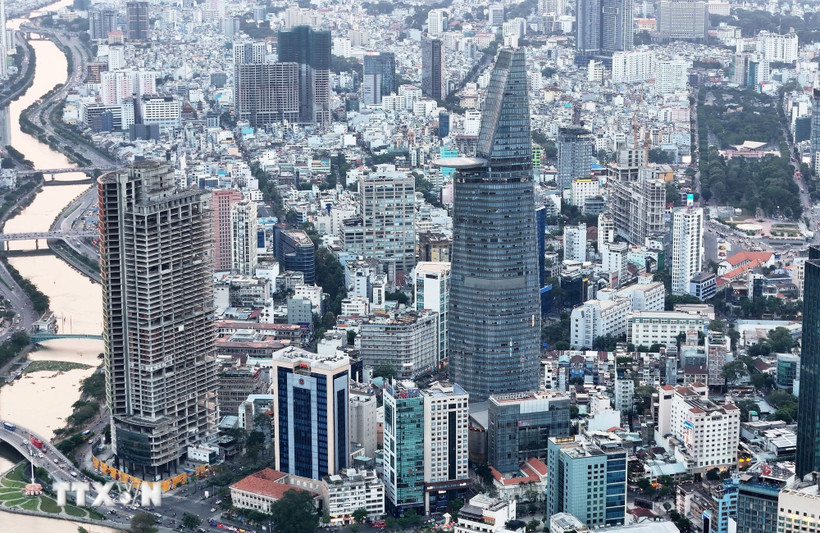
Ho Chi Minh City (VNA) – With the impressive results achieved in 2025, Ho Chi Minh City has not only reaffirmed its role as Vietnam’s economic locomotive but is also poised for “new development opportunities”, with ambitions of double-digit growth, per capita GRDP of 9,800 USD, and a long-term vision of becoming an international mega city ranked among the world’s top 100 most liveable ones.
Contributing 23.5% of national GDP and one-third of total state budget revenue, the southern metropolis closed 2025 with record-breaking figures despite challenges stemming from administrative apparatus restructuring and the expansion of its development space.
On the occasion of New Year 2026, Nguyen Van Duoc, member of the Party Central Committee, Deputy Secretary of the Ho Chi Minh City Party Committee, and Chairman of the municipal People’s Committee, talked to the Vietnam News Agency about the city’s key achievements and the roadmap to realise the goals set by the city’s Party organisation for 2026 and the 2025–2030 term.
Reporter: Could you highlight Ho Chi Minh City’s outstanding socio-economic achievements in 2025, particularly since July 1, when the two-tier local administration model officially came into operation, and following the merger with Binh Duong and Ba Ria – Vung Tau provinces?
Chairman Nguyen Van Duoc: The year 2025 marked a particularly important historical milestone. It was not only the final year of the 2021–2025 five-year socio-economic development plan, but also a period in which the city underwent a profound transformation in both development space and governance institutions. This phase was widely seen as a true “test” of the governance capacity of the new city.
From July 1, 2025, when the two-tier local administration model was officially implemented and the merger with Binh Duong and Ba Ria – Vung Tau provinces was completed, the new Ho Chi Minh City became a mega city with an area of more than 6,772 sq.km and a population of around 14 million. Administrative unit reorganisation was carried out decisively, reducing the number of commune-level units from 441 to 168, while fully ensuring policies and benefits for officials and civil servants. This enabled the new administrative apparatus to operate smoothly, effectively, and efficiently from the outset.
Against that backdrop, with the concerted efforts by the entire political system and the consensus, support, and active participation of the people and business community, the city achieved results that are both commendable and a source of pride. These achievements are reflected in 12 key highlights that together paint a picture of comprehensive and breakthrough development.
On the economic front, the city recorded GRDP growth of 8.03% to hit about 3 quadrillion VND (nearly 114.2 billion USD), accounting for 23.5% of national GDP. Per capita GRDP reached 8,755 USD (around 220 million VND), 1.7 times the national average. State budget revenue exceeded 800 trillion VND, making up nearly one-third of national revenue, surpassing the target assigned by the central government by 19.1% and rising 14.2% year on year. Tourism rebounded strongly, generating around 260 trillion VND in revenue, up 36.1%, and welcoming 8.5 million international visitors, a year-on-year increase of 39.3%. Export turnover reached nearly 95.8 billion USD, up 7%. Public investment disbursement was accelerated and is expected to reach 100% of the plan by January 31, 2026.
Administrative reform and the investment and business environment saw marked improvements, helping attract strong domestic and foreign investment inflows. The attracted foreign direct investment (FDI) stood at around 8.2 billion USD, up 21.1%, including nearly 2 billion USD poured into science, technology, and innovation. Nearly 60,000 new enterprises were established, with total registered capital exceeding 2 quadrillion VND. Notably, the city resolved or mapped out solutions for 712 out of 838 stalled projects, unlocking more than 131 trillion VND in investment capital.
Urban and transport infrastructure witnessed clear progress, with numerous projects completed and others accelerated. A total of 30 transport projects were completed while key projects, urban railway lines, and inter-regional connectivity works were pushed forward. Digital transformation delivered tangible outcomes, with 5G coverage reaching 68% citywide and 96% in key areas, alongside the operation of major data centres. Long-standing public concerns such as flooding, waste, and environmental pollution were addressed with fundamental solutions. Household waste collection and treatment reached 100%, and construction began on modern waste-to-energy plants.
The city proactively proposed and successfully secured the National Assembly’s approval of three breakthrough resolutions, creating a new institutional launchpad for long-term development: Resolution No. 188 on the urban railway network, Resolution No. 222 on the International Financial Centre, and Resolution No. 260 amending and supplementing several provisions of Resolution No. 98/2023/QH15. With a strong sense of urgency, within just 15 days the municipal People’s Committee translated these resolutions into action by submitting seven important resolutions to the municipal People’s Council for approval, covering overall planning, a free trade zone, decentralisation of revenue sources and spending tasks, and the approval of an urban railway project list. At the same time, the city inaugurated its Public Administrative Service Centre and proactively coordinated with ministries and central agencies to launch the International Financial Centre in Ho Chi Minh City, helping to elevate Vietnam’s role from a “manufacturing hub” to a “financial and investment hub”.
In the cultural and social spheres, the city successfully organised numerous major events, particularly the ceremony marking the 50th anniversary of the Liberation of the South, which fostered strong public enthusiasm and pride. Social security was ensured, with more than 1,300 charity houses built or renovated and the rate of poor and near-poor households reduced under the city’s own standards. The healthcare and education systems continued to be invested and modernised, moving toward the goal of becoming a regional hub for high-quality healthcare and human resource training in ASEAN.
Science, technology, and digital transformation activities were intensified and yielded important results. Foreign affairs were conducted effectively while national defence, political security, and social order and safety were firmly maintained.
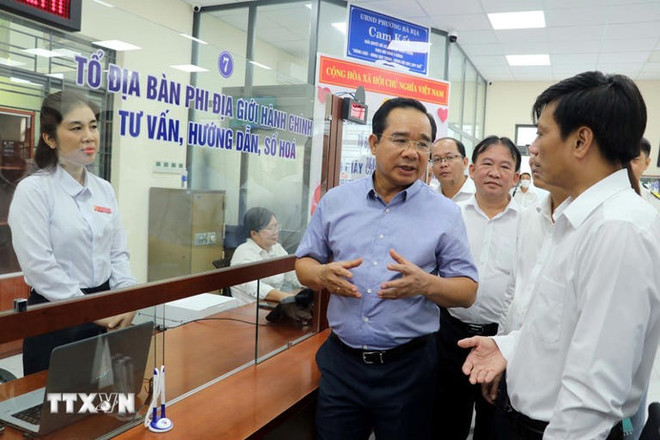
Chairman of the People's Committee of Ho Chi Minh City Nguyen Van Duoc inspects the Public Administrative Service Centre of Ba Ria ward. (Photo: VNA)
Reporter: Building on the achievements of 2025, what socio-economic development targets has the city set for 2026?
Chairman Nguyen Van Duoc: The year 2026 will play a pivotal role in creating momentum for the entire 2026–2030 period. The city clearly recognises that the workload will be immense, the requirements demanding, and there is no room for complacency or delay.
The city has chosen the theme for 2026: “Completing and improving the quality of the organisational apparatus – Unblocking institutions – Making infrastructure breakthroughs – Enhancing the effectiveness of service to the people.”
Among the 26 specific targets, we have set an ambitious plan to generate strong momentum for both the region and the entire nation. Specifically, the city aims for GRDP growth of over 10%, per capita GRDP of 9,800 USD, and a strong shift in the economic structure toward modernity. The digital economy is expected to account for at least 30% of GRDP, total factor productivity (TFP) to contribute around 60% to GRDP, and labour productivity growth to reach 7.5%.
To realise these ambitious and aspiration-driven goals, the municipal People’s Committee will focus on six groups of key tasks and solutions:
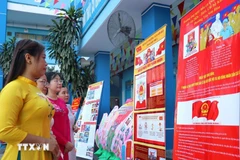
First, we will strive to successfully organise the elections of deputies to the 16th National Assembly and People’s Councils at all levels, while swiftly concretising and implementing the resolutions of Party congresses at all levels in tandem with the five-year development plan and the goal of double-digit growth.
Second, we will leverage the three traditional growth drivers—production, consumption, and exports—while promoting three new drivers, namely the International Financial Centre, the seaport – logistics system, and innovation linked with green and digital transformation. The city will reform its urban governance model, shifting from a management-based mindset to one focused on risk governance and service delivery, and from plan-based to goal- and outcome-based implementation. Special mechanisms under Resolutions 188, 222, and 260 will be implemented decisively to create an attractive environment for strategic investors.
Third, we will work to complete organisational restructuring to ensure a lean, streamlined, strong, efficient, and effective apparatus; accelerate administrative reform associated with the building of a facilitative, integrity-driven, action-oriented, and service-focused administration, with people and businesses at the centre. The quality of its personnel will be enhanced toward greater professionalism, discipline, and sense of responsibility, while dynamic, proactive, creative, and accountable cadres encouraged and protected.
Fourth, the city will finalise the master plan for the new city, reorganise the development space in a multi-polar, integrated, and connected manner, and make breakthroughs in mobilising resources for infrastructure investment, turning 2026 into a year of major construction works. It will also focus on effectively addressing bottlenecks related to flooding, traffic congestion, and environmental pollution, while ensuring progress toward the goal of becoming a drug-free city by 2030.
Fifth, we will promote cultural and human development, ensure social security, improve the quality of education and health care, and better care for people’s life quality, especially during the 2026 Lunar New Year.
Sixth, the city will strengthen external relations and international integration while firmly safeguarding national defence, security, and social order and safety under all circumstances.
Reporter: Ho Chi Minh City is entering 2026 with highly ambitious goals. As the head of the city administration, what message would you like to send to the local political system, people, and business community?
Chairman Nguyen Van Duoc: First, for the political system, 2026 must be a year of decisive action. Discipline and order must be upheld, leadership and governance methods renewed, and decentralisation and delegation of authority strengthened in conjunction with leaders' accountability. The city will make full use of the new mechanisms and policies under Resolution 260, focusing on strategic infrastructure projects and thoroughly removing bottlenecks, ensuring that policy “lags” do not hinder development.
For the people, the city remains steadfast in its people-centred approach to all policies, staying committed to improving the quality of public services, infrastructure, the living environment, and social security. Prioritising land for parks and public cultural spaces clearly reflects a development orientation that serves community interests.
For the business community, the city views enterprises as both a resource and a driving force for development. It will continue to improve the investment environment and accompany businesses in innovation, digital and green economy development, and participation in strategic projects.
The year 2026 must not only be a year of quantitative growth but also one of clear qualitative transformation. With the solidarity of the entire political system and the consensus of the people, Ho Chi Minh City is determined to make strong breakthroughs, maintain its role as the nation’s economic locomotive, and lay a solid foundation for development in the 2026–2030 period.
I call for consensus, solidarity, and a strong sense of responsibility from the entire political system, the business community, and all citizens. Only when all stakeholders share a common vision and act together can the city fully unleash its potential, firmly uphold its role as the country’s economic engine, and move closer to the goal of becoming an international mega city among the world’s 100 most liveable cities./.