Network of Vietnamese scientists, experts in Canada makes debut

Vietnam–Canada relations continue to flourish, with science and technology listed among the seven priority areas of bilateral cooperation. The launch of the Canadian Vietnamese Scholars and Experts Network is expected to contribute to advancing joint innovation and R&D cooperation between the two countries.

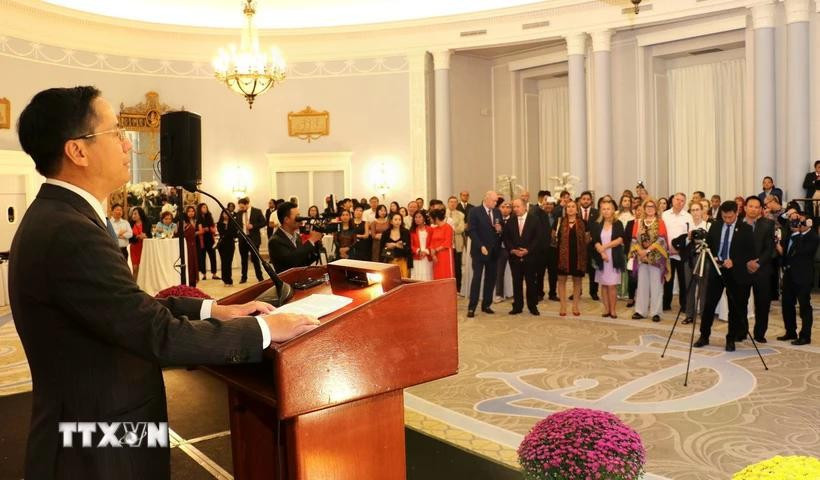
Vietnamese Ambassador to Canada Pham Vinh Quang speaks at the 79th anniversary of Vietnam's National Day, last September. (Illustrative image: VNA)

Ottawa (VNA) – The Canadian Vietnamese Scholars and Experts Network (CVSE) has been launched in an effort to mobilise the knowledge and expertise of overseas Vietnamese communities, particularly in science and technology, to support national development.

The CVSE launch aligns with the Politburo’s Resolution No. 57 on breakthroughs in science, technology, innovation, and national digital transformation. The network brings together individuals who have already established strong reputations in their second homeland through contributions to science, technology, and innovation—fields identified as key drivers for Vietnam's economic transformation.

Chief Representative for Science and Technology at the Vietnamese Embassy Hoang Ngoc Dinh said that this network will help update Vietnam with cutting-edge scientific knowledge, fostering greater alignment with the country’s strategic development directions.

Canada is currently home to an estimated 300,000 Vietnamese nationals, many of whom are highly educated scientists, entrepreneurs, and professionals. Their expertise and technological know-how are considered crucial for Vietnam as it pursues rapid and sustainable development.

Ambassador Pham Vinh Quang highlighted the importance of the network as a tangible outcome of the Vietnamese Government’s Resolution 169 on overseas Vietnamese affairs and, more specifically, as a concrete step toward implementing the Politburo’s Resolution 57.

Associate Professor Vu Viet Hung from the Royal Military College of Canada, and a member of the CVSE Executive Board, noted that the network’s first principle is to create a forum that fosters meaningful exchanges between scientists from both countries. He stressed the importance of leveraging Canada’s pioneering technological directions for Vietnam’s economic and scientific development.

Dr. Nguyen Xuan Phong, an AI expert from the Mila Institute and a CVSE member, emphasised that the network represents a critical platform for Vietnam to catch up with the global technology frontier.

The network will play an essential role in technology transfer and connecting Vietnam with international partners, especially in cutting-edge fields like artificial intelligence, he said.

Vietnam–Canada relations continue to flourish, with science and technology listed among the seven priority areas of bilateral cooperation. The launch of the CVSE is expected to contribute to advancing joint innovation and R&D cooperation between the two countries./.


VNA

See more

Participants at the first meeting of the National Steering Committee on Semiconductor Industry Development in 2026 (Photo: VNA)

Vietnam becomes vital player in global semiconductor value chain: Deputy PM

Vietnamese companies have also gradually joined the global value chain by improving their capabilities in chip design, production and related services. Notably, a semiconductor chip manufacturing plant project developed by the Viettel Military Industry and Telecoms Group (Viettel) has already commenced.

Young voters in Ho Chi Minh City scan an QR code to participate in an online quiz about the Election Law. (Photo: VNA)

Digital technology helps enhance transparency, trust in elections

The use of technology in this election is not merely a short-term measure but reflects Ho Chi Minh City’s broader commitment to comprehensive digital transformation and smart urban governance, reinforcing public trust in the democratic process and administration.

Information about candidates for the Khanh Hoa provincial People's Council for the 2026-2031 term is published on digital information channels, making it convenient for voters to explore. (Photo: VNA)

Technology breakthrough ensures voters' access, rights

Digital platforms such as the national population database and the VNeID application have been widely applied to streamline election management and improve accuracy in voter registration, helping citizens exercise their civic rights more conveniently.

Mang But commune area in Quang Ngai province. (Photo: VNA)

3.9-magnitude earthquake recorded in Mang But, Quang Ngai

According to the Vietnam Earthquake Information and Tsunami Warning Centre under the Institute of Earth Sciences, the tremor occurred at 11:35:06 (Hanoi time) with coordinates of 14.864 degrees North latitude and 108.210 degrees East longitude, at a depth of about 8.1 km. The event was assessed as having a level-0 disaster risk.

Illustrative photo: AFP

AI Law takes effect, anchors national governance framework

Taken together, the new AI Law and its implementation roadmap not only complete Vietnam’s legal architecture for AI, but also lay a structured foundation for risk management, innovation and ecosystem development, aiming to ensure coherent and effective enforcement in the years ahead.

Viettel Networks and Ericsson sign their cooperation agreement on the sidelines of the Mobile World Congress 2026. (MWC 2026)

Viettel Networks, Ericsson partner to advance autonomous telecom networks

Under a newly signed cooperation agreement, Ericsson will provide network automation platforms and artificial intelligence (AI) technologies while working with Viettel to conduct real-world trials. The collaboration marks a new step forward, combining Viettel’s large-scale network operation expertise with Ericsson’s strengths in automation solutions and advanced technologies.

Prime Minister Pham Minh Chinh speaks with students at Hanoi University of Science and Technology (Photo: VNA)

Resolution 57: Developing high-quality sci-tech human resources key to master strategic technologies

After one year of implementing Resolution No. 57-NQ/TW of the Politburo, alongside notable achievements, the Central Steering Committee for science and technology development, innovation, and digital transformation has identified persistent shortcomings and bottlenecks requiring urgent attention - most notably a shortage of high-quality human resources in strategic technology fields.

The Saigon Hi-Tech Park (Photo: VNA)

Vietnam advances toward mastering UAV technology

Products are already making their way into the US market, but this is not merely a story of applying new technology in practice, but a gradual process of mastering core details and affirming international capabilities in the UAV industry, one of Vietnam’s strategic high-tech sectors.