Ninh Binh seeks global recognition for cliff-based Han-Nom inscriptions

They embody a unique intersection of sculpture and literature, deeply reflecting the nation’s cultural, religious, and historical heritage.

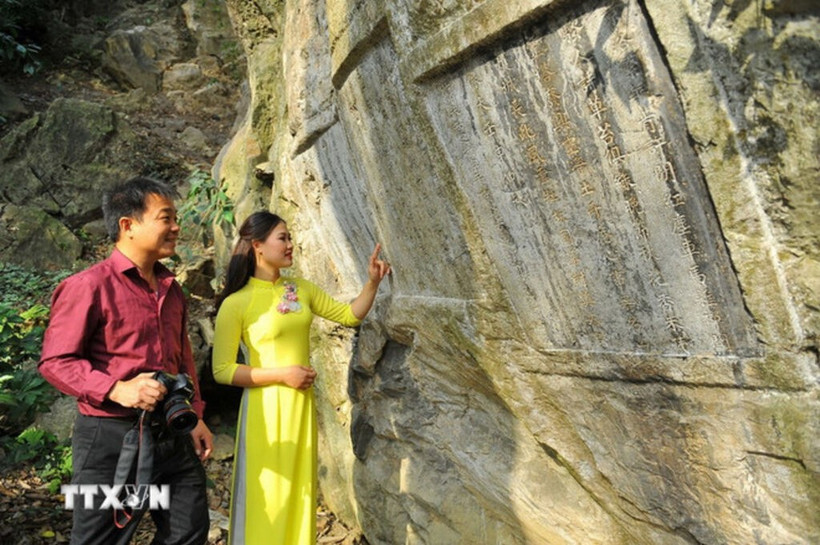
The Han-Nom inscriptions, carved directly into the cliffs of the Special National Historic and Scenic Site of Non Nuoc Mountain (Photo: VNA)

Ninh Binh (VNA) – The Han-Nom inscriptions on the cliffs of Non Nuoc Mountain in Hoa Lu ward of Ninh Binh province, represent the once-flourishing Han-Nom culture and heritage in Vietnam’s former royal capital.

They embody a unique intersection of sculpture and literature, deeply reflecting the nation’s cultural, religious, and historical heritage.

The provincial authorities are currently preparing a nomination dossier for the Han-Nom inscriptions on Non Nuoc Mountain to be included in the heritage list of the UNESCO Memory of the World Committee for Asia and the Pacific (MOWCAP).

A valuable documentary heritage

The Han-Nom inscriptions, carved directly into the cliffs of the Special National Historic and Scenic Site of Non Nuoc Mountain, span from the 14th to the 20th centuries.

This treasure trove of Han and Nom writing documents important historical figures and events not only in Ninh Binh but across Vietnam.Non Nuoc Mountain is currently home to 43 cliffside stone steles (known as ma nhai, or inscriptions carved directly onto natural rock surfaces) and 12 other documents preserved through rubbings.

Among these are 37 Han-Nom texts and six in the romanised Vietnamese script (Chu Quoc ngu), dating from the Tran and Early Le dynasties (15th century), the Mac dynasty (16th century), the Le Trung Hung period (17th–18th centuries), and the Nguyen dynasty into the early 20th century. These inscriptions include royal poems, literary works, and calligraphic scripts.

According to Prof. Dr. Jing Huiling from Chaoyang University of Technology (Taiwan, China), the inscriptions are remarkable for their historical depth and literary richness, reflecting achievements in language, script, and literary style across eras. They offer a comprehensive and authentic account of the country’s past.

Besides their historical and cultural significance, the inscriptions also serve as a treasure of documentary heritage. In 2019, the Prime Minister recognised Non Nuoc Mountain as a special national relic site.

Bringing heritage to the world

Recognising the outstanding value of the inscriptions in both content and form, Ninh Binh province is stepping up efforts in preservation, digitisation, and education, using the site to promote tourism and the traditional scholarly spirit of the Vietnamese people.

Associate Prof. Dr. Nguyen Thi Hiep from the French Development Agency (AFD) said the site holds great potential for educational tourism, particularly through experiential learning activities for local and international students.

In the international context, the Han-Nom inscriptions on Non Nuoc Mountain may be compared with other prominent stone-document legacies such as the Republic of Korea’s steles on Namsan Mountain, ancient Egyptian rock inscriptions, or royal stelae in Ethiopia. For this reason, Ninh Binh is consulting leading experts at home and abroad to improve its nomination dossier for UNESCO recognition.

Dr Vu Thi Minh Huong, Vice President of UNESCO’s Memory of the World Committee for Asia and the Pacific and a member of the National Cultural Heritage Council, believed the inscriptions fully meet the criteria. She noted that, aside from their content, the pieces are beautiful works of art bearing decorative patterns and imagery that mark a historical era, and showcase the development of Ninh Binh’s renowned stone-carving tradition.

Listing the Han-Nom inscriptions on Non Nuoc Mountain in the MOWCAP would not only honour a unique Vietnamese heritage but also enrich humanity’s shared historical legacy.

According to Vu Thanh Lich, Deputy Director of Ninh Binh’s Department of Culture and Sports, the department has advised the provincial People’s Committee on the implementation of conservation projects and promoting the site’s historical and scenic value.

Emphasis is being placed on preserving documentary heritage, raising public awareness, fostering national pride and contributing to sustainable, culturally rich development, positioning Ninh Binh on the global tourism map./.


VNA

See more

Members of the Mong ethnic group in Cao Bang province say that embracing Protestantism and participating in local congregations has brought positive changes to their lives, fostering closer bonds and a strong sense of solidarity among followers. (Photo: VNA)

Digital transformation in religion: When religious teachings spread with a single tap

As Vietnam's digital transformation continues, technology is opening new avenues for religious communities to share their teachings more quickly, more broadly and with more diverse audiences than ever before. Yet these opportunities also bring responsibilities: safeguarding the authenticity of religious teachings, cultivating a healthy and trustworthy digital environment, and equipping religious communities with the digital literacy needed to navigate the online world responsibly.

A performance of classic "cai luong" excerpts at a 2026 competition to look for talents. (Photo: VNA)

Vietnamese culture expected to undergo sharp transformation

Drawing on Party General Secretary and State President To Lam's detailed and practical guidance, artists and researchers voiced confidence that Vietnamese culture will undergo a sharp transformation and truly become both a spiritual foundation and a key driver of sustainable development in the new era.

A working session between Deputy Minister of Culture, Sports and Tourism Ta Quang Dong (centre, right) and UNESCO representative to Vietnam Jonathan Wallace Baker (Photo: baovanhoa.vn)

UNESCO, culture ministry discuss Photography City proposal

Jonathan Wallace Baker, UNESCO representative to Vietnam, confirmed that UNESCO stands ready to work alongside the culture ministry throughout the planning and implementation of the Photography City project, helping identify effective solutions to ensure its success.

The Duong Long tower complex is a special national relic built by the Cham people in the late 12th and early 13th centuries. (Photo: nhandan.vn)

Restoration breathes new life into Southeast Asia's tallest Cham tower

After more than 800 years, the towers have suffered damage from weather, time and plant growth. In late 2025, the provincial Department of Culture, Sports and Tourism launched a restoration project worth more than 90 billion VND (3.4 million USD). Scheduled to last 10 months, the project now sees 40% of its workload completed.

A space for performing traditional Vietnamese music at the Temple of Literature. (Photo: VNA)

Art breathes new life into Vietnam's heritage spaces

In Hanoi, many historical and cultural landmarks have successfully enhanced their value through creative artistic activities. The Thang Long Imperial Citadel regularly hosts historical re-enactments, exhibitions and cultural experiences, while popular night tours at Hoa Lo Prison relic site demonstrate the effectiveness of storytelling through the combination of sound, light and performance.

An art performance at the Vietnam-Japan Festival 2026 in Da Nang city. (Photo: VNA)

Vietnam-Japan Festival 2026 opens in Da Nang

Speaking at the opening ceremony, Vice Chairwoman of the municipal People's Committee and head of the festival's organising committee Nguyen Thi Anh Thi said that after many editions, the festival has become one of the city's signature external affairs events, helping reinforce the increasingly close partnership between Da Nang and Japanese localities and partners.

Visitors participate in a live demonstration of pho roll preparation at the event. (Photo: VNA)

Pho takes Vietnam’s flavours, identity on Europe journey

More than a food showcase, the programme combines live cooking demonstrations, cultural talks, chef-to-chef exchanges, and business networking to strengthen the global profile of Vietnamese cuisine and promote deeper international connections through gastronomy.

The opening ceremony of The Grand Esports 2026 on July 9 (Photo courtesy of the Sports Authority of Vietnam)

The Grand Esports 2026 opens in Hanoi

The Grand Esports 2026 officially opened in Hanoi on July 9, demonstrating that esports has entered a new stage of development and is increasingly recognised as an important part of Vietnam's national sports strategy, cultural industries and digital economy.

The poem inscribed on the roof ridge of Ngo Mon Gate is part of the Poetry on Hue Royal Architecture collection, which was recognised by UNESCO as documentary heritage under the Memory of the World Programme for Asia and the Pacific. (Photo: qdnd.vn)

Workforce vital to documentary heritage

The combination of a transparent legal framework, a comprehensive digitisation strategy and an internationally qualified workforce will provide a solid foundation for preserving, utilising and disseminating the value of Vietnam’s documentary heritage, enabling the nation’s collective memory to be passed on sustainably to future generations.

Members of the Vovinam club in Paris. (Photo: VNA)

Paris Vovinam club promotes Vietnamese culture in France

The club currently has nearly 50 members aged from seven to over 70, with regular training sessions held on Tuesday and Wednesday evenings, alongside extended weekend classes for both children and adults. The classes are led by a father-and-daughter team, assisted by between two and six instructors depending on the session.

Viewers watch Thang Long Capital show featuring 3D mapping and digital experiential spaces. (Photo: VNA)

Digital technologies unlock new value from Vietnam’s cultural heritage

Vietnam possesses a wealth of tangible and intangible cultural heritage, with tens of thousands of historical and cultural sites nationwide. Experts believe that, supported by digital technologies, these resources can become a major driver of culture, tourism, education and creative industries.

Children experience traditional craft (Photo: VNA)

Promoting souvenir industry to spread national image

Experts said that with market-oriented development, improved functionality, stronger storytelling and greater involvement from designers, businesses and market-connecting organisations, souvenirs could become a bridge linking Vietnam with the world while contributing to the growth of cultural industries and the creative economy.