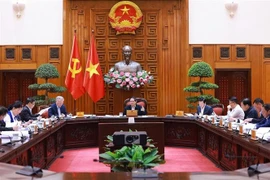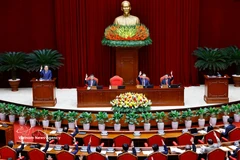
Hanoi (VNA) - The merger of provinces and cities, along with the operation of two-tier local administration system since July 1, has produced significant results, demonstrating that the Party’s and State’s dicision are on the right track, with ministries, sectors, and local authorities implementing it seriously and the public enthusiastically supporting.
According to Minister of Home Affairs Pham Thi Thanh Tra, most initial obstacles in operating the two-tier local government, such as overlaps in decentralisation, incidents in IT systems, and complexity in personnel arrangements, have been largely resolved. The delegation of authority for handling administrative procedures has been strengthened, with the central level now responsible for 44% of tasks and local authorities for 56%.
As of September 15, a total of 741 administrative procedures had been delegated from the central to local levels; 346 procedures previously under district jurisdiction were reassigned to provincial- and communal-level authorities; 298 procedures were abolished; and 14 ministries fully publicised 1,383 out of 1,385 procedures on the national database.
In terms of organisational restructuring, 465 specialised agencies under the People’s Committees of 34 provinces and cities, along with 9,916 specialised offices under the People’s Committees of 3,321 communes, wards, and special zones, have been operating in an orderly, stable, and effective manner.
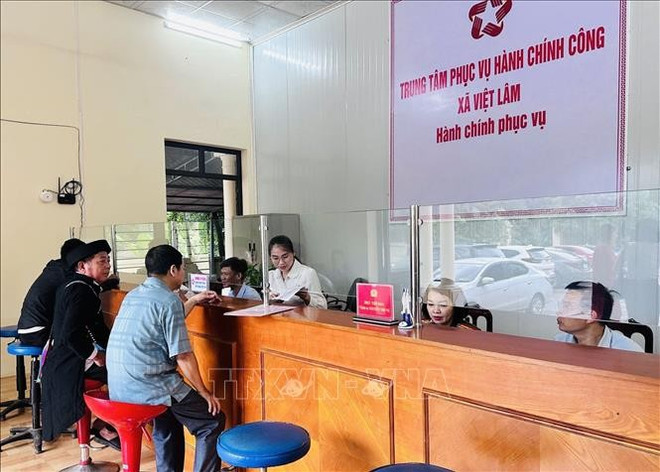
Regarding administrative services, digital infrastructure, and e-government, 3,139 communal-level and one-stop public service centres in Hanoi and Quang Ninh have been operating smoothly. Between July 1 and September 15, about 6.6 million applications were submitted online, 91% processed on time, with over 3 million online payments being completed, totaling 1.7 trillion VND (nearly 64.4 million USD).
Newly-expanded Ho Chi Minh City, formed through its merger with Binh Duong and Ba Ria-Vung Tau, now covers nearly 6,800 sq km and has the country’s largest population, exceeding 14 million. The daily volume of administrative work is immense. In the initial operation phase of the two-tier government system, authorities received over 619,000 applications and processed more than 518,000, ensuring both timeliness and service quality. This demonstrates the new administration apparatus’s capacity to operate effectively in a mega-urban setting.
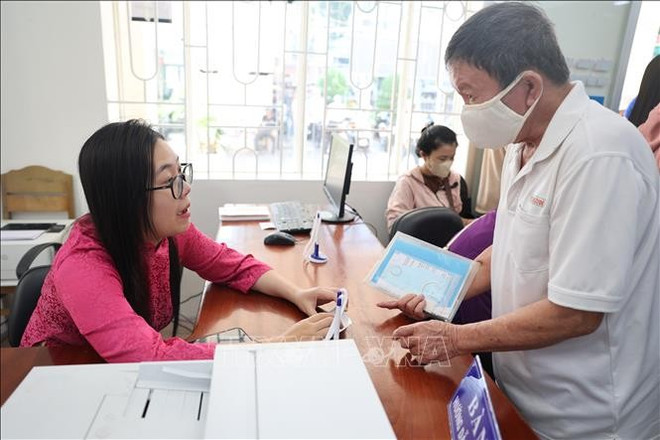
Meanwhile, Tuyen Quang province, established through the merger of former Tuyen Quang and Ha Giang provinces, is a mountainous border locality with an area of nearly 14,000 sq km and a population of about 1.9 million, mostly ethnic minorities, comprising 124 commune-level administrative units. On September 25, the Legal Committee of the provincial People’s Council conducted a survey on the operation of the two-tier local administration in Phu Luu and Binh Xa communes.
The People’s Committee of Phu Luu commune with 35 staff positions, 11 below quota, has since July 1, has received 3,168 applications, including 2,201 submitted online, and successfully processed 3,144 of them, achieving nearly 100% completion. In Binh Xa commune, its public service centre has received 2,500 applications since July, with 99% or 2,477 of which being processed.
In Hanoi, the standing board of the municipal Party Committee noted thorough and coordinated preparation across the entire political system for implementing the two-tier local administration. More than 5,200 officials, civil servants, and public employees were mobilised and assigned to grassroots positions, while nearly 4,300 individuals affected by the organisational restructuring were received support policy.
All 126 communes and wards in the capital city now have stable headquarters equipped with full facilities and equipment. The public service centre network and 126 local service points are running smoothly. Over 413,000 out of more than 523,000 received administrative applications have been processed on time, equivalent to nearly 98%.
The city has also approved 767 procedures to be fully conducted online, advancing digital transformation and reducing pressure on the new system. Platforms such as online meetings, the iHanoi feedback system, and official email services have been adjusted to fit the two-tier model.
The Ministry of Finance reported that 99.74% of commune-level administrative units nationwide had completed salary payments for September 2025, underscoring the swift consolidation of the two-tier administration model in financial management. So far, 33 of 34 provinces have issued resolutions on revenue sharing and expenditure responsibilities between provincial and communal levels.
The concrete figures mentioned above refute biased, ill-intentioned, and even distorted claims about Vietnam’s administrative restructuring process, such as labeling it a “cosmetic campaign” to "score political points" ahead of the 14th Party Congress, or a “subjective” and “illogical” move that would bring “no tangible benefits to the people” or even cause “disturbance” and “total social congestion.”
As of July 1, 2025, Vietnam has 34 provinces and cities and 3,321 commune-level administrative units, while 696 district-level units without the intermediary level. According to the Ministry of Home Affairs, the provincial mergers and two-tier local government model are expected to save over 190 trillion VND between 2026 and 2030 and streamline about 250,000 positions in the state apparatus.
On September 23, in a meeting with voters from 11 wards of Hanoi, Party General Secretary To Lam noted that Vietnam’s political system has been streamlined, with the two-tier local government system now operating smoothly, stably, and with growing effectiveness./.