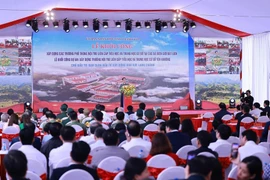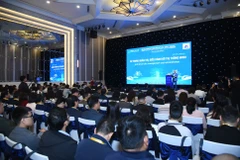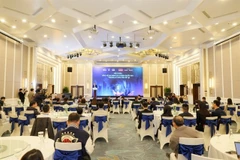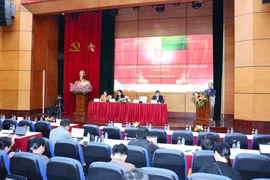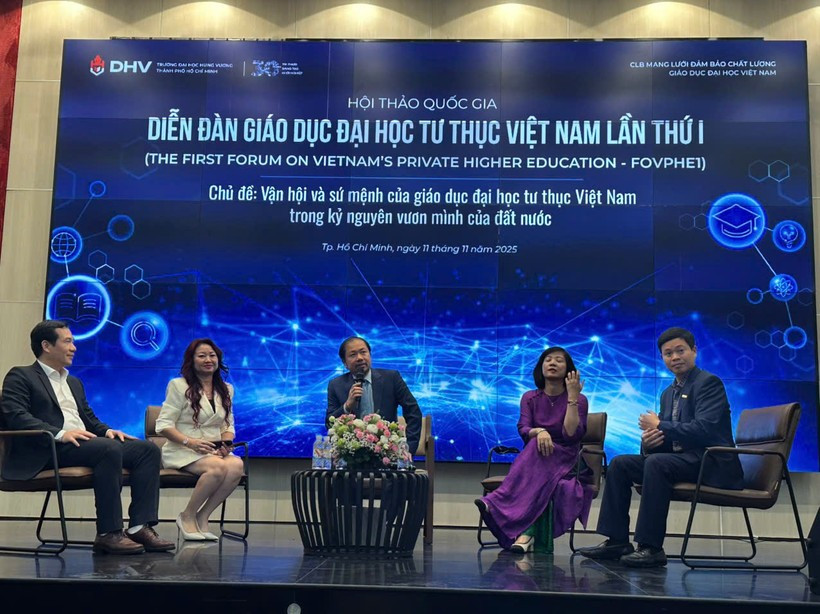
HCM City (VNA) – The first forum on Vietnam’s private higher education themed “Opportunities and Mission of Vietnam’s Private Higher Education in the New Era of the Nation’s Rise” took place on November 11 at Hung Vuong University in Ho Chi Minh City.
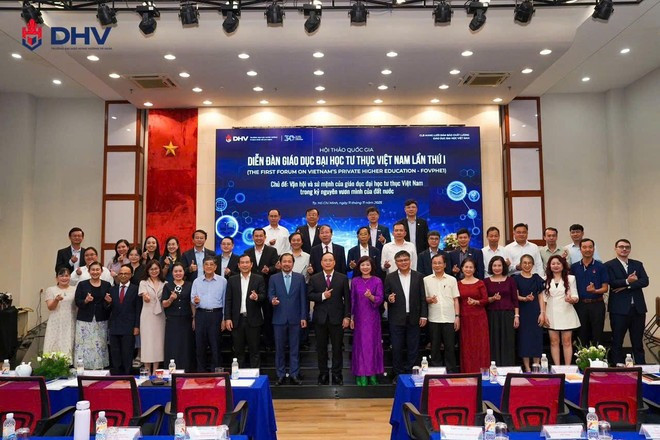
The event was jointly organised by Hung Vuong University, the Vietnam Higher Education Quality Assurance Network, and several private universities. It brought together leaders from 40 private universities and more than 250 delegates representing universities, research institutes, accreditation centres, international organisations, and state management agencies in education and higher education.
According to Dr. Tran Viet Anh, Acting Rector of Hung Vuong University and co-chair of the organising committee, the forum featured five main discussion sessions and a round-table dialogue. These sessions focused on strategic and timely topics, including development models, university autonomy, quality assurance, and sustainable development opportunities for Vietnam’s private higher education sector in the new period.
Delivering the opening speech, Professor Doctor of Science Nguyen Dinh Duc, Chair of the Vietnam Quality Assurance Network, highlighted international experience showing that private universities can rise to lead in various fields. He cited Stanford University in the US, which surged ahead after World War II by focusing on engineering and technology, playing a key role in the emergence of Silicon Valley. Today, Stanford ranks third globally in the QS rankings.
Japan’s Waseda University is another renowned private institution, ranked 196th worldwide. In the Republic of Korea, leading private universities such as Yonsei University and Korea University rank 50th and 67th in the world, respectively, placing just behind Seoul National University.
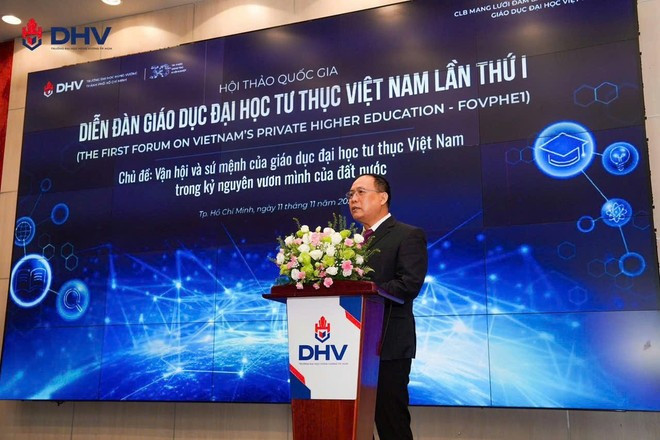
“These achievements are an important source of inspiration, encouraging Vietnam’s private universities to invest boldly and pursue long-term development,” Duc said.
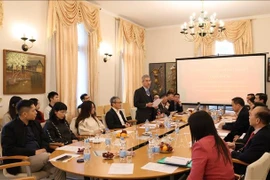
At the forum, delegates assessed the current landscape, opportunities and challenges, as well as strategic models and concrete solutions to enable the private higher education sector to thrive in this transformative period.
Participants also voiced strong support for establishing an Alliance of Vietnam’s Private Universities. The formation of the alliance, along with its operating regulations, will be discussed and implemented in the coming time.
The forum was held in the context of the Politburo’s Resolution 71-NQ/TW on breakthroughs in education and training, which sets ambitious targets for the education system, especially higher education. The resolution aims for Vietnam to have at least eight universities ranked among the top 200 in Asia by 2030, and at least five universities ranked among the world’s top 100 in specific fields by 2045. It emphasises that public education is the main pillar, while non-public education is an important component of the national education system, and introduces new legal frameworks to facilitate the growth of the non-public sector.
Resolution 68-NQ/TW on developing the private economic sector further recognises the private sector as a key engine of national economic growth, and a pioneer in innovation, science and technology, and digital transformation. Together, these two major policy frameworks open new opportunities while also placing significant demands on private universities, requiring them to act swiftly and proactively to affirm their role and contributions.
Duc noted that the forum reflects the unity, determination, and shared commitment of private universities to accompany the country’s educational mission and its broader development goals. He added that with flexible mechanisms, university autonomy, and strong support from the business community, private universities possess distinct advantages but must prioritise training quality, scientific research, innovation, and services to enterprises and national development as their guiding principles.
The forum is expected to serve not only as a major national academic event but also as the foundation for a long-term cooperation network among Vietnam’s private universities, reinforcing the pioneering role of the private sector in the country’s higher education landscape./.