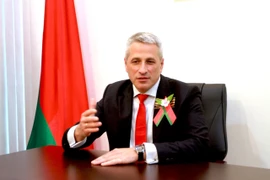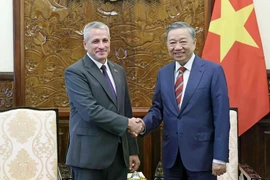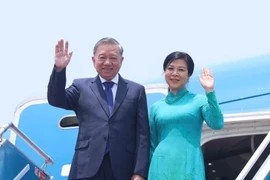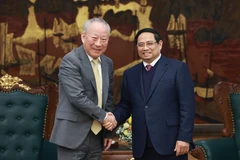
Hanoi (VNA) – The state visit to Belarus by Party General Secretary To Lam, his spouse and a Vietnamese high-ranking delegation from May 11-12 will create new momentum for strengthening and expanding Vietnam-Belarus relations, and provide orientations to further deepen the bilateral relationship, Vietnamese Ambassador to Belarus Nguyen Van Ngu has said.
Speaking to the Vietnam News Agency (VNA)'s correspondent ahead the visit, the ambassador said that the visit is also expected to enhance the effectiveness of existing mechanisms, form new cooperation mechanisms, help ministries, agencies, localities and businesses of the two countries to better understand each other's potential, and seek more cooperation opportunities.
He emphasised that over the past 30 years since Vietnam and Belarus established diplomatic relations, the two countries have built, nurtured and developed the traditional friendship and good cooperation on the basis of trust, equality and mutual respect for the benefit of their people, creating a foundation for closer and more active interactions in all areas. This is an important basis for the two sides to consider bringing the relationship to a new level, the diplomat said.
Moreover, for nearly 40 years since Vietnam started the Doi moi (renewal) process, the country has achieve great achievements thanks to its internal strength, indomitable will, and particularly support from international friends, including the Belarusian people.
The Vietnam-Belarus relationship that originated in the Soviet Union era, witnessed important development steps following President Ho Chi Minh's visits to the Eastern European nation in 1957 and 1961.
Belarusian officials and experts supported Vietnam in national defence and construction, as well as in training thousands of students, postgraduates, and workers. Vietnam and Belarus have similar views, regularly consult, and coordinate in international forums, which have laid the foundation for strengthening and consolidating the traditional friendship and multifaceted cooperation between the two countries.
During the COVID-19 pandemic, Belarus gave Vietnam technical equipment and medical supplies, the ambassador noted.
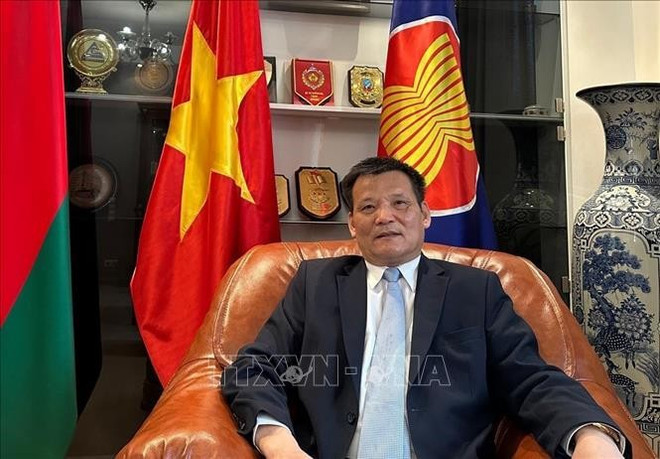
Pursuing the foreign policy of independence, self-reliance, multilateralisation and diversification of international relations, Vietnam wishes to continue to strengthen and expand the friendship relations and multifaceted cooperation with Belarus for the benefit of the people of the two countries, and for peace, cooperation and development, in line with the rapidly changing international and regional context, the ambassador emphasised.
Regarding cooperation areas between the two countries, the ambassador said that since the establishment of diplomatic relations in January 24, 1992, the two countries have maintained and developed their traditional friendship and multifaceted cooperation with increasingly high political trust.
The two sides have regularly exchanged delegations, especially high-level ones. They have developed cooperative ties in fields from national defence and security to economy - trade, culture, education, science and technology, people-to-people exchange, and cooperation among localities.
The two sides have created a legal framework of about 50 documents, including international treaties or agreements between ministries and agencies. Nine provincial-level localities of Vietnam have established friendship and cooperative relations with six out of seven provincial-level administrative units of Belarus.
Internationally, the two countries have regularly consulted and supported each other at multilateral forums and mechanisms. Both Vietnam and Belarus are members of the Eurasian Economic Union (EAEU)-Vietnam Free Trade Agreement (FTA).
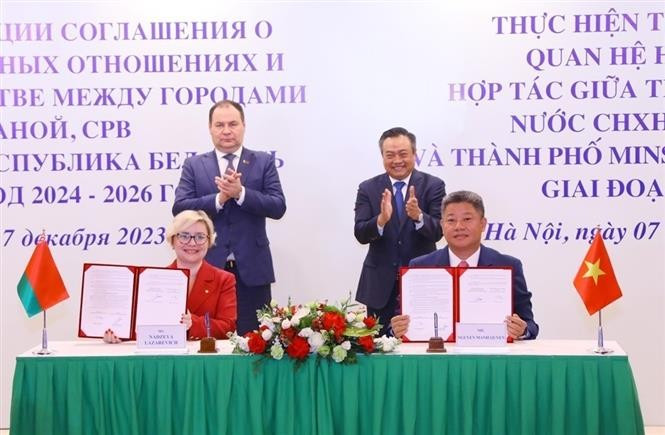
Since the official visit to Vietnam by then Prime Minister of Belarus Roman Golovchenko in December 2023, the two sides have continued to increase delegation exchanges and contacts at all levels, developing and expanding cooperation in most areas, and discussing emerging issues.
The latest development in the bilateral cooperation was the signing of the visa exemption agreement for ordinary passport holders of the two countries that took effect on January 30, 2025. The move opened up many opportunities for extensive cooperation in many areas. This agreement is also of special significance as this is the first time a European country has exempted visas for Vietnamese citizens.
These achievements are just the beginning of a new phase of bilateral cooperation, the ambassador said, adding that the two countries still see ample potential for stronger partnership.
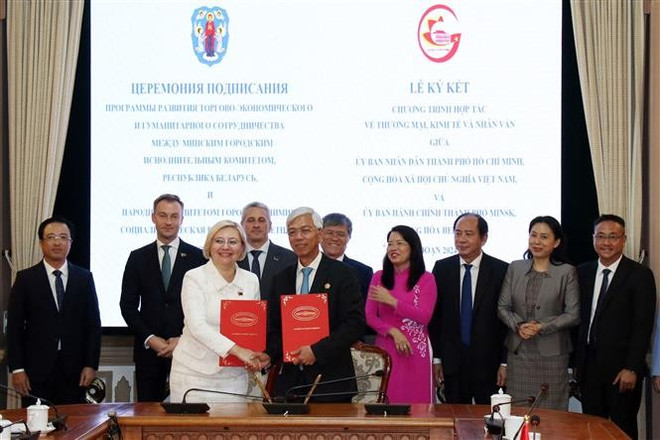
For example, the two sides can enhance the effectiveness of the Intergovernmental Committee for Economic - Trade and Scientific - Technological Cooperation to create a breakthrough in economic cooperation, increasing two-way trade turnover which is still quite modest. In addition to traditional areas of cooperation, it is possible for them to expand to other potential areas such as logistics, transport, digital economy, digital transformation, artificial intelligence, cyber security, high technology for agriculture.
The two countries should effectively implement the EAEU-Vietnam FTA, and support each other to access the markets of the Association of Southeast Asian Nations (ASEAN) and EAEU, he said.
The two sides can also strengthen cultural and historical promotion programmes, particularly tourism cooperation after the visa exemption policy for ordinary passport holders, as their aviation businesses are discussing the possibility of opening direct flights between the two countries.
Vietnam and Belarus should also promote coordination in addressing traditional and non-traditional security challenges such as epidemics, climate change, terrorism, transnational crime, cybercrime, food security, energy security and water resources, the ambassador suggested./.